


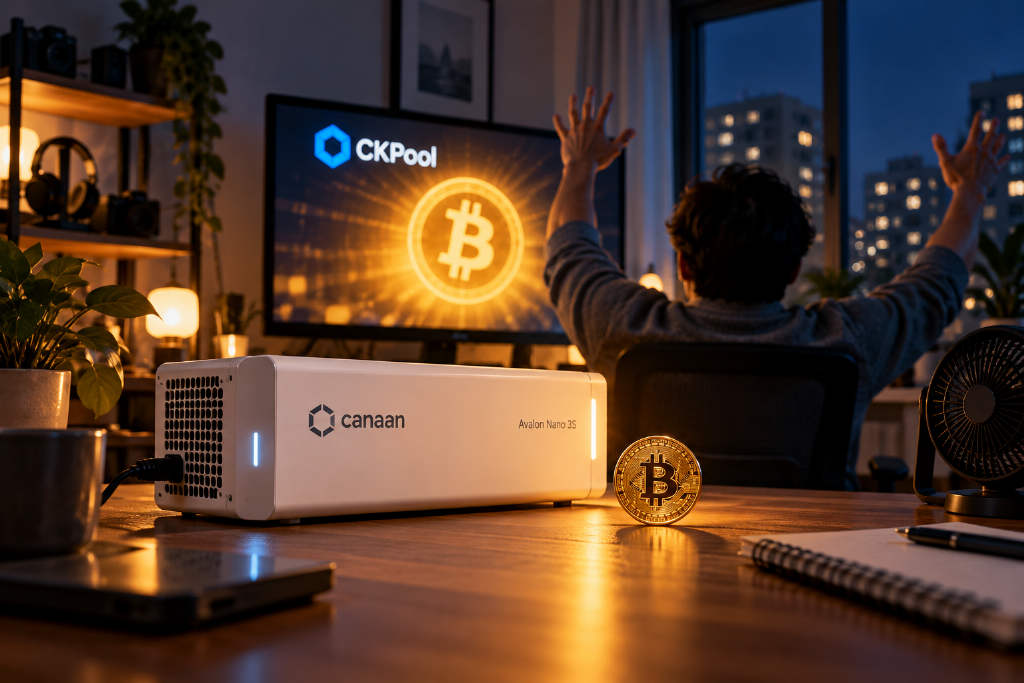
Bitcoin block 973,413 was mined on the night of Oct. 27, carrying a reward of 3.14 BTC worth a little over $250,000 at the time, according to a PANews report citing public data from CKPool. The block was found in solo mode, meaning the miner did not share the reward with a pool.
The detail that drew the most attention was the machine size. The report said the winning device had only about 6.5 TH/s of hash rate. Based on that figure, mining hardware seller Altair Tech said it was likely a Canaan Avalon Nano 3S.
PANews described the Nano 3S as a router-sized unit with 140 watts of power draw and relatively low noise, priced at roughly $200 to $300 online. For comparison, the report said a professional industrial miner such as the S21 XP delivers 270 TH/s, putting the small home unit at less than one-fortieth of that level.
This was not the first such case this year. On May 30, another Nano 3S reportedly mined a block reward worth $232,000. On July 10, a Bitaxe Gamma, described in the article as a $150 open-source mini miner, also landed a solo mining reward worth about $200,000. With this week’s examples included, PANews said small machines hitting full Bitcoin block rewards has become a recurring story in 2026.
Three retail-style wins in five days
The report said Bitcoin produces 144 blocks a day, and most of them are typically mined by large pools such as Foundry, AntPool, and F2Pool. Against that backdrop, a low-power home machine beating industrial-scale operations is an extreme outlier.
Yet several such cases appeared close together. On Oct. 26, one day before the $250,000 block, Bitcoin block 973,262 was mined by a FutureBit Apollo Solo device, earning 3.154 BTC. PANews said it was the fourth block ever mined by that brand.
The article stopped short of fully confirming that case as a retail solo win. It noted that the webpage only showed Braiins Pool, so the identity of the miner could not be verified with complete certainty.
Looking at a longer window, PANews cited solo mining statistics showing that retail solo miners worldwide mined 24 blocks over the past 12 months, up 40% from the previous year. At that pace, one block-sized payout worth more than $200,000 has been claimed about every two weeks.
The probability remains extremely low
The article argues that these wins should not be read as evidence that buying a small miner now gives ordinary users a meaningful chance of striking it rich. A machine’s chance of mining the next block is simply its hash rate divided by the total hash rate of the network.
Bitcoin generates a new block about every 10 minutes, or 144 times a day. Using the Nano 3S as the example, PANews assumed a single-machine hash rate of 6 TH/s and a conservative global network hash rate of 800 EH/s, equal to 800 million TH/s. On that basis, 6 divided by 800 million gives 0.0000000075. The report translated that into a per-draw chance of 0.75 in 100 million, and a daily probability of about 1.08 in 1 million.
PANews then said even that denominator may be too small. Based on a mining difficulty of 140.58T, the article estimated the real network hash rate at around 1,000 EH/s, with some data sources showing intraday readings as high as 1,080 EH/s. Under that range, the daily probability falls to about 0.86 in 1 million, and the annual probability works out to roughly 1 in 3,000.
The report also challenged a widely shared infographic that claimed the Oct. 27 machine had an annual block-finding probability of about 1 in 1,500. Recalculating with 6.5 TH/s, PANews said the result was closer to 1 in 2,900. It added that Altair Tech’s own calculator implied odds of roughly once every 3,200 years.
The gap appears to come from a different assumption. According to the article, a user on Stacker News reviewed CKPool statistics and found that the winning address was linked to five small machines. News.bitcoin reportedly put the combined hash rate at 16.2 TH/s. Using 16.2 TH/s, the annual probability improves to around 1 in 1,200 to 1 in 1,500, but the actual winning machine was still just one of those units.
PANews summed it up this way: if one Nano 3S runs continuously, the expected wait for a block is around 3,000 years.
Pool mining may not cover the power bill
The report said the economics look weak if the machine is used for regular pool mining rather than a low-probability solo jackpot. At a hashprice of about $36 per PH per day, a 6.5 TH/s machine would earn only about $0.23 a day.
Power costs can exceed that. A 140-watt machine consumes 3.36 kWh over 24 hours. At a U.S. household electricity rate of $0.10 per kWh, the daily power bill comes to about $0.34. That leaves the operator losing roughly $0.10 a day on mining income alone.
Still, the article said that framing misses the point of these products. Industrial miners are built for large-scale operations focused on efficiency and payback periods. Home solo miners are sold on a different pitch: low noise, plug-and-play use, and the appeal of taking a shot at a full block reward.
PANews said the Nano series runs at about 33 to 40 decibels and can sit in a bedroom or on a desk. The Q series offers more hash rate, allowing users to mine in a pool most of the time and switch to solo mode when they want to try their luck.
Some buyers use them as heaters
The report grouped buyers into two broad camps. One consists of committed Bitcoin supporters who do not want hash power concentrated entirely in large mining farms and are willing to spend the equivalent of a few hundred or a couple thousand yuan for the sake of participation. The other consists of households in colder, high-latitude parts of Europe and North America.
For those users, the article said, winter heating changes the economics. A 140-watt electric heater turns 140 watts of electricity into 140 watts of heat. A 140-watt home miner does the same, while also performing hash calculations and giving the owner 144 chances a day to participate in Bitcoin’s block lottery.
PANews cited the example of a Nordic user who needs constant heating in winter and bought several Nano 3S units for a living room and study. The machines usually mine in a pool and occasionally switch to solo mode. In that setup, the electricity is not viewed as a mining-only expense because the household would have paid for heating anyway. Any mining income, and any tiny chance at a six-figure block reward, becomes an extra.
Why manufacturers are paying attention to home miners
The article ties the rise of these products to worsening economics for industrial mining. On Oct. 26, Bitcoin fell below $80,000 intraday, touching roughly $79,300, while mining difficulty had already risen 5.92% on Oct. 16 to 140.58T. PANews said another increase of about 5% was expected around Oct. 29.
Revenue per unit of hash power has also weakened. The report said hashprice fell from $41 per PH per day a month earlier to about $36. Transaction fee income has been soft as well. Citing Glassnode, PANews said total on-chain transfer volume rose 26% last week to $5.5 billion, but miner fee revenue fell 8.8% to just $185,000.
Costs remain high. CoinShares estimated that listed mining companies faced a cash cost of $75,500 to mine one Bitcoin in the second quarter. With Bitcoin near $80,000, the gross margin per coin shrinks to only a few thousand dollars before depreciation is counted.
PANews also cited a CryptoQuant weekly report dated Oct. 22, which said IREN, Core Scientific, Cipher, TeraWulf, and Bitfarms mined 7,075 BTC from Jan. 1 to Oct. 19, down from 13,263 BTC in the same period a year earlier.
According to the article, some miners are redirecting power toward AI-related business because the returns are higher. It gave a comparison of about $1.5 million in annual profit per megawatt for AI workloads versus $500,000 for mining. PANews said companies have signed more than $50 billion in AI leasing deals and removed about $1.5 billion worth of older mining machines for resale on the secondary market.
The report added that these transition stories have not been smooth. It said the group of miners pursuing AI exposure was hit by short selling on Oct. 22, with share prices falling between 8% and 11%, as the sector faced a $50 billion AI infrastructure funding gap against annualized revenue of only $1.1 billion.
Even Binance Pool, which the article described as a long-running mining business launched in April 2020 and one that had issued $500 million in loans, has announced a full shutdown on Nov. 10.
Against that backdrop, PANews said mining hardware makers are looking for new demand. Some are investing in AI-related projects, while others are pushing compact miners into households. The article cited two examples: Canaan and MicroBT joined Luxor’s $16 million AI compute financing round on Oct. 27, and Tether, together with Bitmain, Canaan, and 15 companies in total, committed to building version 1.0 of the MDK open-source toolkit by the end of this year.
The report’s conclusion is straightforward. Large listed miners are turning off machines or shifting strategy as margins tighten, while a few tiny devices in living rooms and studies are still occasionally landing full Bitcoin block rewards. For buyers, these machines are not being sold as reliable profit engines. They are being sold as a mix of hobby, participation, heating, and a very remote shot at a jackpot.