
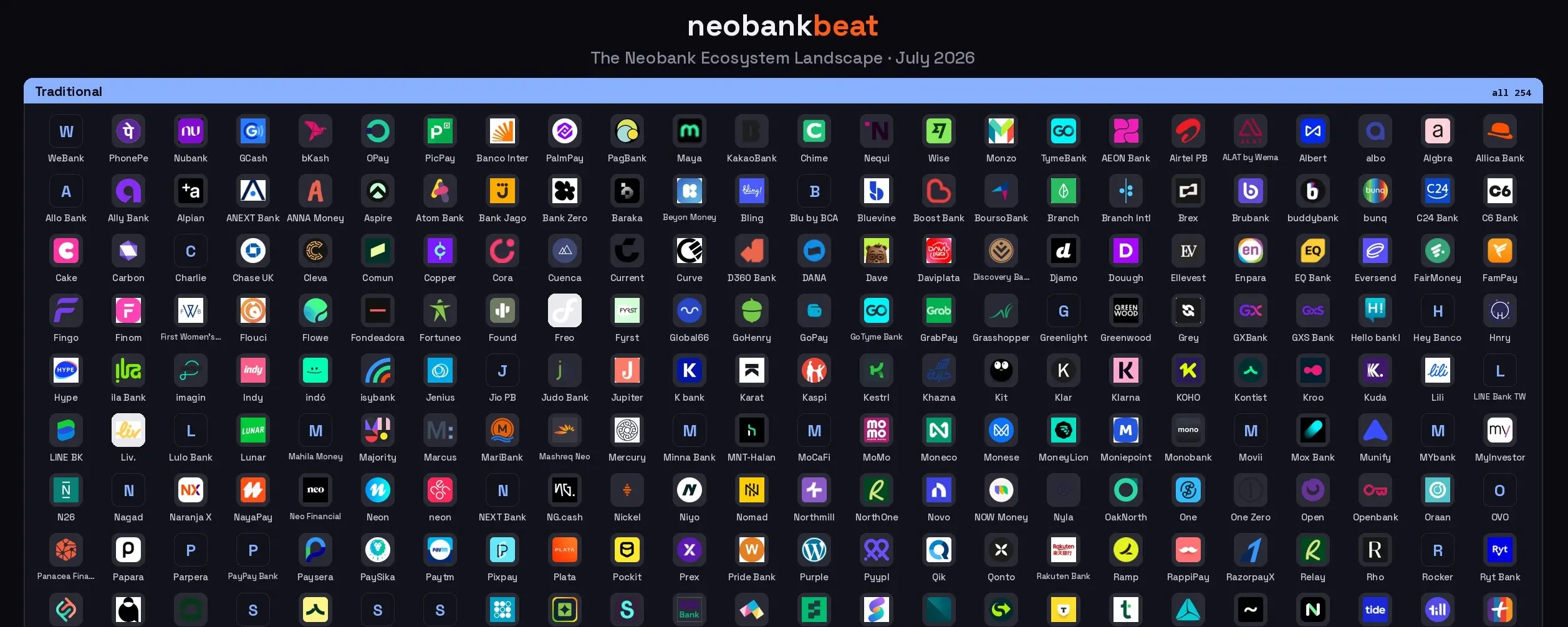
Francesco Andreoli, head of developer relations at Consensys and MetaMask, says he verified 368 neobanks still operating as of July 2026 after finding that few people in the sector could answer a basic question: how many are actually out there. He said analysts selling expensive PDF reports could not pin it down, venture investors could not pin it down, and founders competing with each other could not either. The resulting dataset is published openly on neobankbeat.com.
What changed his view of the industry was not only the 368 that remain, but how many companies had to be removed to get to that number.
1.46 billion reported users, with Asia far ahead
Adding up the customer figures self-reported by the companies in the dataset, Andreoli said the tracked neobanks serve about 1.46 billion people. He stressed that this is not a forecast or a total addressable market estimate, but a sum of disclosed customer counts.
The regional split is uneven. Asia accounts for 817 million users. WeBank alone serves more than 400 million, which Andreoli says is more than all neobanks in the US and Europe combined. Nubank has 131 million customers, more than the total for US neobanks. In Europe, Revolut has more than 50 million users. He described that as a strong number on its own, but small next to the scale seen in Asia.
He also argues that the industry’s marginal momentum is shifting. Among neobanks founded in the 2020s and still alive today, 30% are web3-native self-custodial apps where user balances are not held by the company. For the cohort founded in the 2010s, that share was 4%.
Andreoli groups the 368 surviving companies into three structurally different waves: 254 traditional challenger banks, 58 fiat-and-crypto hybrid apps, and 56 web3-native apps. Under them sits a layer of 106 infrastructure providers, with 219 investors behind the market.
Only 127 hold full banking licenses
For Andreoli, the central structural risk is not a product feature issue. It is the licensing and infrastructure stack. Of the 368 neobanks he tracked, only 127 hold full banking licenses.
That means most of the apps consumers see and think of as banks are not banks in the full legal sense. Their operating rights come through sponsor banks, e-money licenses, or card issuers that customers often do not know anything about.
He points to several cases that illustrate the risk:
- WaveCrest, 2018: Visa revoked an issuer’s status, and dozens of crypto card projects died overnight.
- Wirecard, 2020: a payments processor disclosed a €1.9 billion hole, and funds tied to a group of European “banks” built on top of it were frozen.
- Synapse, 2024: the collapse of a banking-as-a-service intermediary exposed that “FDIC insured” did not mean what many ordinary US users thought it meant, because the ledger recording whose money belonged to whom was itself part of the problem.
- Ready, 2026: Andreoli described it as the same movie with a different cast.
His distinction is blunt. When an actual bank fails, deposit insurance pays out. When a neobank’s infrastructure provider breaks, customers may end up with little more than a place in a bankruptcy queue.
Many neobank deaths happen quietly
After maintaining the dataset, Andreoli said one pattern became impossible to miss: deletions never stopped. In the past month alone, five entities disappeared from the list, whether through liquidation, absorption in mergers, or quiet pivots into something else.
These failures rarely come with a press release or a public postmortem. An app stops updating. Support stops replying. One day the domain redirects to a partner landing page, and hundreds of thousands of customers either migrate or disappear from the active base.
He argues that fintech media tends to focus on launches and funding rounds because that is where ad budgets and interview access sit, while failure data is often more useful than fundraising data.
Only 67 passed his AI review
Andreoli also reviewed AI claims across the 368 companies one by one. He said the standard was not marketing copy, but evidence from financial statements, regulatory disclosures, and production deployment.
Only 67 made the cut, or 18% of the group. The remaining 300-plus were, in his description, either still in pilot mode, still exploring, or presenting a partner’s model as their own.
He says the stronger AI use cases are often not found at the best-known names, but at lenders in Nigeria, the Philippines, Mexico, and Bangladesh. In those markets, where formal credit systems can be weak, a model that can underwrite customers with thin or no credit file is not an extra feature. It is the reason the business can exist.
106 infrastructure firms support 368 consumer brands
One of the clearest messages in the map, he says, is the concentration hidden in the infrastructure layer. A total of 106 providers support 368 consumer-facing brands. Inside that box, a small number of sponsor banks, BaaS platforms, and card processors each carry dozens of logos above them.
That concentration is mostly invisible from the consumer side, but Andreoli argues it is the same kind of concentration that can produce the next Synapse-style event.
His portrait of the industry in 2026 is split down the middle. On one side is a real expansion that has changed access to finance, with about 1.5 billion people receiving banking services through an app, many for the first time. On the other is a load-bearing layer that most customers have never heard of, where two-thirds of the companies may not survive a bad quarter from the landlord they depend on.
Three forecasts he says could still be wrong
Andreoli ends with three predictions he is willing to be wrong about.
- The licensing gap will narrow from both ends. Strong unlicensed players will acquire or apply for licenses, while weaker ones will become deletion entries in 2027. The middle ground will disappear.
- The first major AI underwriting blowup will arrive within two credit cycles. Most of the 67 live models have not yet gone through a real downturn in their current form.
- The next wave of customers will not be human. Banking infrastructure for AI agents, including agent-operated wallets, agent-issued cards, and machine-to-machine payments, is being built by only seven companies today. Andreoli says it looks a lot like web3-native banking in 2021: small, strange, and structural.