



Key Takeaways
- Key points:
- Ripple has expanded RLUSD's reach by enabling native token transfers within a supported blockchain ecosystem through Wormhole.
- Institutional users gain more convenient, compliant USD liquidity channels for payments, tokenization, and entry channels.
- Further network expansion is expected to enhance RLUSD's role in cross-chain stablecoin infrastructure.
The expansion of Ripple's stablecoin is driving RLUSD across multiple blockchain ecosystems
On June 4, Ripple announced on the X platform that its USD-pegged stablecoin Ripple USD (RLUSD) can now be used through Wormhole's native token transfer (NTT) feature to enable native cross-chain transfers between different blockchain ecosystems. This update strengthens RLUSD's position in cross-border payments, institutional deposit/withdrawal channels, and tokenization, while also providing developers and institutions with broader compliant USD liquidity access channels. The announcement expands the application scope of RLUSD in blockchain finance. Ripple stated that the stablecoin can be natively circulated through Wormhole's NTT framework, opening more avenues for payment flow, tokenization projects, and institutional liquidity management. This expansion will enhance RLUSD's practical value for organizations operating across multiple blockchain ecosystems. Ripple statement:
"With Wormhole's native token transfer (NTT) feature, RLUSD can now natively move between multiple blockchain ecosystems, supporting cross-border payments, institutional-level deposit/withdrawal channels, and tokenization application scenarios."
"For institutions and developers developing on-chain, this will expand their channels to access compliant, dollar-backed liquidity within the supporting network," the company added. Wormhole's native token transfer (NTT) is a framework for transferring native tokens between different blockchains. Wormhole stated that NTT allows issuers to retain control over tokens during cross-network transfers while retaining native features including metadata, ownership, upgradability, and customization. The solution also supports rate limits, access control, and supply accounting, enabling issuers to better monitor cross-chain token flows.
For example,
Wormhole's multi-chain standard may expand the application of RLUSD among developers and institutions
Ripple's multi-chain strategy is being implemented in phases. After the native launch on the XRP Ledger (XRPL) and Ethereum, RLUSD entered the Layer 2 scaling phase using Wormhole's NTT standard. Ripple then targeted Optimism, Base, Ink, Unichain, and the XRPL EVM sidechain, while Wormhole stated that this model helps maintain issuer control and native token functionality in cross-network environments.
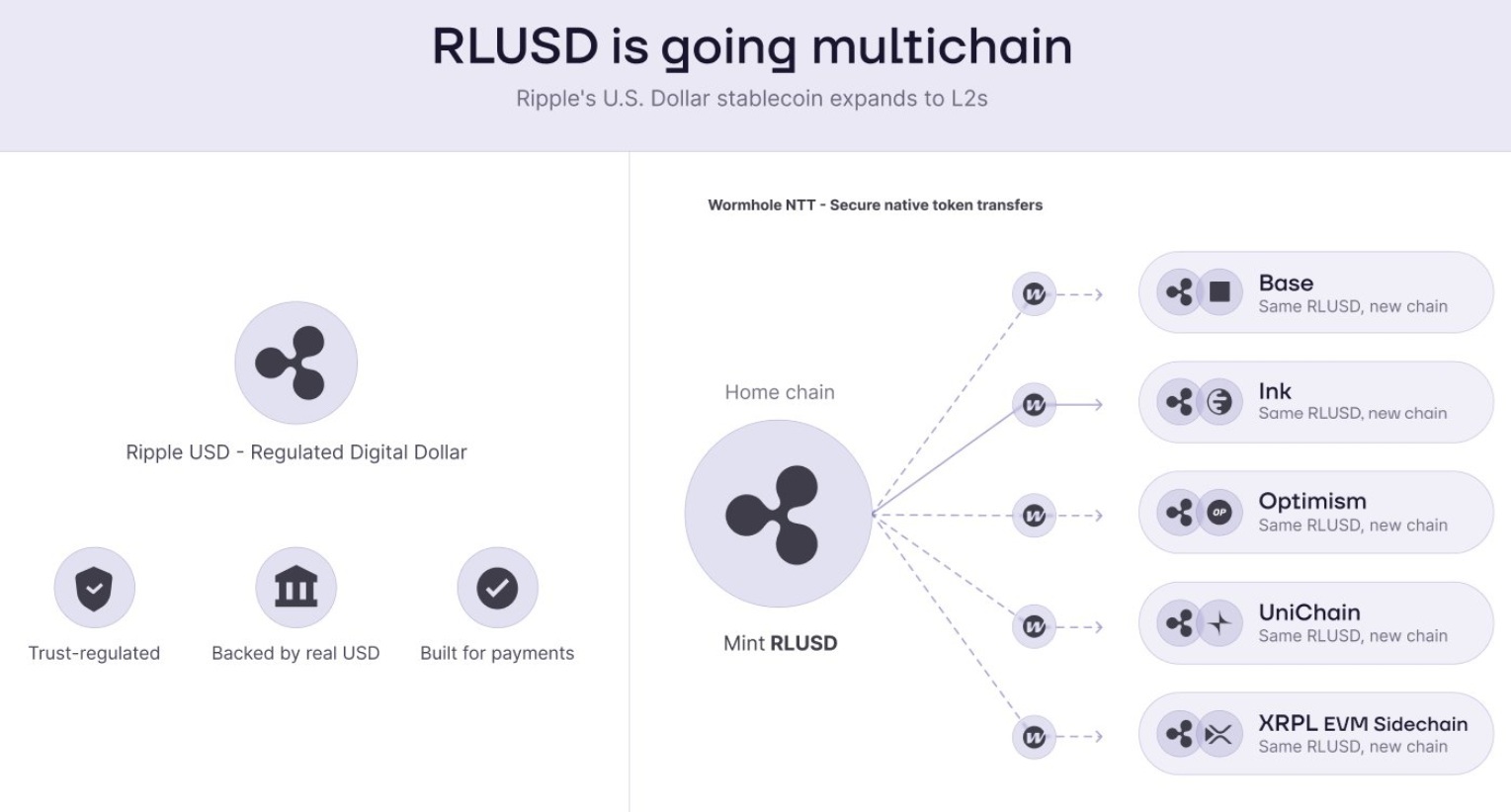
RLUSD multi-chain deployment diagram. Source: Wormhole's X platform post.
Cross-chain bridge infrastructure also opens new pathways for RLUSD circulation. Wanchain integrates it into its own cross-chain architecture, enabling transfers between XRPL, Ethereum, Cardano, and Wanchain. As Ripple expands institutional-level access across multiple blockchain ecosystems, this added connectivity provides another channel for RLUSD liquidity.
"Institutional-grade stablecoins now support multiple chains," Wormhole stated on the X platform, adding:
"Ripple's RLUSD is now available across ecosystems via Wormhole's native token transfer (NTT)—the standard has earned trust from over 100 assets across more than 40 chains. Compliance. Primitive. Multi-chain. ”
Since its launch, RLUSD has grown rapidly. According to Ripple's transparency report, as of May 28, the asset's circulating supply was $1.731 billion, supported by $1.833 billion in reserves. This latest integration with Wormhole builds on previous expansion efforts, further extending RLUSD's reach to more blockchain ecosystems and strengthening its role in payments, tokenization, and institutional liquidity.