
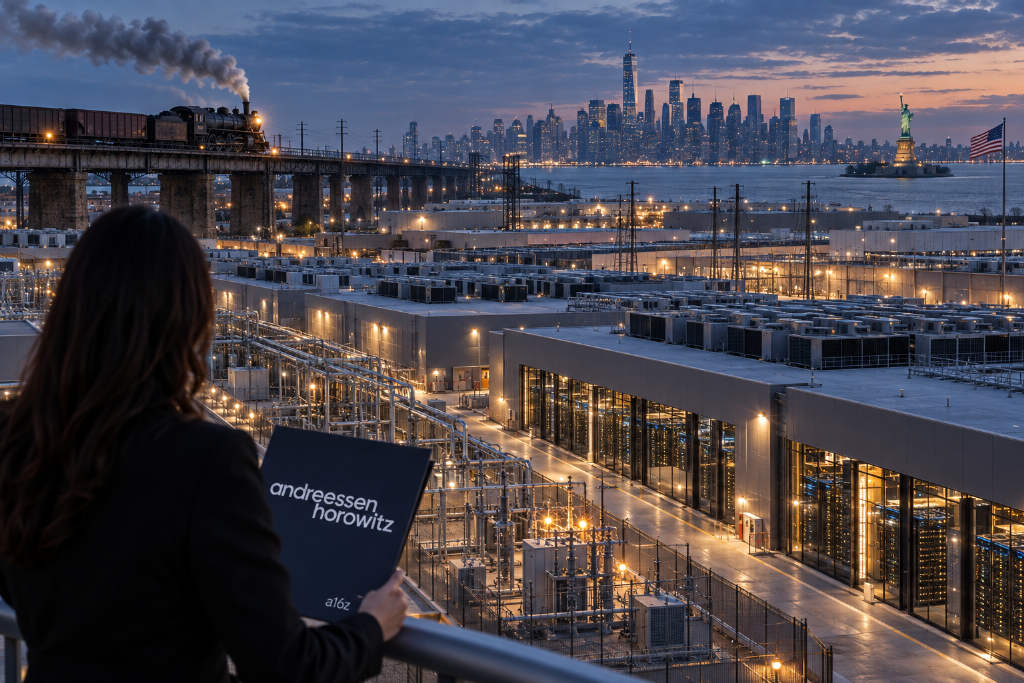
Andreessen Horowitz, or a16z, said in its second annual State of the Market report released on Sept. 30 that the current AI infrastructure buildout now accounts for a larger share of U.S. GDP than the 19th-century railroad expansion. In comments tied to the report, Growth Fund head David George and the a16z team described the shift as the next chapter of “Software Is Eating the World.”
a16z compares the AI buildout to a larger-than-railroad cycle
The firm said that on a long-run historical basis, the current wave of AI-related construction and investment has already surpassed the railroad era in its share of U.S. GDP. Railroads have been one of the most common historical comparisons used by investors, but a16z said the current cycle is already larger by that measure.
The team also estimated that cumulative investment tied to the trend could reach about 20 times today’s level over the next five to seven years, or even over 10 years. Data cited in the report showed that about 76% of S&P 500 earnings growth in 2026 came from technology companies.
a16z said capital expenditure by the four largest U.S. cloud providers and other hyperscalers was about $416 billion in 2025, is projected to rise to about $780 billion in 2026, and could exceed $1 trillion annually starting in 2027. High-tech equipment, software and research and development together already account for about 55% of total U.S. capital expenditure.
Cash from cloud giants is flowing into chips
General partner Alex Immerman said software demand should rise sharply once writing software is no longer limited to engineers. The report said the next stage of growth will move “from bits to atoms,” spanning semiconductors, power, networks, robotics and manufacturing.
As hyperscalers convert large free cash flows into chip purchases, Immerman said, the cash flow of cloud companies effectively becomes the cash flow of semiconductor companies. The report added that these expenditures are increasingly supported by debt. It also pointed to rising demand for investment across global infrastructure, defense spending, grid electrification, manufacturing returning to the U.S., robotics and autonomous taxis.
On questions about whether GPUs depreciate after just three to four years, a16z said Nvidia’s B200 is selling very well, but Nvidia A100 GPUs installed one or two years ago still deliver solid performance because AI computing demand continues to rise.
AI use is spreading, but depth remains limited
The report said AI applications are becoming widespread, but usage is still not deep. About 69% of S&P 500 companies have launched AI applications, and close to 30% said AI has delivered measurable benefits. Only about 2%, however, are consistently tracking performance indicators.
On the consumer side, as of April this year, only about 2% of U.S. households were paying for AI services. a16z said mature AI applications are still at an early stage even as computing capacity remains in short supply.
Software stocks are being repriced, not erased
The report said claims that AI will bring about the end of the software industry are overstated. According to a16z, the sell-off in software stocks reflects not only concern about AI, but also a repricing that the sector already needed to face.
In 2022, the market was filled with software companies that were growing quickly but still losing money, the report said. By 2026, roughly 75% of software companies had become profitable, but only about 30% were still growing revenue by more than 20%. As growth slowed, valuations moved lower.
a16z said companies that are still expanding quickly have largely held valuations near historical averages, but there are fewer of them now. The firm’s view is that software is not facing extinction. It is being asked to show results.
Looking ahead, a16z said AI will keep expanding demand, pushing enterprise and consumer applications toward greater maturity while also extending into robotics, biotech, healthcare and defense. The report added that this technology cycle will not replay the script of any previous one.