
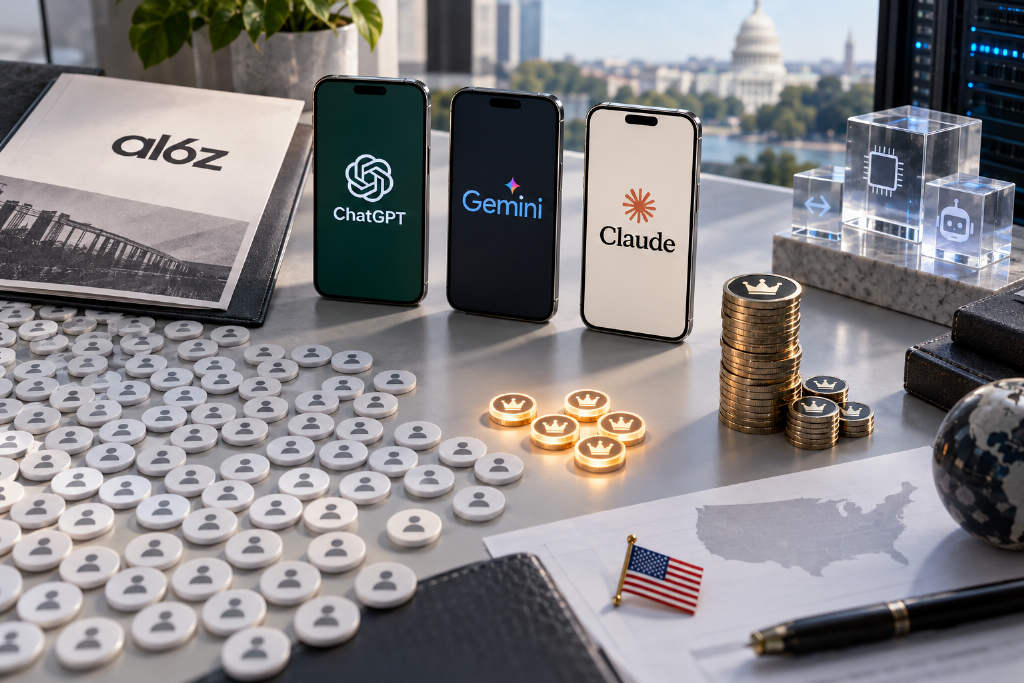
Andreessen Horowitz has published two closely watched AI reports — the seventh edition of Top 100 Consumer AI Apps and the late-September update to State of the Market II — and together they sketch a market that is widely discussed but still shallow in paid and deeply embedded use.
The material centers on the U.S. market. According to the data highlighted in the reports, nearly half of Americans say they have used AI. Daily usage is much lower at 25%. Paid adoption drops again from there: as of August 2026, only 4.5% of consumers in YipitData’s U.S. electronic receipt sample were paying for a personal subscription to ChatGPT, Gemini or Claude. A year earlier, that figure stood at 2.1%.
Broad awareness has not translated into deep adoption
One of the clearest points in the two reports is that “used AI” and “depends on AI” are not remotely the same category. A consumer who opens ChatGPT once to ask for weekend ideas and a worker who has AI connected to email, code repositories, servers and CRM systems both count as AI users in a broad survey, but their real level of adoption is worlds apart.
A16Z makes that divide explicit. In the report’s wording, “Power Users Are Pulling Away.” The firm cites data showing that the top 10% of enterprises are growing AI output tokens far faster than median companies. In the information sector, the gap reaches 11.7x.
The same pattern shows up in corporate deployment claims. The report says 69% of S&P 500 companies say they have formally deployed AI into real business operations. But only 2% say they are consistently tracking a clear metric to judge whether AI is creating value. One quarter earlier, that number was 1%.
That leaves the market with a second digital divide. The first was whether people had access to AI or had tried it at all. The second is about intensity: how deeply AI is embedded in work, automation and decision-making.
The low paid conversion rate makes the early-stage picture even clearer. A16Z compares AI subscriptions with mature consumer subscription services. In 2026, personal paid penetration among U.S. adults was 76% for Netflix and 31% for Apple TV+. Against that backdrop, a 4.5% personal paid rate for major AI assistants still looks small. Framed at the household level, the report says 98% of U.S. households have not paid for AI.
The top 1% of paying users account for 19.5% of spending
This year’s consumer AI ranking adds a new layer to the old traffic-based view. A16Z previously focused on visits and active usage. In the latest edition, it also brought in YipitData’s U.S. consumer card and electronic receipt sample, making it possible to compare who uses AI with who actually pays for it.
That shift changes the map. Among people already willing to spend on AI, only 13% also pay for a second AI product. In other words, most paying users subscribe to just one service.
Spending concentration is even more striking. The top 1% of AI paying users account for 19.5% of all spending, while the bottom 50% account for 16.6% combined. A tiny group at the top is therefore spending more than half the market’s lower tier put together.
The dollar figures are far apart as well. The top 1% spend an average of $903 per month on AI through personal bank cards. The median user spends $25, and that median has barely moved over the past two years. By contrast, spending by the top 1% has climbed another 80% over the past 18 months.
A16Z says those highest-spending users are not just buying access to flagship models. Outside the core model providers, a large share of spend is going to automation and product-building tools such as N8N, Figma and Manus. That points to a user group treating AI less as a consumer novelty and more as production infrastructure.
The reports use platform-level data to show how different that paying base can look from a traffic ranking. ChatGPT still leads by a wide margin in web traffic, with web visits around 2x Gemini and 6x Claude, with an even larger gap on mobile. But at the high end of personal subscriptions, Claude stands out. A16Z says 7.3% of Claude’s paying users are on the $100-and-up Max plan. For ChatGPT and Gemini, the comparable figure is 1.3%. The report notes that this is measured within the paying user base only, not across free users.
Another number underlines the split between attention and revenue. Of the top 50 AI products by consumer spend, 29 do not appear on either the web traffic ranking or the mobile app ranking. More than half of the biggest spend winners are therefore largely invisible in standard traffic league tables.
That is a meaningful shift from older internet logic. In AI, at least for now, traffic is not automatically money. Revenue is showing up where products help users do work with clear value attached.
Jevons paradox is showing up in AI infrastructure
One of the report’s central arguments is that AI is replaying a classic economic pattern: Jevons paradox. As the cost of a unit of intelligence falls, total demand does not necessarily fall with it. It can rise sharply instead.
A16Z frames this through two related trends. On one side, the price of intelligence has dropped steeply over the past several years. Comparable model performance costs less, open-source models have improved and caching has become cheaper. On the other side, demand for compute has stayed strong enough that H100 rental prices have moved higher again, while older GPUs have not collapsed in value as quickly as many expected.
The reports also point to steep revenue growth at newer compute cloud providers including CoreWeave and Lambda. The explanation is straightforward. When an AI task costs a lot, users reserve it for only the highest-priority jobs. When the same task becomes far cheaper, they do not simply save the difference. They start applying AI to many more tasks that previously did not justify automation.
Agents are now the clearest expression of that shift. Citing OpenRouter data, A16Z says agent-generated tokens surpassed tokens generated by direct human chat starting on February 6 this year. By August, the 7-day average token usage generated by agents had reached 7.3 trillion tokens per day, up 14x from a year earlier.
The annual increase is even more dramatic on weekly throughput. In September 2025, OpenRouter processed about 4.7 trillion tokens in a week. By September 2026, that figure had climbed to 126.2 trillion, a 27x year-on-year increase. From June to September of this year alone, token demand doubled twice in succession.
Those numbers matter for pricing frameworks. Looking only at the cost per million tokens is becoming less informative if a cheap model consumes far more tokens because of lower reasoning efficiency or repeated failure loops on a task. The report’s takeaway is that single-task cost may become a more useful measure than headline token pricing alone.
Consumer AI still monetizes like SaaS, but agents may change that
A16Z also breaks down how top web AI products make money. The report says 84% use subscriptions. Another 64% use usage-based pricing or credits. Advertising appears in 14% of cases, while transaction commissions or take rates show up in just 2%. Since one product can use more than one model, the totals add up to more than 100%.
The structure is still clear. Consumer AI may look like an internet product in form, but its revenue model is still far closer to SaaS. Users pay directly for intelligence, receive an allocation, and buy more capacity if they run out.
That stands in contrast with the last generation of internet giants. A16Z notes that 97.6% of Meta’s 2025 revenue came from advertising, while the figure for Google was 73.2%. Earlier consumer internet businesses scaled by letting advertisers or platforms pay instead of users. AI has had a harder time following that route because inference has a real marginal cost. The more a user talks to the model, the more compute the provider burns.
That helps explain a puzzle in the reports: AI is everywhere in the public conversation, yet paid penetration remains only a few percentage points. The issue is not necessarily a lack of value. It is that persuading global users to pay an additional $20 every month for software is difficult in any category. A16Z argues that ChatGPT reaching the global top 20 consumer subscription products in a little more than three years is already remarkable.
Still, transaction-based monetization is beginning to show up in agent products. One example in the report is Instinct, a personal agent that works through iMessage and WhatsApp for tasks such as booking tickets, booking hotels, canceling subscriptions and shopping. According to its own public data cited by A16Z, 40% of users link a credit card within three weeks, and those who actually purchase through the agent run an average of $1,300 per month through it.
The commercial implication is obvious. If an agent sits close enough to everyday consumer transactions, charging a flat monthly fee may not be the only option. A provider could offer the tool free of charge and monetize through transaction take rates instead. A16Z also notes that Meta’s Muse has been moving along a similar path and at one point topped the App Store.
That is one reason personal agents remain attractive to venture investors. The business model is easier to map onto the transaction logic of the mobile internet era than onto pure software subscriptions.
AI is pulling capital back into the physical world
The reports go beyond software and consumer spending. A16Z argues that AI is also reversing the direction of capital intensity in tech. It sums this up with a simple phrase: “Atoms Are So Back.”
For roughly two decades, the industry’s center of gravity was built on bits — software, the internet, cloud services and SaaS. Their appeal to capital markets was obvious: low marginal cost, high gross margins and rapid scalability. AI appears even more digital on the surface. Underneath, it is highly physical.
A16Z says AI capex is redirecting free cash flow away from software leaders and toward chips, energy, the power grid, cooling systems, copper and industrial supply chains. Building AI capacity requires GPUs, optical modules, transformers, land, electricity and construction. The reports say hyperscalers including Microsoft, Google, Amazon and Meta are spending heavily enough on AI that free cash flow has been visibly pressured, with that pattern expected to last until around 2028.
Debt markets have now become part of the buildout as well. Bonds and credit are being used to add leverage to this round of AI infrastructure. The reports stop short of reducing the whole cycle to a simple bubble narrative, arguing that the companies involved are still making money, returns on invested capital still exceed financing costs, cloud backlogs are still expanding and demand for compute still exceeds supply.
GPU market behavior supports that point. Older GPUs have not rapidly collapsed in rental price or residual value in the way many expected. Semiconductor backlogs remain. Even when companies secure chips, they may not be able to deliver data center capacity on schedule because power access and supporting infrastructure are still constraints.
That is one of the report’s broader messages. Unlike the earlier internet cycle, the AI cycle is restoring strategic weight to physical infrastructure. A16Z links that trend not only to today’s digital AI workloads, but also to what comes next in embodied AI, autonomous driving and rockets — areas where the physical layer is not incidental but central.
What the two reports say together
Read side by side, the two A16Z reports describe an AI market splitting along several lines at once.
Usage is broad, but depth remains limited. Nearly half of Americans have tried AI, yet daily use is 25% and personal paid subscriptions for ChatGPT, Gemini and Claude are only at 4.5%.
Spending is increasingly concentrated among a small professionalized cohort. The top 1% of paying users account for 19.5% of total AI spend and average $903 a month, while the median paying user spends $25.
Compute demand is not easing as intelligence gets cheaper. Agent activity is pushing token consumption to levels that were difficult to imagine a short time ago, with OpenRouter’s weekly throughput climbing to 126.2 trillion tokens by September 2026.
Monetization is splitting too. Subscription and usage-based pricing still dominate, but agent products are opening a path toward transaction fees and platform take rates. At the same time, the old assumption that traffic maps neatly to revenue is breaking down.
And beneath all of that, the investment story is shifting from pure software economics back toward physical buildout. Chips, power, cooling, copper and industrial capacity are once again central to how value is created in tech.
The central divide in AI is no longer just who has touched the technology. It is who has embedded it deeply enough to change output, spending patterns and infrastructure demand. On A16Z’s numbers, the leaders are already operating in a very different stage of the AI market from everyone else.