
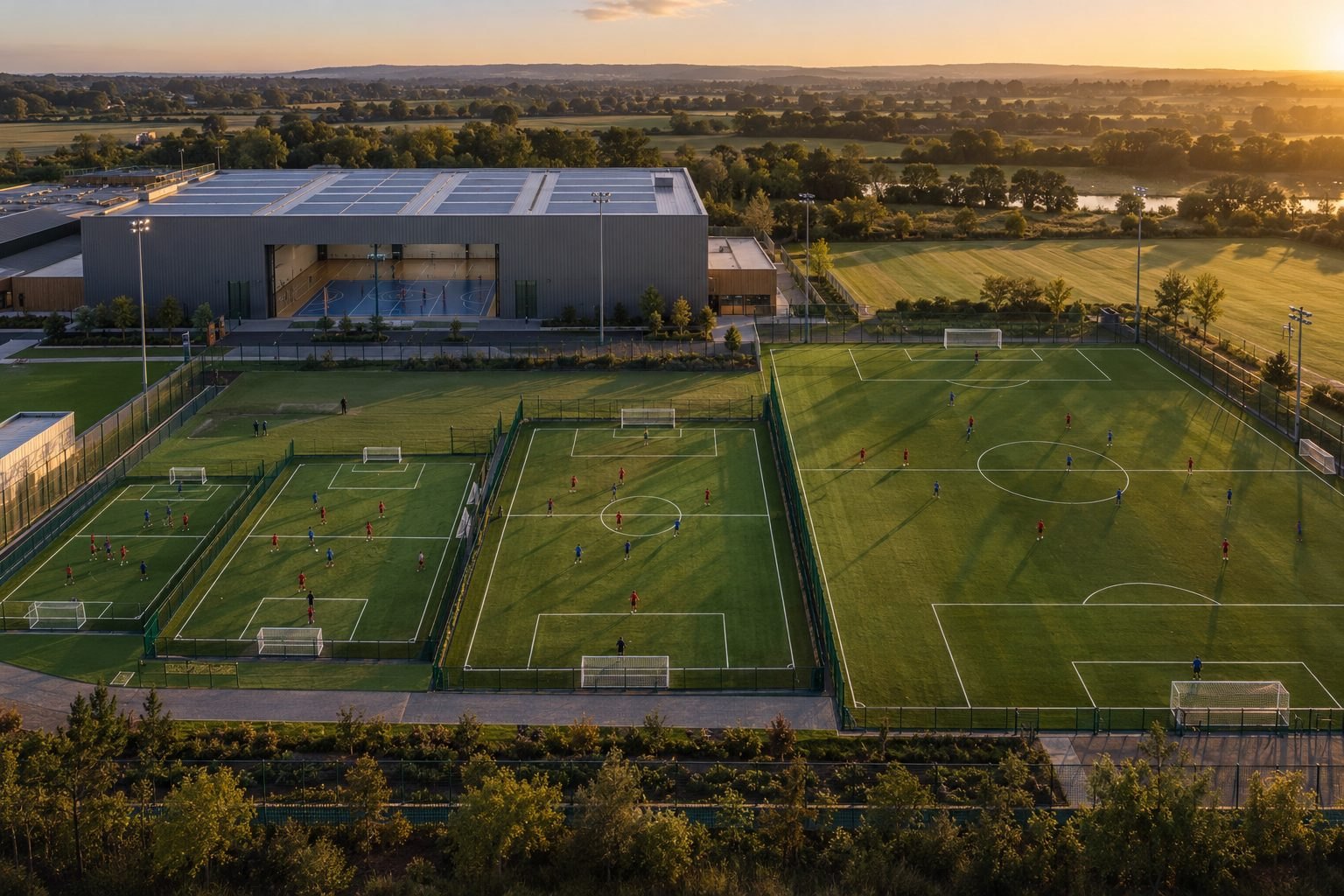
Premier League academy matches start with small-sided formats from Under 9 to Under 11, reach 11v11 by Under 12, and usually do not produce a league table before the Under 18 league stage. The exceptions are the Under 13, Under 14 and Under 15 National Cups.
Format by age group
Here is the format for each age group.
| Age group | Team size | Pitch size (yards) | Goal size (feet) | Ball size |
|---|---|---|---|---|
| Under 9 | 4v4, 5v5, 6v6 or 7v7 | 30x20 to 40x30 (4v4 and 5v5); 50x30 to 60x40 (7v7) | 12x6 | 3, or 4 at the home club's option |
| Under 10 | 4v4, 5v5, 6v6 and 7v7 | 30x20 to 40x30 (4v4 and 5v5); 50x30 to 60x40 (7v7) | 12x6 (4v4 and 5v5); 12x6 to 16x7 (7v7) | 4 |
| Under 11 | 7v7 or 9v9 | 50x30 to 60x40 (7v7); 70x40 to 80x50 (9v9) | 12x6 to 16x7 (7v7); 16x7 (9v9) | 4 |
| Under 12 | 11v11, or 9v9 if both clubs agree | 90x60 (11v11); 80x50 (9v9) | 21x7 (11v11); 16x7 (9v9) | 4 |
| Under 13 | 11v11 | 90x60 | 21x7 | 4 |
| Under 14 | 11v11 | 90x60 to 100x60 | 21x7 to 24x8 | 5 |
| Under 15 | 11v11 | 110x70 | 24x8 | 5 |
| Under 16 | 11v11 | 110x70 | 24x8 | 5 |
The structure is progressive rather than fixed at one setting from the start. The youngest ages use a flexible small-sided approach, then the programme moves into fuller match conditions, before the professional development phase switches fully to 11v11 under the Laws of the Game.
Under 12 is the clear transition point because full-sided football appears there while one agreed alternative still remains available. After that, the format is much less flexible than it is in the foundation phase.
Who decides the format and when indoor games are allowed
In the foundation phase, which covers Under 9 to Under 11, the two clubs try to agree which permitted format to use. If they cannot agree, the home club makes the call.
Those matches are played outdoors as a rule. During the second half of December and throughout January and February, they may be played indoors, and some indoor fixtures may be staged as futsal.
Every club with a Category 1 academy must also organise and host at least three festivals in a season.
Do academy matches have a league table?
Foundation phase matches are competitive, but outside tournaments their results carry no particular competitive significance between academies. That is why there is no league table or similar ranking for the regular Under 9 to Under 11 programme.
The same broad approach applies in the youth development phase. Results there also carry no particular competitive significance, except in the Under 13, Under 14 and Under 15 Premier League National Cups.
Ranking begins in the professional development phase. That programme consists of competitive leagues and tournaments, and a club with a Category 1 academy must take part in Premier League 2 within it.
National Cups and the oldest academy band
Entry to the three National Cups is optional. A club must tell the league by 1 August each year if it wants to enter them in the following season.
For the oldest academy band covered by league-run professional development matches, the format is 11v11 under the Laws of the Game. It is for players in the Under 18 age group and younger, with one specific exception: a club may name a goalkeeper from the Under 19 age group on its team sheet.
The substitute rules then split by programme. In league-run professional development matches, only five substitutes may be named, with up to three entering the field, plus up to one concussion substitute and/or one additional substitute, as appropriate, from those already named. In the programme run by the EFL for Category 3 and 4 academies, up to three Under 19 players may be named on the team sheet and all five named substitutes may enter the field.
FAQ
When do academy players start playing 11 a side?
Under 12 is the first age group where 11v11 appears in the standard format list. That band still allows 9v9 if both clubs agree, so the transition is not completely rigid at that point.
What size pitch do academy teams use?
The pitch changes with age and format, rather than staying on one standard size. The smallest setup in the table is used for the youngest small-sided games, while Under 15 and Under 16 use 110x70 yards.
What are the Premier League National Cups?
They are the exception to the usual unranked academy structure before the Under 18 league stage. They exist for Under 13, Under 14 and Under 15, and clubs have to opt in by notifying the league by 1 August for the following season.
Does the oldest academy programme allow older players?
In league-run professional development matches, the age limit is Under 18 and younger, with one named Under 19 goalkeeper allowed on the team sheet. In the separate EFL programme for Category 3 and 4 academies, up to three Under 19 players may be named.