
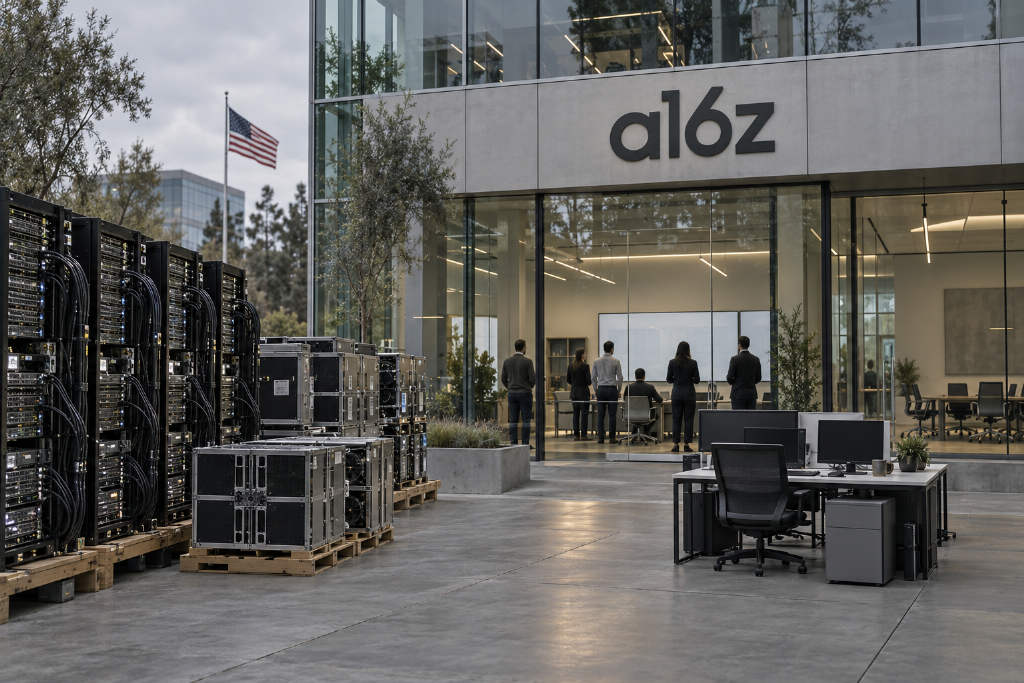
Andreessen Horowitz, or a16z, said in its 2026 first-half market report that the gap in AI spending among technology companies has widened to nearly 8x. Built around more than 100 charts, the report focuses on several questions that have shaped this year’s market debate: how tech came to dominate earnings growth, why leadership has shifted from software to hardware, whether GPUs will lose value quickly, and whether SaaS is facing a real endgame.
Tech has become the main source of earnings growth
a16z said technology became a major force in capital markets after the financial crisis. After the housing bubble burst and credit tightened, tech offered investors a high-growth, asset-light alternative. Software’s near-zero marginal cost and the size of its untapped markets also created strong operating leverage.
The report said software did in fact “eat the world,” but technology’s role in public markets has moved well beyond that of a single sector. Tech earnings have continued to compound from a relatively low base and have outpaced other parts of the market. Since 2023, that trend has become even more pronounced. As of the end of August 2026, technology accounted for about 76% of total earnings growth in the S&P 500, according to a16z.
In the firm’s view, cycles that were once defined by durable goods such as houses, dishwashers, and cars are now being defined by technology. Tech has spread across the economy rather than sitting beside it. The report’s framing is blunt: technology is now the cycle of everything.
The market has rotated from bits to atoms
Within tech, a16z described this year and the period ahead as a rotation from “bits” to “atoms.” Software led the last cycle. Hardware is now taking center stage. The report tied that shift to the AI buildout, which has driven a surge in demand for industries that were traditionally cyclical, capital-intensive, and often overlooked, including semiconductors, power, and networking equipment.
a16z said much of that demand is being funded by the historic profit pools generated by the world’s largest technology companies. In practice, the report said, that means the free cash flow of hyperscale data center operators is being converted into free cash flow for semiconductor companies. It also noted that debt financing is taking a larger role.
AI is not the only force behind the return of the physical economy, the report said. It also pointed to trillion-dollar global infrastructure needs, rising defense spending, power grids adapting to electrification, the return of manufacturing, and the approach of robotics and robotaxis.
After years of lagging software, hardware and infrastructure have become market favorites again. a16z said both public markets and private equity are investing in computing, storage, power, robotics, manufacturing, and defense innovation with unusual intensity. Its conclusion was direct: atoms are back.
GPU demand still exceeds supply
On AI capital spending, a16z said one point remains clear: demand for compute still exceeds supply. The report referred to a skeptical view that questions whether current spending makes sense if GPUs become obsolete in three to four years. That argument also extends to what NVIDIA’s strong B200 sales might mean for A100 systems installed one or two years ago.
a16z said that, at least for now, the upward bend in AI compute demand means A100s remain useful. In theory, rental pricing and residual values for GPUs should decline over time. The report said that is not what the market is showing. As intelligence gets cheaper, demand for compute keeps rising, lifting prices for the newest chips while also supporting older ones.
The report said A100 pricing has stayed at or above levels seen at the start of the year. So far, a16z argued, progress in compute and models is not a zero-sum trade. Better and cheaper intelligence is creating value across the ecosystem, and older chips and older models are still retaining meaningful value beyond the expiration dates suggested by skeptics.
AI adoption is broad, but still shallow
a16z also said this is happening while AI adoption remains relatively immature. The report described adoption as broad in reach but limited in depth.
On the enterprise side, nearly 30% of S&P 500 companies reported some “quantifiable impact” from AI, but only about 2% are tracking any specific metrics. The same pattern appears in agent use cases, where only a very small share of users are deploying agents at real scale.
Consumer adoption is also still early. As of April, only about 2% of U.S. households were paying for an AI service, according to the report. a16z said that figure is now higher and still rising, but remains small in the broader picture.
Its takeaway was that GPUs are already running at full load while mature AI adoption and utilization are only beginning.
SaaS is not dead, but it has to prove itself
a16z pushed back on the claim, popular earlier this year, that software is dead. That argument held that AI would generate code, software would become the casualty, and enterprise SaaS would be next.
The firm said reality is more selective than that. Software did go through a selloff, but the move looked more like a repricing than an extinction event. AI, or the threat of AI, has been part of the story, but not the whole story.
The report said some of the washout in public software names had been building for some time. Since the end of the zero-rate era, technology companies have traded growth for profitability. In 2022, the market still had many software companies growing quickly but earning little or no profit. By 2026, that picture had flipped: about 75% of companies were profitable, but only around 30% were growing faster than 20%.
a16z said that shift fits a higher-rate environment in which capital is scarcer. Companies moved from loss-making growth to slower but steadier and more sustainable expansion. That is rational, but slower growth cannot support high-growth valuation multiples indefinitely. In the report’s view, that is what eventually fed into the broad repricing across software.
Not every company was hit the same way. Valuation multiples for high-growth companies are still in line with historical averages, though not at the peaks seen during the zero-rate period. There are simply fewer of those companies now. a16z’s bottom line on software was that the sector is not facing doomsday. It is facing a “show me” market.
What a16z expects next
Looking ahead, a16z said AI will widen the scope of demand. That includes more mature adoption in both enterprise and consumer markets, as well as expansion into robotics, biotech, health, and autonomous driving.
The report ended by saying technology is still advancing at an exponential pace. No one can predict the future with precision, it said, but given the speed and rhythm of change, this cycle is unlikely to look like any cycle that came before.