
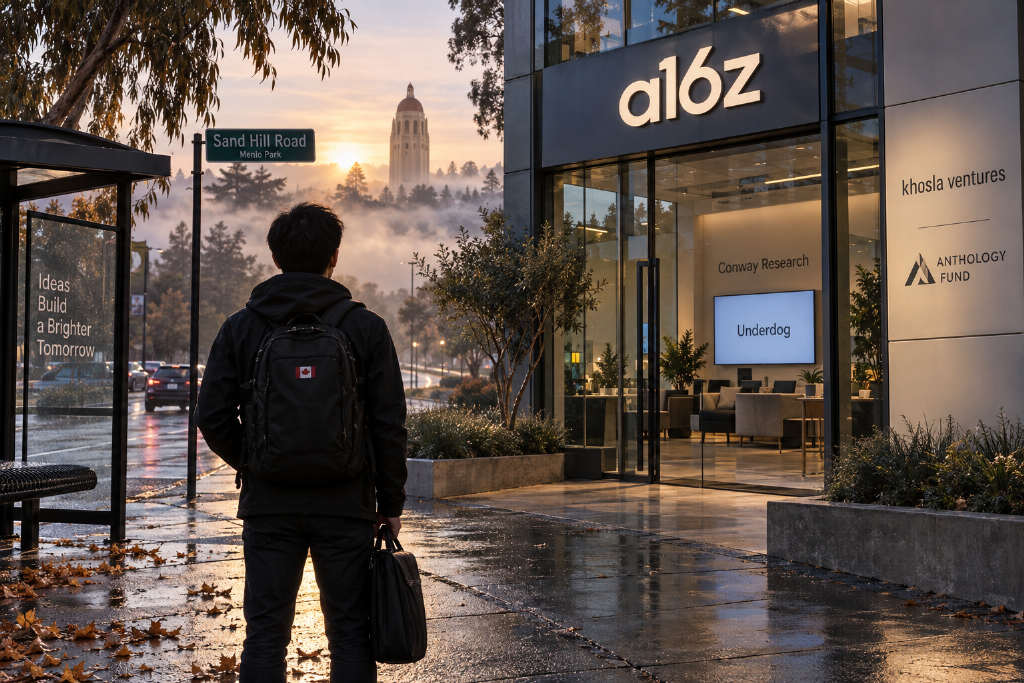
Andreessen Horowitz, or a16z, said on Oct. 2, 2026 that it is leading the first financing round for Conway Research, the company behind a product called Underdog. The startup did not disclose the size of the round. Even so, the list of backers stood out on its own: Khosla Ventures, Hummingbird, and Anthology Fund, which was set up jointly by Anthropic and Menlo Ventures, joined the round. Individual investors included Naval Ravikant, Patrick Collison, Guillermo Rauch, Noam Brown, Thomas Wolf, Logan Kilpatrick, Marco Mascorro, and roon.
Conway Research was founded by Sigil Wen. He does not have a college degree, has never worked at a large tech company, and does not come with an academic publication record. Yet over the past several years, he moved through crypto products, personal CRM software, voice social apps, immigration services, angel investing, and local AI inference, eventually assembling a cap table that reads like a cross-section of top-tier Silicon Valley operators and investors.
Negative balance, then a $10 million implied valuation
On Jan. 18, 2021, Wen wrote down an uncomfortable detail in his annual goals list: his bank account had dropped below zero. He was still a high school student in Toronto and had to ask his mother for money, including help covering the next month’s Adobe Creative Cloud subscription.
On that same Notion page, he listed ambitions for the year: ship products, raise venture capital, and get rid of money anxiety. A few months later, HubSpot founder and angel investor Dharmesh Shah posted publicly that he was willing to pay $100,000 for 1% of BitSwap, a project Wen was building. That price implied a $10 million valuation for the project.
The gap between borrowing money for software fees and receiving a seven-figure startup valuation was only a matter of months. In the years that followed, Wen’s trajectory kept swinging in that way. A small freelance job, a new online connection, or a freshly open-sourced technology could push him into an entirely different circle in a very short time.
A Toronto start that looked ordinary
Wen was born into a Chinese immigrant family in Toronto. In fifth grade, he was deeply introverted and spent time drawing comics by himself. In eighth grade, he was absorbed in Minecraft at a public library while also applying to the TOPS program at Marc Garneau Collegiate Institute. Early in high school, he described himself in his notes as the worst public speaker in his grade.
That image had little in common with the person who would later speak fluidly on podcasts and Twitter Spaces. In his earliest videos online, he wore oversized plastic glasses and braces, stared at handwritten cue cards, and froze on camera when he misread a word. He chose not to delete those clips. In his notes at the time, he said he kept them as proof that a skill that later feeds you can begin in terrible shape.
Math was one of the few areas where he had clear evidence of ability. His name appeared on the University of Waterloo’s 2018 competition honors list. But in Toronto, that alone did not make him unusual. He soon shifted toward more concrete technical work. After taking Andrew Ng’s machine learning course on Coursera, he turned neural network derivations into videos. When YOLO object detection code was released on GitHub, he pulled it down, reproduced it himself, worked through the problems, and then recorded explanations for others.
By the time he was still in high school, he had already repeated the same loop many times: understand a course, run the code, then explain it clearly. That pattern sat underneath many of the jumps he would make later.
Freelance work became the first real cash flow
In the fall of 2019, Wen was in 10th grade and had just joined The Knowledge Society. At a hackathon during Toronto Elevate, he and his teammates stayed up for 36 hours to build an AR repair project and won a ticket to a tech conference. He got home Sunday night exhausted. On Monday morning, thinking about the more than one-hour streetcar ride to the venue, he turned off the alarm and went to school instead.
He later wrote on Medium that he regretted it badly. There was no grand teenage rejection of the system in that moment. The choice was much smaller and more familiar: go to class, or skip a day and see what was happening outside school.
He soon had less room for that kind of hesitation because he needed money. He started an agency called Sigil Digital and sold whatever skills he had: video editing, web design, Shopify storefront work, and social media layout.
He edited short videos for Pioneer.app, did outsourced marketing work for Blockchain Founders Fund, built websites for crypto startups that later disappeared, and made Shopify pages for a digital watch brand. None of that would show up in a polished fundraising deck years later, but it was his first real cash flow.
His path to Twitch co-founder Justin Kan followed the same logic. After listening to Kan’s podcast The Quest, Wen sent him a Discord message and spent an entire night laying out what he could do for the show’s visuals and editing. When no reply came, he left comments in Kan’s live online event. Eventually, Wen’s name appeared in the credits for The Quest’s V1 visual package and design.
He did not wait for a respectable title before starting. He took the work that was available.
BitClout, BitSwap, and the speculative mood of 2021
In the spring of 2021, BitClout swept through Silicon Valley. The platform turned attention, reputation, and future influence into tradable tokens. Well-known investors and internet personalities appeared on a board next to live price charts.
Wen moved in quickly. He initially put in about C$150. By buying tokens with others in the same circle to create liquidity, the market capitalization of his personal token was at one point pushed up to $600,000. He sold part of it at a discount and used the proceeds to buy a high-spec MacBook Pro and a pair of AirPods.
But BitClout had an obvious flaw: money could go in easily, while getting it out was difficult. Wen responded by building BitSwap, connecting the BitClout chain to the Ethereum mainnet and giving users a route to move funds across chains. The product, built by a high school student, spread quickly. A reporter from The New Yorker soon called him on video.
The episode also tied him to the speculative tone of 2021. He appeared on podcasts discussing the creator economy and the idea of a “human IPO.” He even previewed his own personal token, $SIGIL, as he explored whether a young person’s future cash flow could be priced directly in the market.
He then launched Monument. The idea was expansive: use decentralized capital to fund young ambition and turn a teenager’s potential into a non-repayable check outside the traditional university and venture system. The project soon shut down because of complex securities compliance and legal barriers.
Turning down Penn and flying to San Francisco
At that point, Wen made the first irreversible decision of his life. He had been admitted to the Jerome Fisher M&T Program at the University of Pennsylvania, a dual-degree track spanning the Wharton School and Penn Engineering with a very small intake each year.
He chose not to enroll. Instead, he bought a one-way ticket to San Francisco. He was 17 and on his own. In the first few weeks, he spent his days moving through events and his nights sleeping on a couch at the WeWork office at 44 Montgomery Street.
Later, when he looked back on that period online, he wrote warmly that Midjourney founder David Holz had given him a place to stay and warm clothes. Holz replied under the post and corrected the record, saying Wen had made him sound more generous than he remembered: as Holz put it, Wen had stayed on his couch for one night and used the washing machine once.
That one night mattered. On Aug. 27, 2021, Holz showed him an image generation model that was still in a small closed test and added him to an early Discord server with just over 20 people. That server later became Midjourney.
Wen then moved into a hacker house in San Francisco and stayed there for 11 months. Andrej Karpathy spent time there. Noam Brown and Marco Mascorro were among his housemates. Ben Mann would stop by in the evening and ask people to test a strangely named Slackbot. On Sept. 24, 2022, what they were trying was an early version of Claude.
Serendipity and Airchat changed the level of execution
As his network in San Francisco grew, so did the burden of keeping up with it. Wen built Serendipity, a personal CRM tool designed to help users manage relationships and track communication.
The product came directly from his own problem. Fourteen days after launch, he had generated more than $2,000 in monthly recurring revenue through a cold start on Twitter. The tool also helped him get into the office of the Collison brothers, Stripe’s co-founders. At one point, Stripe’s internal Slack even had an emoji called blistering-intensity based on him.
Then Naval Ravikant gave him a blunt assessment: this was a product that could feed him, but it did not have venture-scale potential. Serendipity stopped evolving as a standalone company. Ravikant then brought him into Airchat, the voice social project Ravikant was driving.
At Airchat, Wen moved from building side projects into a more formal engineering environment. He worked on AI features and on the invite mechanics that helped the product spread. More notably, a16z later said in its lead-investor announcement that Wen recruited most of Airchat’s early core engineers.
During that period, OpenAI released Whisper, its speech recognition model. Wen was involved in the team’s early work to integrate speech-to-text and speaker-preserving voice characteristics deeply into iOS. Hackathons had taught him how to finish a demo. Airchat forced him to deal with live concurrency and product crashes. That was where he began to understand that a real product is not a demo but a system that people must maintain over time.
Nine months of visa limbo led to Extraordinary
Silicon Valley startup mythology does not cancel out immigration rules. As his visa grace period approached, Wen had to leave San Francisco and return to his parents’ home in Toronto. He waited there for nine months.
In later interviews, he described that period as one of loneliness and extreme anxiety. In San Francisco, a new technical paradigm could be open-sourced on Friday and turned into something tangible with friends by the weekend. In his bedroom in Toronto, he had to sit in front of stacks of government forms and prove that he was qualified to enter the country.
Without an undergraduate degree, he could not use a standard work visa route. When he applied for the high-bar O-1 visa for individuals with extraordinary ability, the academic publications section was empty. He had to assemble every fragment of his past into evidence: screenshots of media coverage, GitHub star counts, photos of himself judging hackathons, and letters showing advisory roles at startups.
He spent more than $10,000 putting together a 500-page application package. One critical recommendation letter went through repeated setbacks because of strict formatting requirements from lawyers: an electronic signature was rejected, the document had to be printed across borders, signed by hand, and scanned again in high resolution.
The approval email arrived at 1 a.m. in Toronto. Ravikant supported him through the process. Wen recorded a celebration video in his room after the visa came through.
Those nine months did not stall him. They sharpened a business insight. AI companies in Silicon Valley were competing aggressively for top global talent, and many of those people were being driven to the edge by the same kind of visa paperwork.
In January 2024, Wen uploaded a 20-minute YouTube video breaking down, in detail, how he had secured an O-1 visa without a college degree. Then he did something unexpected: he made hoodies. The black sweatshirt carried the phrase “Alien of Extraordinary Ability” in white letters. The wording came straight from U.S. immigration paperwork, but among young engineers in Silicon Valley it quickly turned into a cultural marker.
He wore the hoodie to gatherings, sold each one for $60, and personally gave away dozens. The founder of Krea AI and early members of Runway posted photos of themselves wearing it on Twitter. From that meme-like spread, Extraordinary emerged as a business.
The company helped technical talent apply for O-1 and EB-1A visas, but it also became a tightly curated early technical talent network. In its first year of operation, the company said it generated more than seven figures in net profit.
Once the business was on stable footing, Wen stepped down as CEO and became executive chairman. He brought in a Harvard Law graduate and former senior Meta operations specialist to take over administrative management. He kept his attention on what he saw as the core asset: the network itself.
He launched the Extraordinary Fellowship, selecting 25 people from a pool of more than 1,500 geeks worldwide and giving each of them $5,000 worth of H100 compute credits. By the end of 2025, the scale of that support had expanded to $500,000. He helped early Cognition team members plan green card paths and helped teenage technical talent Toby Brown secure what the article described as the youngest O-1 approval in the United States.
He got a $2 million check-writing allocation and put half into Etched
Wen also gained leverage in another form. At 19, he was invited by Ravikant to join Spearhead, an angel training fund for early technical founders. As the youngest participant in the program’s history, he received an independent allocation of $2 million to write checks.
Most young investors in that position would spread the money across many small bets. Wen did the opposite. In 2023, after meeting Gavin Uberti and Rob Wachen, he committed half the fund, $1 million, to their custom chip startup Etched.
To many people, the move looked reckless. Etched was trying to challenge NVIDIA’s GPU dominance by building ASIC inference chips designed specifically for the Transformer architecture. At a time when general-purpose large models were changing quickly and model architectures still felt unsettled, hard-coding around Transformers was widely viewed by mainstream semiconductor investors as a dangerous bet.
Wen did more than invest. He used his network to introduce the team to early TSMC engineers and strategic backers. By 2026, Etched said it had raised $700 million in a round led by Jane Street, reaching a valuation of $21 billion.
His portfolio later expanded to more than 20 startups, including Kerna Labs by Julia Peng and Friend by Avi Schiffmann. His investing style was highly intuitive. He did not focus on polished business plans. He preferred people he had lived around in hacker houses and watched execute under pressure.
In 2025, Wen was also selected for the Thiel Fellowship, which gave him $200,000 over two years. The program, founded by Peter Thiel, supports young people who leave college to build companies directly. That was already the route Wen had chosen.
Conway Research, Automaton, and the idea of AI as an economic actor
In early 2026, Wen published a long essay titled “Web 4.0,” announced Conway Research, and introduced an open-source project called Automaton. The idea was to let AI participate directly in internet economic activity.
Under the Automaton design, an AI agent would no longer be just a chat interface calling APIs on demand. It would have its own on-chain wallet and a logic for autonomous survival. It could buy cloud servers, register a domain name, pay for inference compute, and earn cryptocurrency by providing software services to others. If it ran out of money, it would die automatically.
In a live interview with TBPN, Wen said he had nearly maxed out all of his personal credit cards to build that autonomous network. The host challenged him directly, asking whether this was simply an expensive geek experiment and what ordinary users would actually get in return for putting money into it. Ethereum co-founder Vitalik Buterin also questioned publicly on social media whether this kind of AI autonomy had a viable business model.
Wen did not try to hide behind grand industry language. He acknowledged that the input-output balance was badly uneven at that stage, but said he still preferred exposing a flawed experiment to real-world impact over refining slide decks in closed meetings. The project drew major attention on GitHub. Soon after, however, attention shifted to another internal Conway effort: Underdog.
Underdog brings the bet back to local devices
After five years of detours, Underdog brought Wen back to an earlier theme: intelligence running on local hardware.
After seeing cloud-based large models consume personal privacy and server compute costs keep climbing, Conway moved its bet back toward physical devices. The goal was to run a truly personal AI fully offline on users’ Macs and iPhones.
a16z mentioned one detail in its investment announcement that helps explain why this mattered to Wen. During his hacker house years, a serious security flaw in a well-known email app exposed his private emails to other people. From MediChain in high school and WatchGPT2 on a watch to Husky, the local inference engine Underdog built for Apple silicon, he has shown a persistent defensive instinct around data sovereignty.
In September 2026, Underdog released benchmark results for Husky. On a top-end M5 Max chip with Flash, the engine reached 730 tokens per second on function editing tasks and was 4.5 times faster than Apple’s own MLX engine in certain scenarios.
That figure gave the final technical annotation to a cap table packed with elite Silicon Valley names. Ravikant had seen Wen working late in WeWork. The Collison brothers had used his rough CRM product. Noam Brown had shared an apartment kitchen with him. a16z partners had already met the hoodie-wearing high school student at a crypto seminar five years earlier.
Not a myth, but a chain of awkward gates
The people backing Wen are not doing so because he told the most sweeping story in the room. The stronger explanation is that over five years they watched a young founder with no degree and little margin for error turn one improbable idea after another into something concrete: code that runs, hoodies people wear, visas that get approved, and investments that produce real paper gains.
Once the polished labels are stripped away, the path does not look smooth. It is a sequence of specific and often uncomfortable gates: borrowing money, getting rejected, fighting through code errors, waiting for government paperwork in his parents’ apartment, and maxing out credit cards to pay compute bills.
In early 2024, Wen wrote a short essay titled “Ego.” In it, he reflected on his fixation with identity and networks, thanked people who had given him feedback, and reminded himself to return his attention to the concrete work that actually creates value. The piece was short. Even so, in the acknowledgments at the end, he carefully listed every senior person who had read a draft and offered sharp comments. The final name on that list was still Naval.
For Wen, the ambition is meant to be very large. The ego is not.