
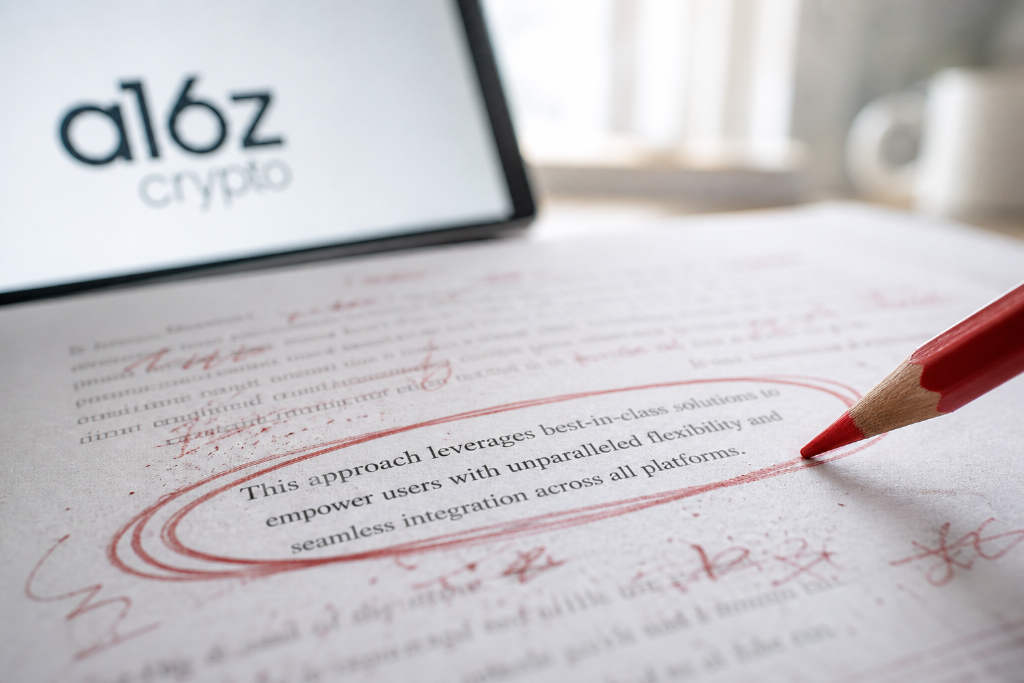
As generative AI spreads across publishing and online media, one question keeps surfacing: was this written by AI? a16z crypto says that may be the wrong place to start.
In a recent piece titled The habits of AI writing, and what to do about them, the firm argued that many problems now blamed on AI writing were already present before large language models entered mainstream use. In its telling, AI did not create these habits. It scaled them.
The “AI feel” may be inherited from human writing
a16z crypto said readers often identify text as AI-generated based on a familiar set of signals. Those include lines that sound deep but carry little information, corporate presentation-style phrasing, arguments broken into neat sets of three, polished structure without a distinct authorial voice, and repeated punctuation or sentence patterns.
The article grouped those habits into several buckets: pseudo-profound wording, overly generic language, excessive structure, a lack of personal voice, and repeated punctuation and syntax.
Its central point is that none of those flaws began with AI. Similar patterns have long appeared in corporate public relations copy, consulting reports, academic writing, and press releases. Large language models learn from large bodies of human text, then recombine the most common, safest, and most predictable forms of expression.
That means much of what readers dislike as “AI writing,” the article said, may simply reflect the average of mediocre human writing.
Use those signals as an editing framework, not just detection
From there, a16z crypto offered a different lens on AI detection. Rather than treating these traits as evidence that a piece was generated by a model, it suggested using them as a taxonomy of bad writing.
If a draft leans on vague adjectives, the fix is to add concrete people, numbers, events, and examples. If a paragraph appears complete but lacks a real point, the writer should be pressed on what they are actually trying to say. If every paragraph has the same shape, the rhythm should change. If a sentence could apply to any industry, it probably does not say much at all.
By that standard, the better question is not how much of a piece was generated by AI. The better question is whether the writing is clear, whether the information is trustworthy, and whether the piece gives readers real value.
Specificity and authenticity matter more than a no-AI rule
a16z crypto said the more useful target is to preserve specificity and authenticity in writing. That does not require removing AI from the process altogether.
According to the article, AI can help spot sections that are too empty, identify sentences that can be cut, check whether the structure is messy, and even reveal the stock phrases a writer keeps repeating.
What should not be fully outsourced, it argued, is the writer’s own judgment: why a topic is worth covering, which detail matters most, which market view the author disagrees with, and which information deserves a reader’s time.
Without that layer of judgment, the result may still be grammatically correct and neatly organized. But it can also end up as a piece with no obvious mistakes and nothing memorable in it.