
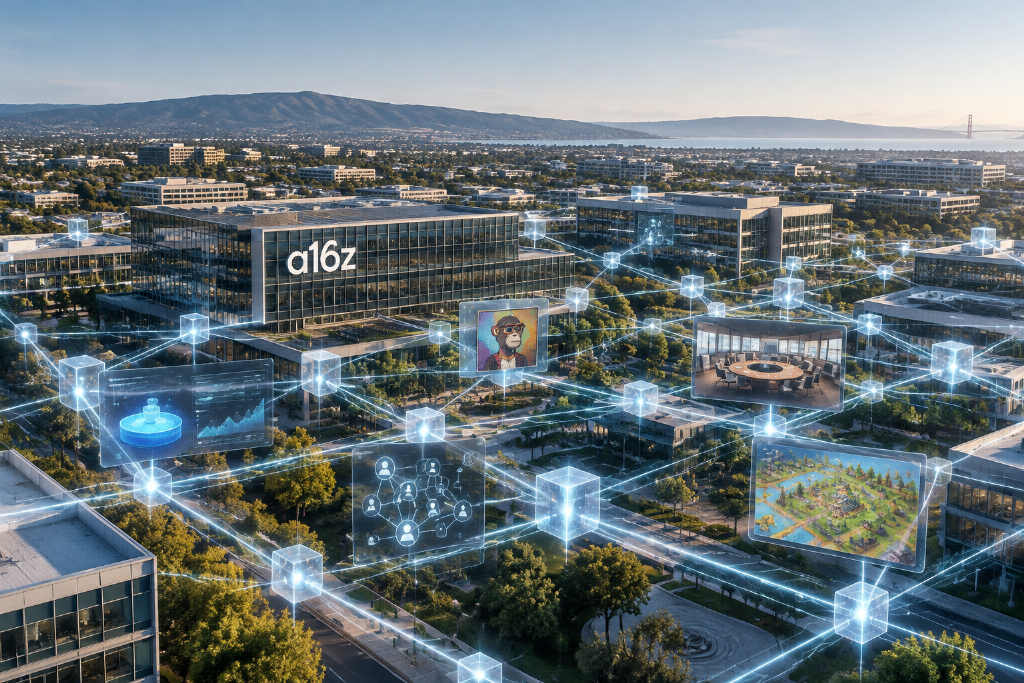
Eddy Lazzarin, chief technology officer at a16z Crypto, says artificial intelligence is driving the cost of making software toward zero and changing what actually counts as scarce in technology. The old model, built around open-source software and composable code, is giving way to something harder to copy: reusable networks.
His argument is blunt. Software is no longer the moat. Networks are.
From composable code to reusable networks
Lazzarin writes that open source reshaped the software industry by making code composable. Developers no longer had to build everything from scratch. They could assemble full applications from existing repositories, frameworks, and protocols.
Now AI is pushing the marginal cost of writing software even lower. As that happens, he argues, the center of composability is shifting. It is no longer only about reusable code. It is about reusable networks.
He frames this as a major point for crypto as well as for software builders and startups more broadly. Composability has long been one of the most compelling ideas in crypto. Early decentralized finance, or DeFi, protocols such as Uniswap showed why. New applications could build directly on top of existing liquidity instead of recreating liquidity pools from the ground up.
Even so, he says this never fully became the industry’s defining narrative because experimentation remained expensive. Building onchain applications required specialized expertise in smart contracts, security, audits, and blockchain infrastructure. Exploring that design space took substantial time and capital, which kept the builder base relatively narrow.
AI changes the economics of experimentation
According to Lazzarin, AI has overturned that constraint. People with ideas, including builders without technical backgrounds, can now generate working prototypes in hours, integrate existing protocols, and ship iterations that previously could have taken months.
As the cost of building software falls sharply, the number of experiments is likely to rise with it. He says that makes this the right moment to revisit some of crypto’s most ambitious concepts.
- NFTs: digital-native assets that can include collectibles and art, event tickets, real-world assets, community identity credentials, and intellectual property, all of which can be recognized and extended across applications.
- DAOs: a testing ground for internet-native coordination and new forms of onchain governance.
- Decentralized social networks: portable digital identity and social graphs controlled by users themselves.
- Onchain games: virtual worlds turned into open infrastructure and functioning internet economies.
He says these ideas reach their full force only when large numbers of real users and many AI agents keep building on top of those networks.
AI can copy apps, not the accumulated value inside networks
Lazzarin argues that AI can reproduce and generate almost any application. It can clone front ends in minutes, rewrite APIs, and produce new software products quickly. That makes software development cheap and changes the economics of scarcity.
Networks, in his view, do not become abundant in the same way. What remains scarce is not the best wallet client or the cleanest interface, but access to the deepest liquidity, the strongest historical reputation, the richest identity graph, and the settlement network trusted across the broader ecosystem.
He offers a wallet example. If building crypto wallet software becomes as easy as pressing a button, traders could generate personalized wallets on demand. If AI agents begin executing onchain transactions directly for users, the traditional wallet interface could fade from view. In that world, the front end matters less than the network underneath it.
The same logic applies to digital assets. AI may be able to generate an NFT with ease, but it cannot create the provenance behind that NFT, the community consensus around it, or the extensibility that connects it to outside networks.
He also says AI cannot fabricate a user’s onchain identity, credit reputation, or social graph. It cannot instantly create the liquidity already accumulated inside a protocol, and it cannot reproduce the history, coordination, and trust that a network has built over years.
One line in the piece captures the point clearly: you can never vibe-code a USDC into existence.
Blockchains as the internet’s shared state layer
Lazzarin says this may be the role blockchains were always meant to play: serving as the internet’s canonical layer of shared state.
As applications at the top of the stack become more like commodities, value capture across the technology ecosystem shifts toward the networks those applications rely on and compose with. In a future filled with AI agents, he argues, a unified global layer of shared state becomes even more necessary.
Front ends can be copied quickly, and software code can be rebuilt repeatedly by AI. The core state underneath remains scarce: asset ownership, identity, liquidity depth, reputation systems, and network coordination.
For developers and founders, Lazzarin presents these reusable networks with strong network effects as one of the biggest opportunities of the AI era.
The article was written by Eddy Lazzarin, chief technology officer at a16z Crypto, translated into Chinese by TechFlow, and published by MarsBit.



