
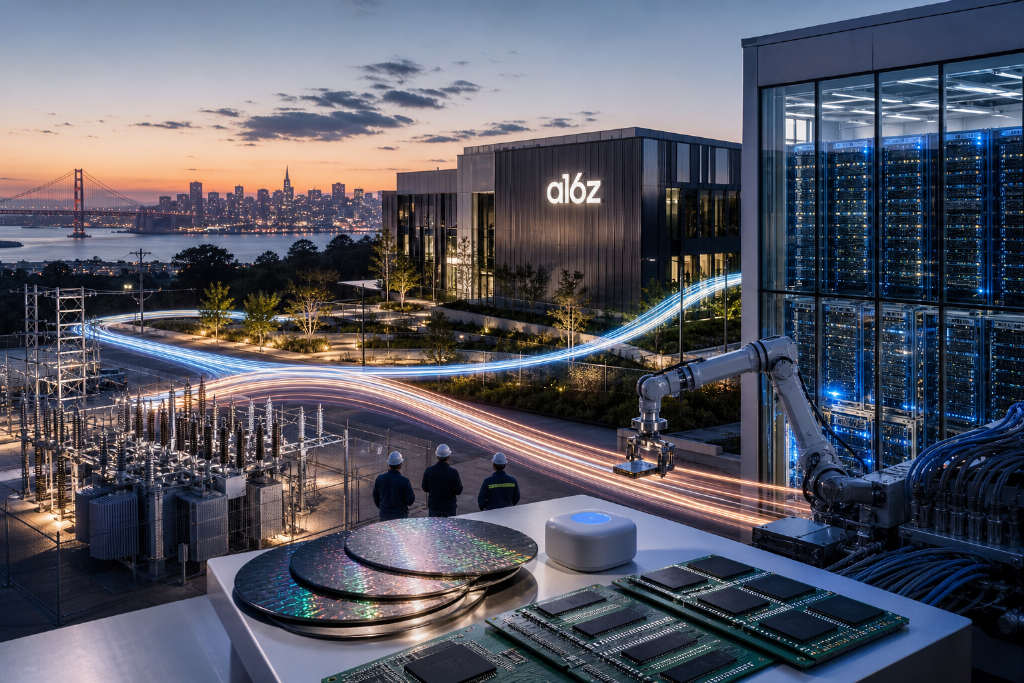
Andreessen Horowitz, or a16z, said it has raised $1.1 billion for a new Machine Age Fund, making AI hardware and physical infrastructure a core investment focus.
The move shifts capital deeper into the AI stack. Instead of concentrating on large language models, AI applications and software layers, the fund will target chips, memory, networking, storage, data centers, robotics, home AI devices and the power systems that support the broader AI buildout.
AI workloads are getting heavier
a16z said the issue is no longer simply a need for more GPUs. In its view, the entire AI supply chain is beginning to run into physical, electrical and capacity limits.
The firm said the past year marked a clear shift in what AI can do and how useful it has become. AI is moving from early chatbot use cases into reasoning, coding and a wider range of knowledge work. As tasks grow more complex, token usage and compute requirements per task are increasing by orders of magnitude.
That idea sits at the center of what a16z described as "Machine Intelligence is going vertical." The point, it said, is that AI is not only spreading to more users horizontally. It is also moving into more complex and intensive work, raising demand for compute, memory and network resources for each task. Under that view, the limiting factor for the next phase of AI may shift from the model itself to whether the underlying infrastructure can keep pace.
From H100 to Rubin, rack density rises about 28x
a16z used the evolution of NVIDIA AI systems to illustrate the infrastructure strain. From the H100 generation to Rubin systems, compute density within a single rack has increased by about 28x, according to the firm.
Once density rises that quickly, networking becomes the first bottleneck. The amount of data moving within the rack climbs at the same time, and traditional copper cabling is approaching physical limits. That puts more weight on high-speed interconnects, optical communications and more advanced network architectures.
The change in power demand is even more visible. A single rack in a traditional data center typically consumes about 5 to 10 kW. Racks supporting AI systems are now in the 100 to 250 kW range, and a16z said that figure could climb to 1 MW per rack within the next three years.
That pushes the problem far beyond buying additional GPUs. Power delivery, distribution, heat dissipation, cooling, materials, facility design and even real estate all need to be reworked for the next generation of AI infrastructure.
AI data centers are moving toward gigawatt-scale campuses
a16z said data centers were often planned in units of tens of megawatts in the past. Now they are moving into the hundreds of megawatts, and some AI infrastructure projects are heading toward gigawatt-scale campuses.
At that level of electricity demand, relying only on the public grid becomes harder. As a result, the energy model for new AI data centers is evolving from simple grid connections to combinations of grid access, behind-the-meter arrangements, dedicated generation facilities and other captive power structures. a16z said that is why it now treats power as part of the AI technology stack itself.
The next wave of AI infrastructure, the firm said, will need to solve several issues at once: faster and more energy-efficient compute systems; cheaper, higher-bandwidth memory; faster and scalable interconnects between nodes and large systems; and low-power Edge AI devices that bring AI into real-world environments. Cooling, materials, power engineering and land tied to those systems also represent investable areas in its view.
Hardware supply chains are not built for this growth rate
a16z said the biggest problem is that traditional hardware supply chains are not used to demand moving at this speed. On the supply side, the hardware industry has typically operated with annual growth of about 20% to 30%. AI demand, it said, may require supply chains to grow at triple-digit rates to keep up.
Hardware startups now make up more than 20% of a16z deal flow
The shift is already showing up in venture activity. a16z said hardware startups have risen from a relative minority to more than 20% of the investment opportunities it receives.
Although the firm is best known for software investing, it said hardware has always been part of its history. More recently, a16z has invested in hardware companies including Unconventional AI, Nexthop, Volta, Atoms and Mind Robotics.
Earlier examples include leading drone company Skydio’s Series A in 2016, investing in SpaceX in the same period, backing defense technology company Anduril in 2019, and becoming one of the early venture investors in Waymo’s 2020 fundraising round.
What makes the Machine Age Fund different, a16z said, is that hardware is no longer being treated as a selective side bet. The firm has elevated it to one of its main investment strategies.