

Tokenized stocks are moving further into traditional finance. In a recent market overview, a16z said these blockchain-based instruments, often described more broadly as tokenized securities, represent traditional assets such as shares in Apple and Tesla, as well as ETFs and index products.
Unlike conventional equities, tokenized stocks can be held in self-custodied digital wallets, transferred without permission, traded 24/7, and posted directly as collateral in DeFi. Over the past two months, Coinbase, the Depository Trust & Clearing Corporation (DTCC), the New York Stock Exchange, and Robinhood have all made moves in the sector, covering on-chain trade processing, new joint ventures, and new blockchain networks.
Market capitalization reached about $1.7 billion by the end of June
As of late June, the global tokenized stock market was worth about $1.7 billion, up from $329 million a year earlier. That is a fourfold increase and puts the segment among the fastest-growing categories in real-world assets, or RWA.
The report also said market capitalization for tokenized stocks increased 45 times over the past year. The key question is what drove that jump: a wave of new token issuance, or price gains in the underlying equities.
With stablecoins, supply is easier to read because one token is pegged to one dollar. Tokenized stocks are different. Their prices move with the stocks they track, so aggregate market capitalization alone does not cleanly separate newly minted tokens from gains in existing tokens.
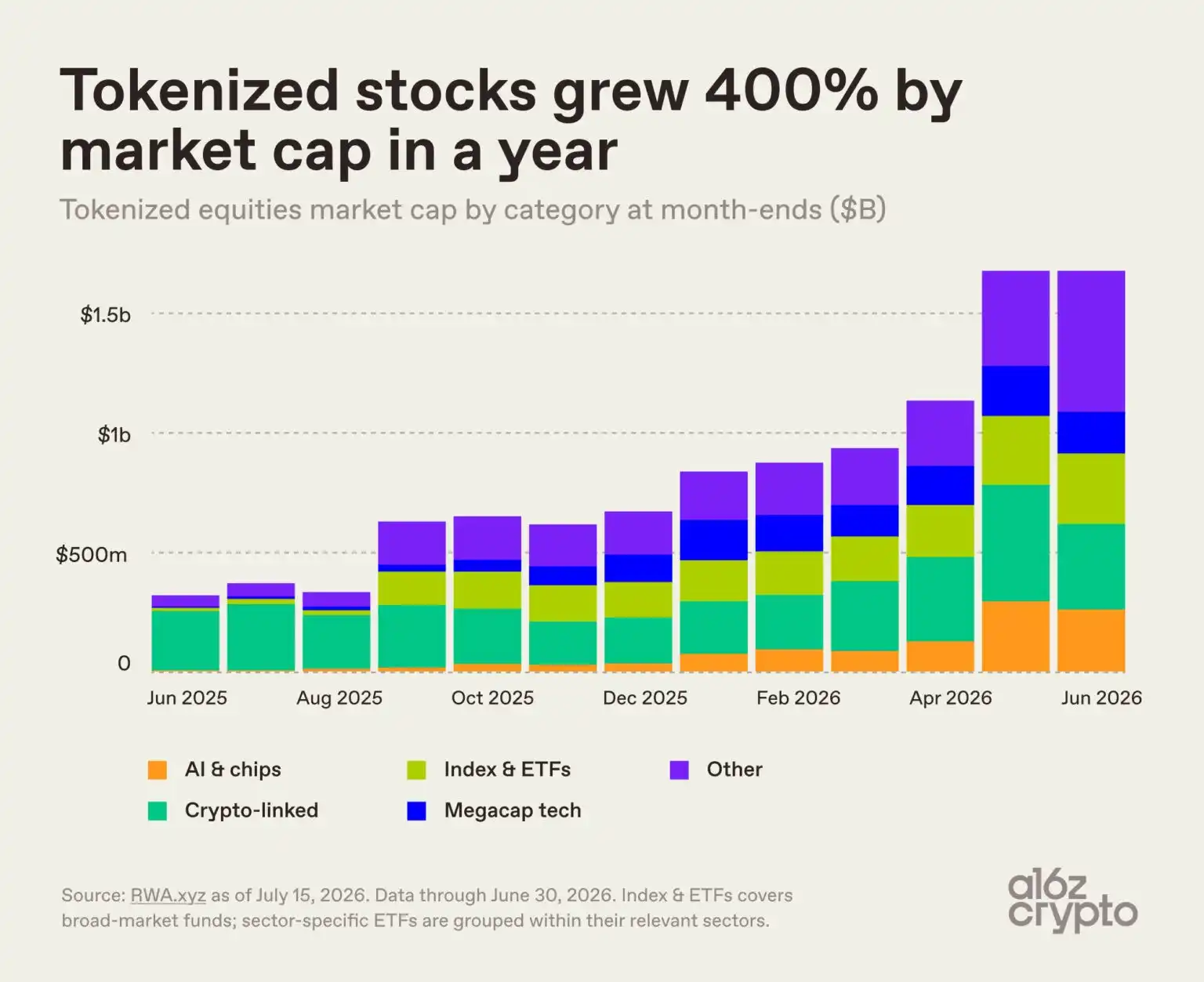
a16z said the available data is enough to show that new issuance has been the main engine of growth. More than half of the assets in the market today were not circulating on-chain a year ago. Most of the remaining legacy assets were launched only around the middle of this year, after the main annual moves in the underlying U.S. equities had largely already played out.
The market mix changed sharply over the past year
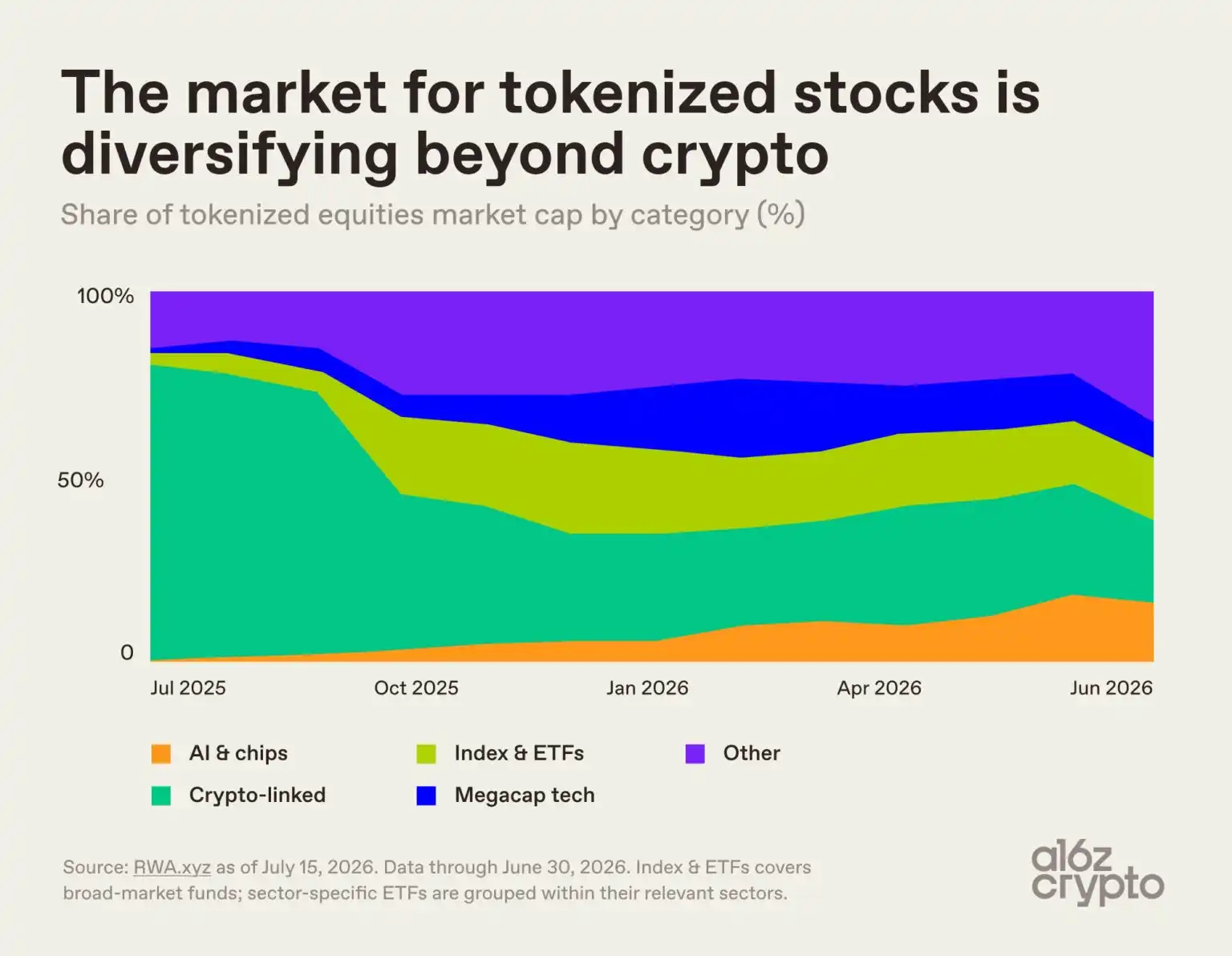
The tokenized stock market is still early, but its internal composition has already changed dramatically.
Crypto-related products once dominated the space. Their share of market capitalization fell from 79% a year ago to 21% as of June. The lead has shifted to the “other” category, a long-tail bucket that includes hundreds of smaller products. That category now accounts for 35% of the market, up from 15% a year earlier.
Other segments also expanded. As of June, products tied to mega-cap technology companies valued at $100 billion or more made up 10.6% of the market, compared with 0.6% a year earlier. Over the same period, ETFs and indexes rose to 17.3% from 4.5%.
The fastest-growing segment was artificial intelligence and semiconductors. In June 2025, the category was worth less than $1 million and represented just 0.3% of the total market. One year later, its share had climbed to 15.5%.
On-chain transfers hit $9.22 billion in June
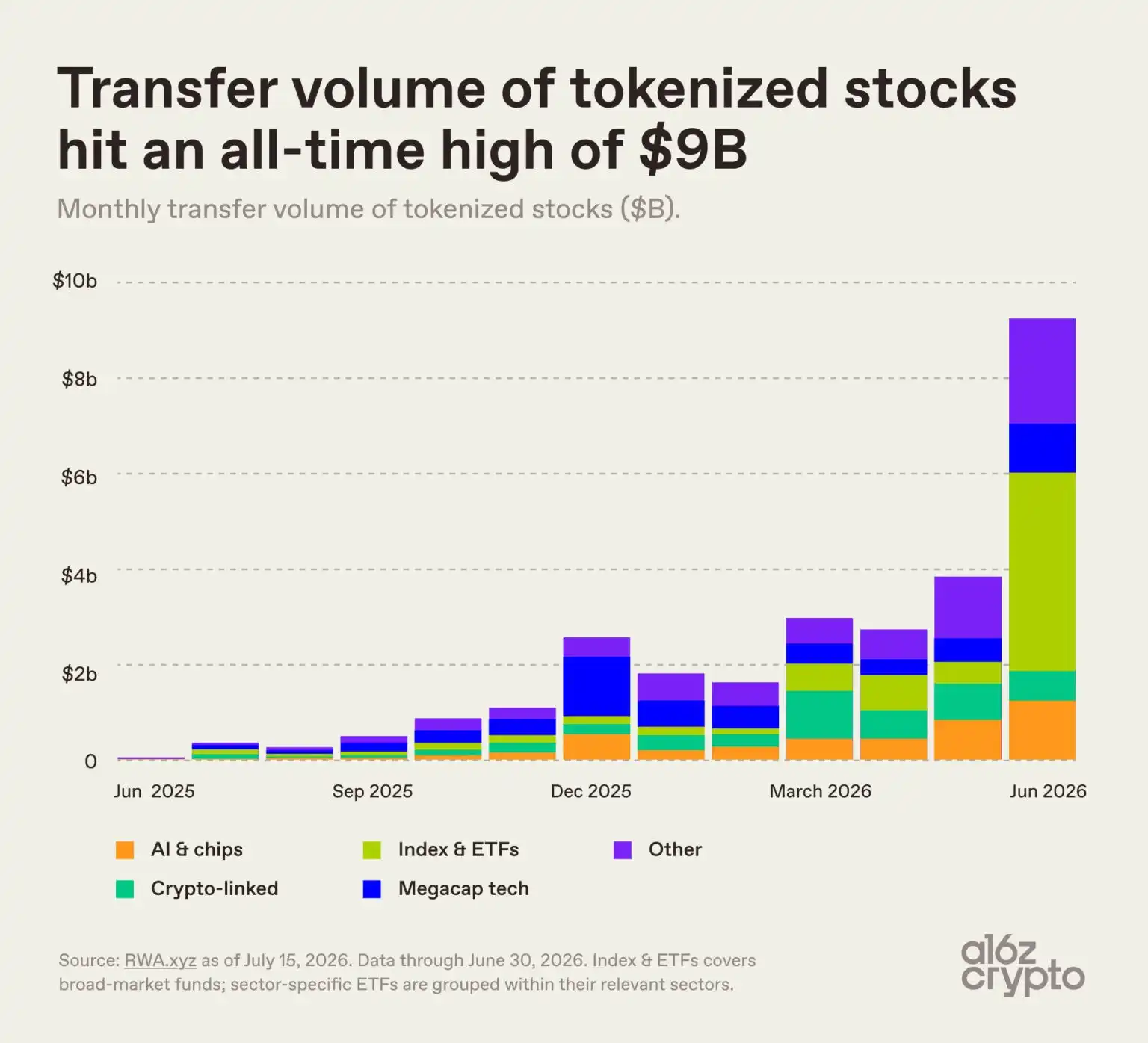
Transfer activity on-chain has risen with the market. In June, monthly on-chain transfer volume for tokenized stocks reached $9.22 billion, up from just $53 million in the same month last year, an increase of more than 170 times.
This metric covers all on-chain asset movements, including secondary-market trades, wallet-to-wallet transfers, and deposits into DeFi protocols for collateral use.
Institutional infrastructure saw a cluster of launches over the past month
Infrastructure buildout has also accelerated. Over the past month alone, several industry players pushed through new milestones.
DTCC completed its first real-time trades in tokenized U.S. Treasuries and stocks on Digital Asset’s Canton Network. A broader tokenization service is scheduled to launch in October, giving Wall Street direct access to roughly $114 trillion in assets held in DTC custody.
Earlier this month, Robinhood launched its own chain on mainnet, aiming to bring traditional markets, crypto, and real-world assets onto one open network.
On June 22, the parent company of the New York Stock Exchange said it had formed a joint venture with OKX. Once regulators approve the plan, the venture will offer users tokenized NYSE-listed stocks.
On June 16, Coinbase said it would offer non-U.S. users 1:1-backed tokenized U.S. stocks with dividends, full shareholder rights, and round-the-clock trading. Binance launched a similar product a few days earlier.
Compared with the traditional equity market, where monthly trading volume runs into the tens of trillions of dollars, tokenized stocks are still small. Even so, the direction is clear: more issuers and trading platforms are bringing these products to market, and the sector is still expanding at a high rate.