
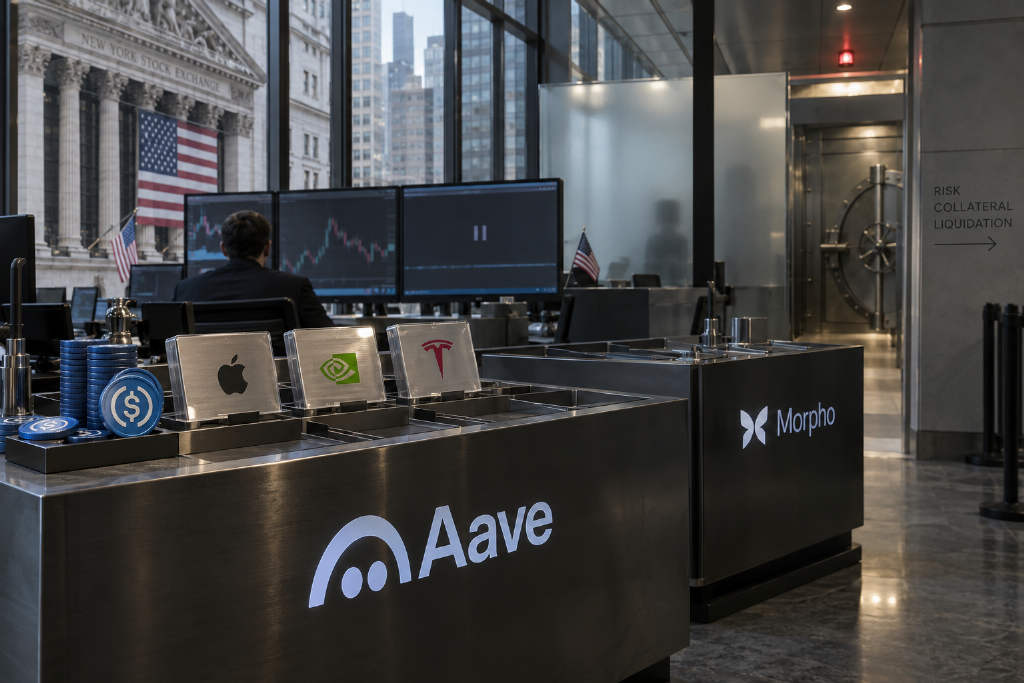
Aave launched Equities Hub on Base on Sept. 25, giving users a way to deposit tokenized shares of seven U.S. stocks, including Apple, Nvidia and Tesla, as collateral to borrow USDC.
Morpho, one of Aave’s main rivals, introduced a similar market on Base a week earlier. The two lending protocols have moved into tokenized equities almost at the same time, but actual borrowing activity is still limited. Stocks are moving onchain quickly. Borrowers have not kept pace.
Why Aave is looking for new collateral
Aave’s share of the lending market has fallen this year from about 59% to 41%, while Morpho rose from 9% to 19% and Spark climbed from 5% to 10%. In the RWA lending segment, Aave’s share dropped from 62% to 33%, and daily revenue fell from about $261,000 at the start of the year to about $158,000.
That is the business backdrop for Aave’s push to widen the range of collateral it accepts. Founder Stani Kulechov’s logic is straightforward: more collateral types create more lending opportunities.
Aave also said on Sept. 16 that it plans to launch an institutional RWA Hub on Avalanche, where eligible institutions will be able to post RWA tokens as collateral and borrow Tether’s USA₮.
Supply is growing faster than demand
The supply side of tokenized stocks has expanded quickly. At the start of September, tokenized equities had a market capitalization of about $3.1 billion, up from less than $1 billion at the beginning of the year.
Borrowing demand has not followed at the same speed. In Aave’s Equities Hub, deposits topped $8.15 million shortly after launch, while borrowing stood at about $435,000, putting overall utilization at just 5.34%. In Morpho’s market, users posted about $104,000 in collateral and borrowed about $55,000 in the early stage. In its largest market, 98.9% of liquidity came from two DeFi vaults managed by Steakhouse.
Those figures show how fast assets can be brought onchain, but they do not yet show that tokenized stocks can generate sustained lending demand. The markets are new, and the current numbers only show a small starting point.
A 48-hour pricing gap on weekends
Aave is using tokenized economic exposure to stocks, but the trading-hour limits of traditional equity markets come with it.
Chainlink provides price feeds for these tokens from 8 p.m. Eastern Time on Sunday through 8 p.m. on Friday. On weekends and U.S. market holidays, the feed holds the last published price, which means prices do not update for 48 hours each week. According to DeFi risk service provider LlamaRisk, Aave’s market remains open for deposits, borrowing and liquidations during the weekend.
Two issues need to be separated. First, there is a gap in price information. If Nvidia were hit by a major event on Saturday, the stock could gap when markets reopen on Monday, while the protocol would still be looking at Friday’s collateral value. LlamaRisk said news during market closures may show up as a one-time price move when the feed resumes.
Second, there is the question of how Aave handles that gap. When setting the initial parameters, LlamaRisk said it incorporated weekend and holiday price gaps, liquidation delays and related factors into its model. Based on that work, the seven stocks were assigned loan-to-value ratios ranging from 65% to 79%. LlamaRisk also said USDC suppliers enter this market voluntarily, so the risk does not spread to Aave’s other markets.
Some media analysis has argued that if a price gap is combined with weak token liquidity, bad debt could be left with those suppliers. Whether the current parameters can absorb an extreme weekend move has not been tested in live market conditions.
Liquidation depends on market depth, not just oracle prices
The problem does not end when liquidation starts. Liquidation is not a direct conversion of collateral into cash at the oracle price. The protocol still has to sell the tokenized stocks in the market.
If trading depth on Base is thin, a large forced sale could push prices lower, leaving the actual execution price below the level used by the protocol to calculate collateral value. That would increase bad-debt risk.
This is another constraint facing the sector right now. Assets can move onchain, but onchain market depth may not keep up with the scale of collateral posted against them. Some analysis has pointed out that trading in tokenized stocks on Base is growing quickly, while market depth remains limited.
Nasdaq and NYSE Arca, part of the New York Stock Exchange, both plan to extend trading hours to nearly 23/5 starting Dec. 6, which would narrow the time mismatch between traditional markets and onchain markets. Nasdaq’s plan was approved by the U.S. Securities and Exchange Commission in April this year. Chainlink also expects to provide 24/7 feeds for these tokens later, but that service is not live yet.
What Mirror showed about broken links in the system
In December 2020, Terraform Labs, the company behind Terra, launched the synthetic asset protocol Mirror Protocol. Users could mint mAssets onchain that tracked the prices of U.S. stocks such as Apple and Tesla, using overcollateralized UST. Those tokens were not backed by real shares. They only mirrored price movements.
After Terra collapsed in May 2022, Mirror lost the foundation of its collateral system. In August, Band Protocol stopped providing price data for Terra Classic, forcing Mirror’s CDP operations to halt. The protocol eventually stalled.
Today’s structure is different. Tokenized stocks issued by crypto exchange Coinbase are backed by real shares held in segregated custody, giving holders economic exposure to actual stocks rather than synthetic price tracking alone.
The point of revisiting Mirror is not to say Aave will repeat that outcome. It is that if any one link breaks — the asset, the price, the collateral framework or the liquidation path — putting U.S. equities onchain does not solve the infrastructure problem by itself.
Aave’s own lesson from collateral risk
On April 18 this year, Kelp DAO’s cross-chain bridge was attacked and about 116,500 rsETH were stolen, worth about $292 million at the time. The incident was not caused by Aave, but the attacker deposited about 89,600 depegged rsETH into Aave and borrowed about $190 million in assets. Estimated bad debt ranged from $123.7 million to $230.1 million.
Afterward, utilization in Aave’s WETH market stayed above 99% for 12.7 consecutive days.
The risk in tokenized stocks comes from stale pricing, while the rsETH case involved a problem with the asset itself. The mechanisms are different. The common point is that the value recognized by the protocol diverged from the asset’s real market value after funds had already been borrowed. Both cases lead back to the same question: can a lending protocol price collateral correctly and liquidate it when needed?
The full loop still needs to be proven
Aave needs more high-quality collateral, which is why it is bringing traditional financial assets onchain. But once stocks become collateral, the trading hours, price discovery process and liquidity limits of U.S. equities also enter the onchain lending system.
The question is no longer whether stocks can be tokenized and moved onchain. The harder test is whether borrowers want to use them, whether liquidity providers are willing to fund the market, whether prices can reflect market changes in time, and whether collateral can actually be sold once liquidation is triggered.
That is the missing part of the loop for tokenized stocks as collateral. Moving assets from traditional markets onto blockchains is not the difficult part. Connecting the asset, the price, the loan, and the liquidation into one working chain is.
