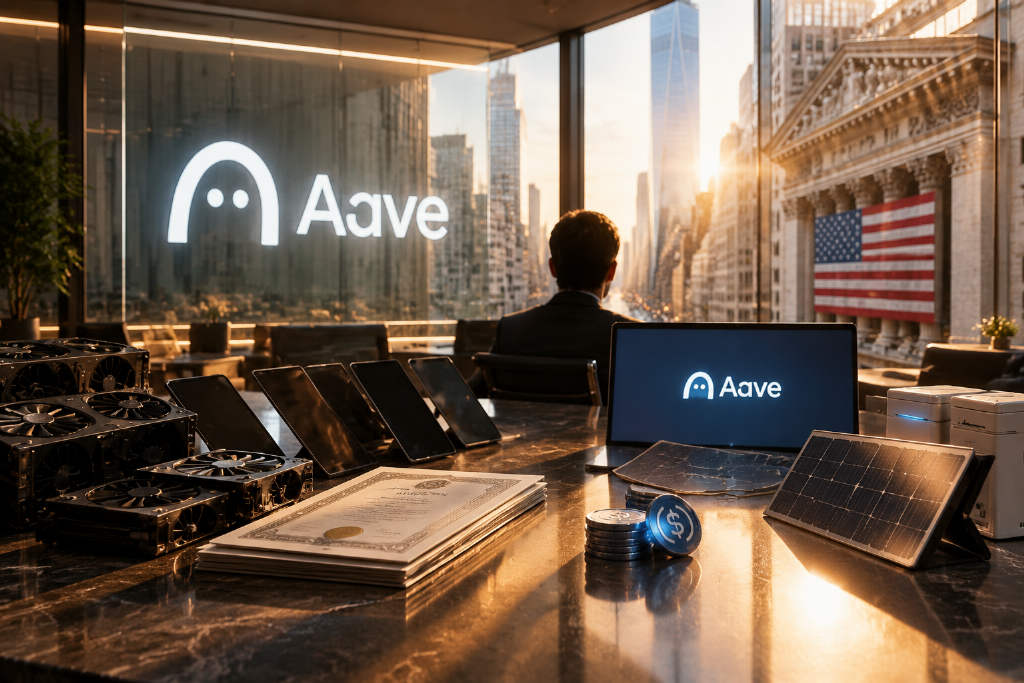
Discussion around Aave’s next phase centers on extending collateralized lending beyond crypto assets and into securities and other productive real-world assets. The discussion says Aave V4 has launched tokenized stock lending on Base, initially supporting seven U.S. stocks, allowing users to borrow USDC against stock holdings instead of selling them. Aave founder Stani is said to frame the addressable market in three stages: Crypto, Securities, and Abundance Assets. Under that roadmap, later asset categories could include solar, batteries, GPUs, robots, and even space infrastructure, with financing aimed at productive assets tied to what was described as an “abundance society.” On token design, AAVE currently relies mainly on buybacks, though the related buyback activity has reportedly been halted for a long period. One view cited in the discussion says Aave tokenomics 3.0 may consider adding a burn mechanism. Whether those plans are ultimately implemented, and whether market participants choose to position in AAVE on that basis, remains an open question.
Aave’s current expansion path is being discussed as a move to extend collateralized lending from crypto assets into securities and a broader set of productive real-world assets.
According to the discussion, Aave V4 has launched tokenized stock lending on Base, with an initial batch of seven U.S. stocks. Users can borrow USDC against those stock holdings rather than selling their positions outright.
Three-stage market framework
Aave founder Stani is said to divide the potential market into three stages: Crypto, Securities, and Abundance Assets.
Under that framework, later plans would cover assets such as solar, batteries, GPUs, robots, and even space infrastructure, providing financing for productive assets described as helping build an “abundance society.”
One view around this direction holds that Aave’s long-term narrative has already been mapped out to 2050, with collateral expanding from crypto assets to securities and then into physical assets.
Tokenomics 3.0 and burn discussion
On token mechanics, AAVE currently mainly uses a buyback model, but the related buybacks have been halted for a long period, according to the discussion.
One view says Aave tokenomics 3.0 may consider adding a burn mechanism. Whether these plans can be executed, and whether market participants will allocate to AAVE on that basis, remains up to individual choice.
This article was originally published by Bit.Fan. For more cryptocurrency news and market insights, visit www.bit.fan. Disclaimer:
The market information, project data, and third-party content displayed on this platform are for industry information sharing only and do not constitute any form of investment advice or return commitment.
Cryptocurrency trading carries high risks. Users should fully assess their risk tolerance and make independent decisions. All profits, losses, and legal responsibilities are borne by the users themselves.