


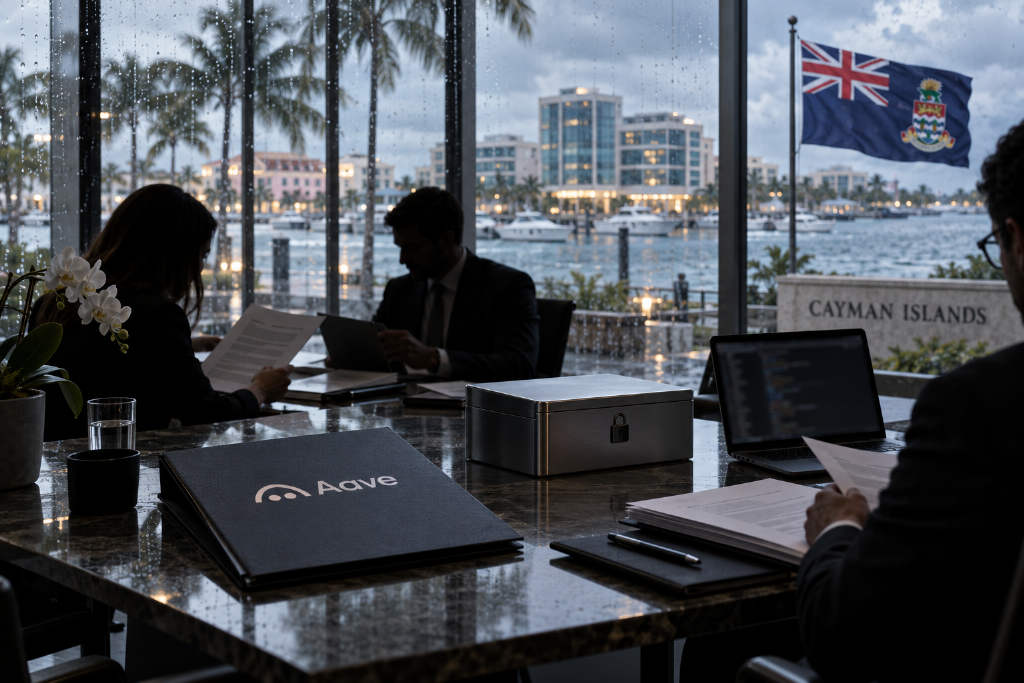
A governance proposal written by Aave Labs would establish an Aave Foundation in the Cayman Islands as a foundation company without members, with a narrowly defined purpose: holding, protecting, and licensing Aave trademarks and related intellectual property for the benefit of the Aave protocol.
The ARFC only covers the first phase. That phase includes incorporating the entity and appointing the initial independent director and independent supervisor. Later phases would be brought back to governance separately and would address the transfer of trademarks, domain names, protocol codebase IP, and the operating scope of the entity.
The proposal says the structure follows through on a commitment made under the "Aave Must Win" framework by bringing the community protection vehicle for brand and IP into governance and reinforcing AAVE as the only core asset in the Aave ecosystem. In phase one, it asks only for reasonable incorporation, legal, and appointment costs covering the director, supervisor, and secretary.
Aave Labs argues that Aave governance has funded multiple service providers over several years to produce code, risk tools, models, and documentation, but ownership treatment has not been consistent across engagements. In some cases, ownership remained with the development provider involved at the time. The text also says Aave trademarks and key domains are still outside DAO control. Because a DAO cannot register trademarks, bring infringement claims, or hold title to domain names, the proposal argues that the DAO cannot directly protect assets that were created with community funds.
Proposed legal structure
Under the draft, the Aave Foundation would be incorporated under the Cayman Islands Foundation Companies Act as a foundation company without members. Its memorandum would limit its purpose to holding, protecting, and licensing intellectual property solely for the benefit of the Aave protocol.
The entity would be managed by an independent director and overseen by an independent supervisor with no affiliation to that director. After the initial appointments, directors could be appointed or removed only through an AIP.
The proposal adds explicit restrictions. Aave Labs, any service provider hired by the DAO, and any of their affiliates would have no right to appoint directors or supervisors and could not be appointed to those roles themselves.
The text says a Cayman foundation company can hold title, sign contracts, and appear in court while maintaining a no-member structure, so no member can exercise rights over it. It also notes that DeFi foundations have often come under scrutiny when they build up discretionary power over time, especially when they rely on recurring annual treasury grants and are managed by the same team that originally proposed them. The design here, according to the proposal, removes both of those conditions.
What the foundation would hold
The foundation would receive legal ownership of Aave trademarks, protocol codebase IP assigned to it, major domain names, and IP assigned to it through service provider agreements. As owner, it would handle filing, maintenance, defense, and enforcement of those assets.
Trademark licensing would be one-way. The foundation would license the Aave name back for product development so Aave-branded products can continue to be delivered, and that license would be royalty-free.
The DAO would keep using existing governance processes to select service providers, define their scopes, and approve compensation. Code, tools, models, and documentation created through those engagements would be assigned to the foundation as a standard term. The proposal says that would give the DAO’s accumulated technical output a single durable owner, while the foundation would have no say over what gets built or who builds it.
The DAO would cover reasonable incorporation costs, qualifying secretary onboarding costs, legal fees, and costs tied to trademark and IP assignment mechanisms. No recurring budget is requested. Any future funding need would require a separate governance proposal.
Powers retained by the DAO
The proposal states that asset listings, parameter changes, budgets, service provider appointments, and framework amendments would remain DAO decisions made through the current governance system.
Through an AIP, the DAO would be able to appoint or remove directors, consent to any amendment of the foundation constitution, any disposal of core IP, and any merger or reorganization, and instruct the foundation to liquidate and transfer residual assets to a successor vehicle.
In its expectations section, the draft repeats that governance would keep full decision-making authority over the protocol exactly as it does today. The foundation would have no voting rights, no veto rights, and no advisory role in protocol decisions.
Reporting and phased rollout
The foundation would publish quarterly reports to the governance forum covering the assets it holds, changes in ownership, operating expenses, and any legal action taken to protect trademarks or the codebase. The first report would be published within 90 days after the end of its first full calendar quarter of operation.
The proposal says that incorporating the entity, transferring registered trademarks across jurisdictions, and negotiating assignment terms under existing agreements each involve distinct legal work and separate costs. Breaking the process into phases is meant to keep each request narrowly defined, limit the scope to work the community can evaluate, and allow review before the next phase begins.
The DAO, the text says, can stop the process after any phase. Even in that case, the foundation would remain an operational entity with a defined governance framework.
If the ARFC reaches community consensus, the next step would be a Snapshot vote, followed by an AIP to authorize reasonable incorporation, legal, and director appointment costs. After that, the entity would be registered in the Cayman Islands and the independent director and supervisor would be appointed.
Once the entity exists and can hold title, transfers of the Aave trademarks, domains, and codebase IP would begin. IP created under future service provider engagements would be folded into standard contract terms as those relationships are renewed or replaced through normal governance processes.
Questions addressed in the proposal
Would this give Aave Labs control over the protocol?
The answer in the proposal is no. The protocol would continue to be governed by the DAO through tokenholder governance. Aave Labs would hold no board seat, no supervisor role, and no appointment right in the foundation. Because the foundation would have no members, the text says there would be no shareholder standing above the Aave ecosystem. The same restriction would apply to every DAO-hired service provider.
What changes in governance?
According to the draft, nothing changes. Asset listings, parameters, budgets, service provider appointments, and framework amendments would still be DAO decisions made through the current process. The foundation would hold title to assets but would have no discretion over protocol decisions.
Why the Cayman Islands?
The proposal says a foundation company formed under Cayman law can exist without members or shareholders while still holding legal title, signing contracts, and appearing in court. That, it argues, allows the entity to own and defend trademarks without creating an owner above the DAO.
What if the DAO wants to dissolve the foundation?
The text says the DAO could replace directors at any time through an AIP or instruct the foundation to liquidate and determine the destination of residual assets, including transfer to a successor vehicle, subject in each case to fiduciary duties, statutory duties, and applicable law.
Which IP would be transferred, and when?
Once the entity is formed, the Aave trademarks, primary domain names, and protocol codebase IP would be transferred. IP produced in future service provider relationships would be assigned under the standard terms of those agreements.
Attribution and statement in the proposal
The text says the proposal was written by Aave Labs. It also states that Aave Labs would hold no governance role or economic role in the foundation and would receive no setup grant.
The document also says copyright and related rights are waived under Creative Commons Zero, or CC0.
Separate argument calls for a Switzerland comparison
The latter portion of the text includes a separate view supporting the creation of an independent legal vehicle to hold and protect Aave trademarks, domains, and protocol IP, while arguing that governance should compare the Cayman structure with a Swiss foundation before committing to incorporation in Cayman.
That view says the central question is not whether Cayman works. It says Cayman does work. The question, instead, is which jurisdiction is better suited for a long-term ownerless entity holding Aave’s core assets.
1. Stronger statutory purpose protection
According to that view, a Swiss foundation also has no shareholders or members, and its assets are legally dedicated to the purpose set out in the foundation deed under independent statutory supervision. For Aave, the purpose could be narrowly defined as holding, protecting, and managing Aave trademarks, domains, and protocol IP for the benefit of the Aave ecosystem. The argument says that supervisory oversight adds a legal safeguard to keep those assets tied to that purpose, including in a scenario where someone tries to capture governance by buying tokens on the market.
It contrasts that structure with one that relies mainly on privately drafted constitutional restrictions and a designated corporate services provider.
2. AAVE governance can be embedded directly
The separate view says this is possible in both jurisdictions. It argues that Cayman law is flexible enough to give tokenholders direct constitutional governance rights, so Cayman should not be criticized on the basis that each DAO vote would be merely advisory.
It also says a Swiss foundation can embed AAVE governance in its constitutional architecture. Subject to mandatory Swiss law, tokenholders could be given express rights over specific matters, including the appointment and removal of the foundation board, licensing or transfer of core IP, oversight of the foundation board, and dissolution and the destination of residual assets.
Under that analysis, Switzerland’s edge would not come from tokenholder voting on its own, but from combining DAO governance with statutory purpose lock and independent supervision.
3. IP commercialization and economic substance
The separate argument says this point matters because the foundation is being created to hold IP. A royalty-free license may mean Cayman’s economic substance rules are not a material issue at the start, but the entity is intended to exist over the long term.
If Aave later commercializes its IP through license fees, royalties, or other IP income, Cayman’s economic substance regime could become directly relevant. The text says entities conducting IP business in Cayman may need real local substance there, including relevant activities, expenditure, presence, and personnel.
It contrasts that with Switzerland, which it says does not impose a Cayman-style economic substance regime on IP commercialization. On that basis, the selected jurisdiction should work not just on day one of incorporation but also if Aave later decides to monetize its IP.
4. Treaty network for international tax matters
The same section also raises international tax considerations. It says Switzerland has a network of more than 100 double taxation treaties, while Cayman has a much more limited network of comprehensive tax treaties.
If the foundation were to collect royalties or license fees from counterparties in different jurisdictions, the text says, treaty access could become important. Depending on the applicable treaty and anti-abuse requirements, that could reduce withholding tax and provide mechanisms to avoid double taxation. For a long-term IP holding vehicle, the author of that section presents this as a structural factor worth weighing.
Suggested next step
The recommendation in that section is to obtain a short comparative legal opinion on Cayman versus Switzerland before incorporation, focused on four areas: integration of AAVE governance, legal protection of the foundation purpose and core IP, treatment of future IP commercialization and economic substance requirements, and treaty access for cross-border IP income.
That section closes by saying Cayman may still turn out to be the preferred jurisdiction, but because the foundation is meant to hold some of Aave’s most important assets for the long term, the jurisdictional comparison should be completed before the IP transfer rather than after it.