


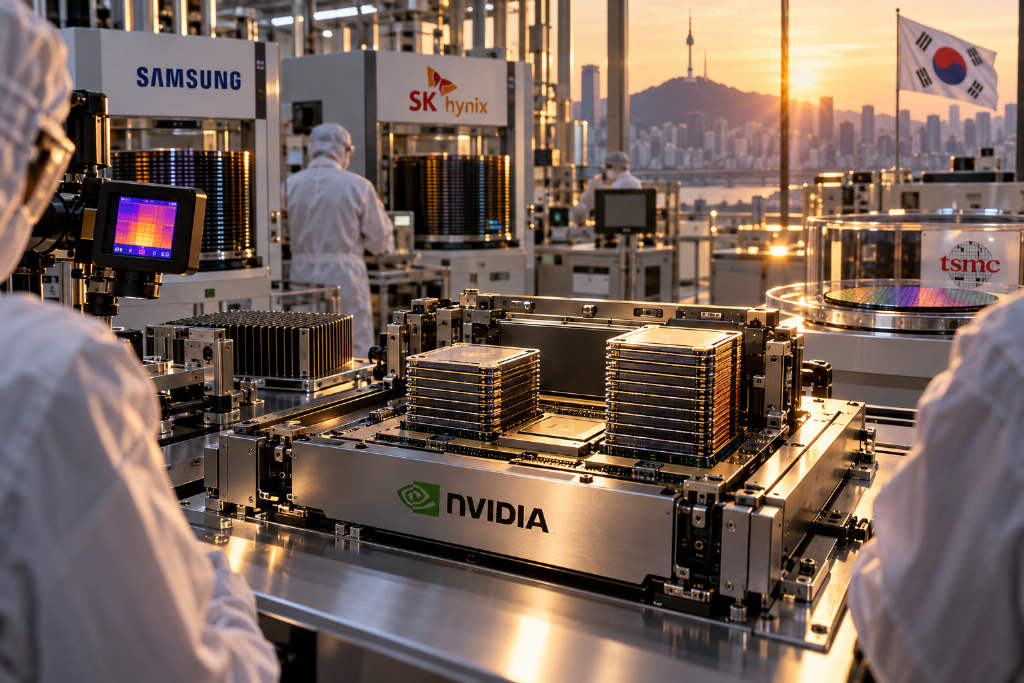
Nvidia is reviewing the memory strategy for Rubin Ultra, its next-generation AI accelerator slated for 2027, according to a report cited by Korean media. The company is said to be considering a change from the originally planned 12-layer HBM4/HBM4E configuration to a mixed setup using both 8-layer and 12-layer stacks, with the goal of keeping AI server production stable and supply flowing smoothly.
Thermals and yield are at the center of the review
On paper, 12-Hi HBM provides higher memory capacity and greater total throughput. The trade-off is straightforward: more heat and lower manufacturing yield.
The report says that in high-intensity AI server workloads, a 12-layer design may end up delivering less real computing performance than an 8-layer product if thermal pressure forces the system into clock-throttling protection. With global demand for AI chips still surging, lower yields on 12-layer HBM could also become a major constraint on Nvidia shipments.
That appears to be why Nvidia is evaluating a dual-track option for HBM4, using both 8-layer and 12-layer products. The idea described in the report is to give up some headroom on a single memory specification in exchange for better overall stability across Rubin Ultra server deployments and the broader supply chain.
Samsung and SK hynix are aiming for Q2 2027 shipments of 8-Hi HBM4
The current HBM market is still dominated by three companies: SK hynix, Samsung Electronics, and Micron Technology. The article says SK hynix remains ahead in thermal management and yield control, and continues to lead in both HBM market share and mass-production progress. Samsung is pursuing orders with an integrated offering that combines foundry services and advanced packaging. Micron, the report adds, is also developing both 8-layer and 12-layer HBM4 products and is actively competing for business.
According to the Korean media report cited in the article, Samsung Electronics and SK hynix have set around the second quarter of 2027 as the target timing for mass production and shipments of Nvidia’s 8-Hi HBM4.
HBM4 base die shift raises TSMC’s importance
The article highlights another structural change in the HBM4 generation: the base die moves to a logic process. That gives Taiwan Semiconductor Manufacturing Co. a more critical role in the memory supply chain. SK hynix has already announced an alliance with TSMC, with TSMC set to manufacture that key logic die.
The report points to possible spillover for Taiwan’s server supply chain
The article says this apparent specification step-down could still create a multiplier effect for Taiwan’s server supply chain. If each GPU ships with less memory capacity and lower peak performance, cloud service providers may need to buy more GPUs and add more racks to maintain the total computing power they expect in data centers.
- Foundry and advanced packaging: A higher total GPU count could tighten demand for TSMC’s CoWoS capacity and strengthen order momentum and pricing power for TSMC and packaging and testing companies such as ASE.
- Cooling and power: More racks could lift demand for cold plates, quick disconnect couplings, vapor chambers, and high-end power supply units. The article names Auras, AVC, and Delta Electronics.
- High-speed materials and assembly: A larger server footprint could also support demand for high-end OAM/UBB boards, HDI, and ABF substrates. The report mentions EMC, Unimicron, and assemblers including Quanta, Wistron, and Hon Hai, while noting that contract manufacturers may face short-term supply-chain management pressure as component specifications change.
The article was first published by ABMedia.