
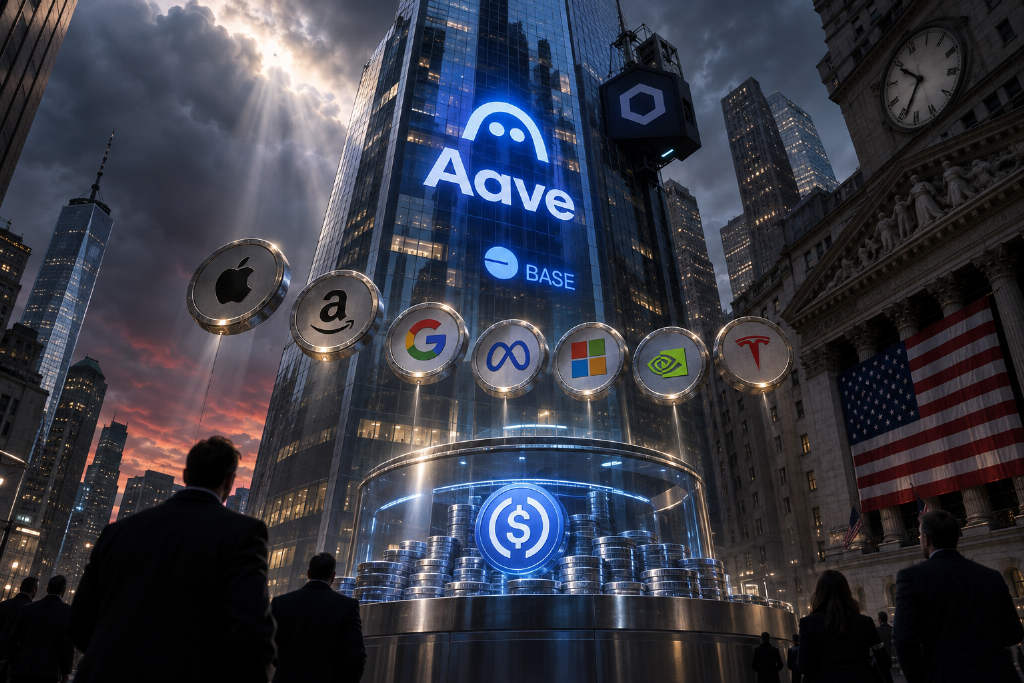
Aave has opened a new lending market on Base that allows seven Coinbase stock tokens to be used as collateral for USDC loans, creating a weekend gap-risk profile for stablecoin lenders who opt into that isolated pool.

Aave Labs said on Sept. 25 that its V4 equity hub went live after temporary restrictions were lifted. The Mag-7 branch carries a $21 million USDC borrow cap, which is a ceiling on borrowing capacity rather than the amount already borrowed.
Trading stays open while oracle prices stop updating
The eligible collateral set includes AAPLc, AMZNc, GOOGLc, METAc, MSFTc, NVDAc and TSLAc. These tokens can only be used as collateral, and borrowers can only draw USDC from this dedicated pool. Risk provider LlamaRisk set the market’s initial parameters and said USDC lenders are voluntarily taking on this equity exposure, with no spillover to other Aave markets.
Chainlink’s equity oracle combines the underlying stock price with the multiplier used by Coinbase’s issuer. LlamaRisk set the oracle’s operating window from 20:00 Sunday to 20:00 Friday Eastern Time. From Friday evening to Sunday evening, and during U.S. stock market holidays, the oracle holds the last quoted price and does not publish fresh updates.
The Aave market itself does not pause. Deposits, borrowing and liquidations remain available, and the stock tokens can still trade on-chain. As a result, a position’s health metrics can stop reflecting current market conditions while the oracle is frozen.
If the underlying stock falls over the weekend, a borrower’s position may already be weaker, but the protocol will not detect that change until the oracle starts updating again. Interest on the USDC debt can also keep accruing during the freeze, which can push a position toward its liquidation threshold even without a new price print. A position that became unsafe during the closure may only turn liquidatable once the oracle resumes on Sunday evening and reprices in one move.
At that point, liquidators may have to hold the seized collateral exposure until U.S. equities enter deeper trading hours on Monday. If they cannot recover enough value from the seized tokens, the isolated USDC pool can end up with bad debt.
How the market was activated
The original ARFC, or Aave Request for Comment, outlined a different approval path. Before execution, Aave Labs said the activation would be bound by the Snapshot vote result, allowing the protocol’s Security Committee to lift the pause on the deployed market directly, without going through an AIP or an Aave V3 governance vote.
Subsequent confirmation showed that the committee had completed that step. A separate risk administrator configuration still requires approval through an AIP.
Caps, collateral factors and model assumptions
The Mag-7 branch has a $21 million borrow cap and a $32 million USDC supply cap. The supply cap limits the total amount of USDC that can be deposited into the sub-pool. Neither figure represents current deposits, borrowing or utilization.
The seven stock tokens carry collateral factors ranging from 65% to 79%. LlamaRisk said that in Aave V4, the collateral factor also determines each token’s borrowing limit and liquidation threshold.
Those buffers are meant to absorb price declines between the moment a position becomes liquidatable and the moment a liquidator finishes unwinding it. LlamaRisk’s stress-testing framework references historical after-hours volatility in U.S. equities, allows for a 0.5% deviation between oracle prices and the real market, and assumes debt accrues at the top end of the USDC borrow-rate curve, capped at 24% annualized, over the longest market closure. The model also assumes liquidation is completed within five minutes of the next regular U.S. market open. Collateral factors for each asset were derived from historical maximum drawdowns and statistical tail-risk measures.
LlamaRisk also said these parameters are only a model of tolerable loss under the protocol’s design goals, not a guarantee that the next market closure will be safe. Historical data, it said, cannot capture unprecedented crash scenarios. Liquidation bonuses of up to 5.5% are meant to compensate liquidators for the cost of repaying USDC debt and then selling, redeeming or hedging the tokens. Whether that incentive is enough depends on market pricing and executable liquidity at the time of liquidation.
The chart included with the source material illustrates the market’s specific risk pattern: the oracle freezes over the weekend, then reprices all at once on Monday, which corresponds to Sunday evening in Eastern Time. If a large gap move meets thin token liquidity, liquidations and bad debt can follow.
Who absorbs the loss depends on the liquidation path
Liquidators that receive seized B20 tokens cannot automatically redeem them for the underlying shares. LlamaRisk’s technical assessment said secondary-market buyers initially receive unvested positions and must complete an issuer-controlled vesting process before redemption becomes possible.
For liquidators without redemption eligibility, the options include selling the tokens on Base, finding a counterparty that does have redemption rights, or using hedging tools while the position is being unwound. The perpetual futures hedge mentioned in the risk assessment is only a modeling assumption and does not guarantee enough hedge capacity in every liquidation event.
Secondary-market depth is also limited. Using data from Sept. 17, before the market launch, LlamaRisk estimated that a sale large enough to cause 2% price impact would range from about $270,000 to $1.08 million for a single token. That figure is only a historical snapshot and does not mean the same size could actually be sold on Sept. 27 if a liquidation occurred. Larger collateral disposals may need to be split into smaller orders or transferred to counterparties with redemption rights.
If a liquidator can dispose of the seized tokens and fully repay the USDC debt, the pool avoids a shortfall. If the opening gap exceeds the model’s buffers, or the collateral cannot be sold or hedged at the assumed price and speed, the equity pool can incur bad debt.
That shortfall would be borne by USDC lenders in this pool. The risk documents describe scenario analysis rather than realized losses. The caps only limit the market’s maximum borrowing size; real-time risk still depends on outstanding loans, position sizes and liquidity when the oracle starts updating again.