
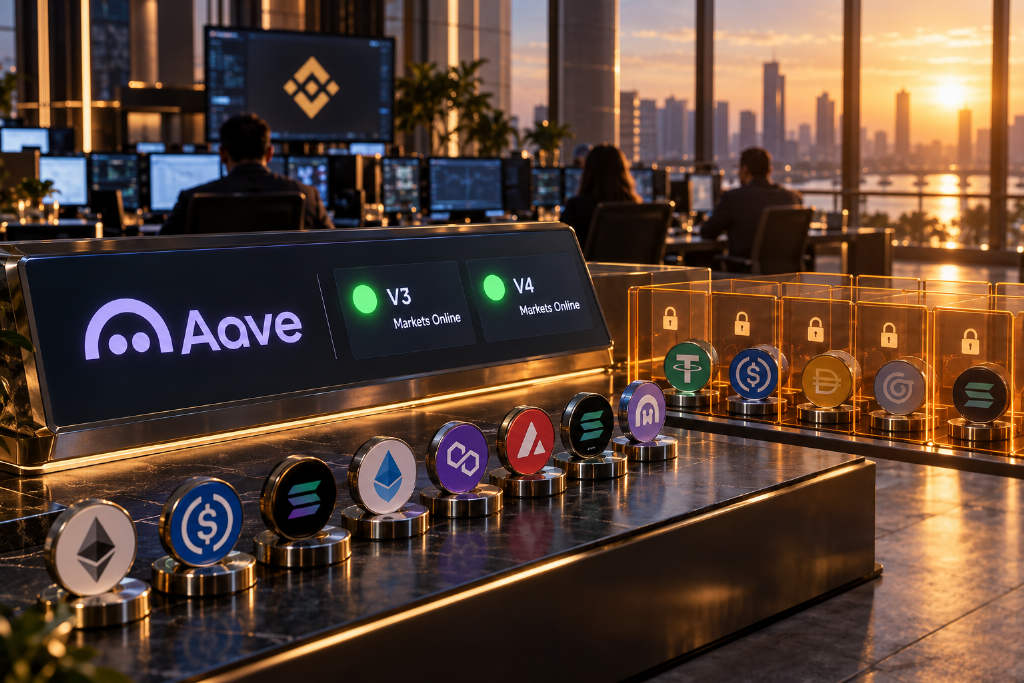
Aave has lifted the precautionary freeze it placed on its V3 and V4 markets following the Binance hot wallet hack.
At about 21:57 Taipei time on Oct. 30, Aave said on X that all V3 and V4 markets had been unfrozen. The protocol had earlier paused new deposits and new borrowing after initial reports of unusually large outflows tied to the Binance incident, while withdrawals and repayments continued as normal. Aave said its contracts were not affected by the event and that positions remained fully collateralized.
New deposits and borrowing are open again
Aave said the freeze was a precautionary step taken after the first reports emerged. The goal was to halt new deposits and new borrowing while allowing existing users to keep withdrawing and repaying. With the situation becoming clearer, V3 and V4 markets have now fully reopened.
The protocol repeated that the Binance incident did not affect Aave’s contracts. Existing positions, it said, remain overcollateralized, meaning collateral values are still sufficient to cover the related loans.
Nine assets remain at LTV 0
Aave is still keeping tighter controls on a group of assets. USDT, USDC, USDT0, POL, WAVAX, sAVAX, XAUT, PAXG, and OP will temporarily remain at a loan-to-value ratio of 0.
In practice, those assets cannot currently be used as collateral to open new loans. Aave said this does not mean the market has been frozen again. It is a targeted reduction in collateral eligibility for specific assets. Existing positions, as well as withdrawal and repayment flows, continue to operate under the protocol’s rules, but users trying to add leverage or open new borrowing with those assets will be blocked for now.
Background to the freeze
Binance has confirmed that its hot wallet was hacked. According to the initial investigation, the intrusion route pointed to areas including an operations engineer’s laptop. Binance estimated the total impact at about $6.3 billion and said losses would be covered by company funds and the SAFU fund.
Aave also said the attacker had deposited stablecoins into Aave and borrowed ETH, making the lending market one of the routes used to move funds. That was the direct backdrop to Aave’s emergency freeze.
Short-term limits remain for some borrowing strategies
The unfreeze restores normal access across most Aave markets, but the LTV 0 setting on stablecoins and several on-chain assets still limits new leveraged positions. Strategies that rely on USDT or USDC as collateral will need to switch to other eligible collateral, or repay first and adjust positions.
With the Binance incident still unfolding, Aave has chosen to reopen the market while keeping stricter collateral controls on selected assets.


