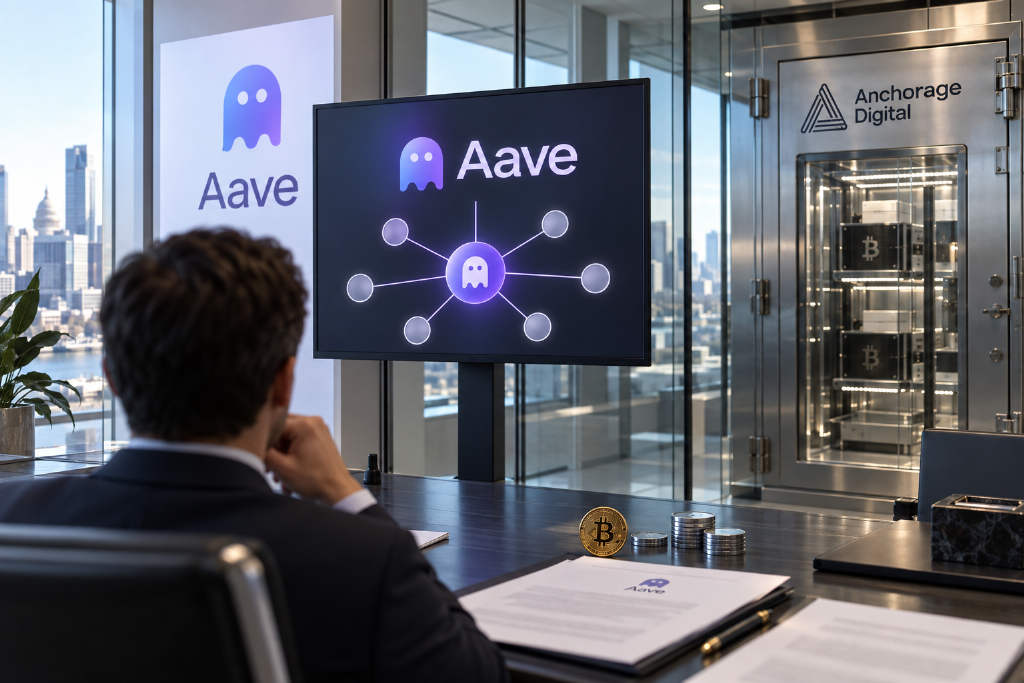
Aave Labs published an ARFC proposal on Sept. 14 to deploy an isolated Hub and Spoke structure in Aave V4 that would let institutionally custodied assets be used as collateral for stablecoin borrowing. The first planned implementation would use BTC held in custody by Anchorage, with Anchorage retaining the underlying collateral throughout the full life cycle of the loan. According to the proposal, key risk and market parameters — including loan-to-value, liquidation penalties, supply and borrow caps, the interest rate model, and oracle settings — would not be set at this stage. Those items are expected to be submitted later by DAO risk service providers through a separate AIP. Before any deployment can move ahead, the proposal must pass through the standard governance sequence of ARFC feedback collection, a Snapshot vote, and then the AIP process.
Aave Labs on Sept. 14 published an Aave Request for Final Comment, or ARFC, proposing the deployment of an isolated Hub and Spoke framework in Aave V4. The design would allow institutionally custodied assets to serve as collateral for borrowing stablecoins.
The first planned implementation would use BTC custodied by Anchorage. Under the proposal, Anchorage would hold the underlying collateral for the entire duration of the loan.
Risk parameters to be proposed later
Key settings, including loan-to-value, liquidation penalties, supply and borrow caps, the interest rate model, and oracle configuration, would be proposed later in a separate AIP by DAO risk service providers.
Governance path
The proposal must proceed through ARFC feedback collection, a Snapshot vote, and the AIP process.
This article was originally published by Bit.Fan. For more cryptocurrency news and market insights, visit www.bit.fan. Disclaimer:
The market information, project data, and third-party content displayed on this platform are for industry information sharing only and do not constitute any form of investment advice or return commitment.
Cryptocurrency trading carries high risks. Users should fully assess their risk tolerance and make independent decisions. All profits, losses, and legal responsibilities are borne by the users themselves.