
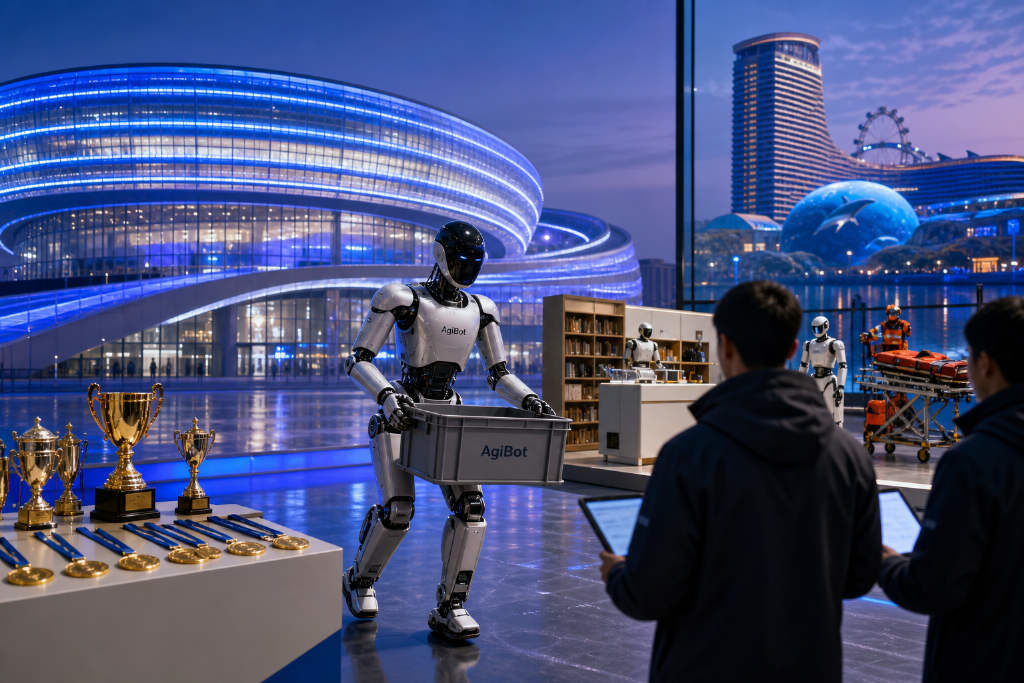
Humanoid robots can already put on a show. They run, jump, flip, and even perform with professional dancers. What companies care about, though, is not a polished demo. They want a worker they can actually deploy.
That gap sat at the center of Agibot’s weekend. On Aug. 22, the company appeared at Beijing’s Ice Ribbon. The next day, it was in Hengqin Chimelong, more than 2,000 kilometers away. One was a competition venue. The other was a real operating environment. Seen together, they point to two very different tests for the same industry.
Robots are being judged on two fronts
The Second World Humanoid Robot Games offered a direct measure of core capabilities: speed, strength, balance, perception, and control. Put a robot on the field, and its limits are easier to see.
The event itself grew quickly. The number of competitions rose from 26 in the first edition to 51 in the second. Participating teams increased from 280 to 666. The number of robots climbed from about 500 to 2,056. The schedule expanded from three days to five, with teams from 16 countries across six continents.
Those figures suggest humanoid robots are moving out of laboratories and into open competition at a faster pace. Agibot was one of the standout participants. Over the course of the games, it won 18 gold medals and 46 medals in total, ranking first on both the gold medal table and the overall medal table.
Still, strong results in competition and a successful delivery in a factory or hotel are not the same thing. One measures the technical ceiling. The other measures whether the machine can complete work in the real world. That split now defines two main dimensions in embodied AI: technical performance and commercial deployment.
One of the most notable changes this year was that the games moved beyond standardized arenas and into real scenarios. The event added 21 scenario-based competitions covering four areas: emergency rescue, hotel service, library management, and home life.
Agibot won six gold medals in those scenario events. The result matters, but the settings matter more. Firefighting and library environments were not redesigned for robots. The machines had to complete tasks in existing spaces and deal with unexpected conditions. The test was no longer limited to whether a robot could execute a movement. It had to finish a job.
On the night of Aug. 22, Agibot sent 24 Expedition A3 robots on stage with 20 professional dancers, then had them rally with table tennis world champion Ding Ning. The next day, the company showed up at Chimelong. From the Ice Ribbon in Beijing to Chimelong in the south, the robots faced two separate demands: pushing capability to the limit in one setting, and putting that capability to work in another.
Being good at only one thing is no longer enough
If the embodied AI sector is mapped out, two obvious paths appear.
One path prioritizes commercialization. Robots for hotel delivery, campus services, and basic transport tasks can already secure large numbers of orders. Their strengths are clear costs, clear demand, and scalable deployment. Their technical ceiling is relatively limited.
Another group emphasizes technical capability. More robotics companies are treating sports-style events as demonstration platforms, pushing results higher in speed, strength, balance, and dexterity. Some even build machines around a single competition goal and maximize one capability.
Both approaches can attract attention. But the market is now asking a third question: can one robotics company rank near the front technologically and also deliver robots into real commercial environments?
That is where the scarcity lies. The harder task is leading on both counts at the same time.
On Aug. 19, Unitree listed on the STAR Market. Its issue price was 150.8 yuan. The stock briefly climbed to 1,100 yuan after the open, pushing market capitalization to as high as 444.9 billion yuan. It later closed at 845 yuan, still valuing the company at more than 340 billion yuan. On the second trading day, the stock fell 18.7%, cutting market capitalization to 277.9 billion yuan.
In two trading days, the market showed both excitement and restraint. That swing also suggested investors are becoming more specific in how they assess embodied AI. Orders and scale can support a commercial case. Running, jumping, and completing difficult motions can support a technical case. If a company can offer only one of the two, the limits of the story are easier to see.
According to Counterpoint Research, global humanoid robot shipments exceeded 22,000 units in the first half of 2026, up nearly 300% year over year. China’s Ministry of Industry and Information Technology expects the country’s full-year complete-machine output to top 100,000 units.
Shipment growth is only the first step. Once a robot enters active work, the question shifts to operating economics: uptime, task efficiency, fault recovery, and maintenance costs all have to be weighed against what customers are willing to pay.
- Advanced models cost $20,000 to $30,000 per unit
- Entry-level models cost $8,000 to $10,000
- Operating cost is about $2 per hour
Those numbers mean robots now have a path into commercial settings. But after deployment, cost, efficiency, reliability, battery life, and maintenance all shape the final economics. Technical breakthroughs can be presented at launch events. Commercial value has to be proven by repeated operation in the field. The issues that rarely make it onto a stage are often the ones that decide whether a customer places an order.
Chimelong offers a second test, this time in live operations
If the capital market is starting to ask whether robots can create value, Chimelong provides a place to test that question directly.
Cultural tourism settings bring heavy visitor traffic, long operating hours, multilingual interaction, changing environments, and clear service standards. Chimelong has spent more than 30 years in the tourism business and has mature experience in visitor service, park operations, and on-site management. For robots, entering that kind of setting means plugging into an established service system rather than a controlled lab environment.
If the games answer what robots can do, Chimelong answers whether those capabilities can be turned into sustained work.
Under the agreement between the two sides, Agibot and Chimelong will work across four global projects: the world’s first immersive robot theme park, the world’s first large-scale robot circus show, the world’s most distinctive cyber-themed parade, and the world’s first robot service hotel. The two sides also plan to build a joint embodied AI laboratory for the cultural tourism industry and carry out technical development and scenario verification across multiple parks.
These are not standardized lab conditions. Visitors, languages, tasks, and surroundings change constantly. Robots are not facing a fixed set of prewritten actions. They need to understand people, read the environment, move, interact, execute tasks, and remain stable over long operating cycles.
There is also a feedback loop that only real deployment can produce. Which motions work, which interactions fail, and which tasks still need human intervention all become inputs for the next product iteration. The longer a project runs, the more operational knowledge it accumulates. That is another way commercial scenarios test technical depth.
From the robot body to delivery, every layer matters
Getting robots on site is only the start. The larger challenge is turning one successful appearance into repeatable delivery. Once a robot enters a real environment, the issue is no longer limited to the hardware itself.
There is one detail shared by the games and the Chimelong deployment: scale.
At the games, Agibot’s three major robot series and its dexterous hand all recorded gold-medal results, and its products appeared from the opening ceremony to multiple competition categories. In Zhuhai, the company assembled more than 100 robots for multiple Chimelong scenarios. The two events were held more than 2,000 kilometers apart and ran almost at the same time.
That is no longer a display of a single machine. It is closer to a stress test of delivery capability. Mass production answers how many units can be built. Delivery answers whether that many units can be put to work at the same time.
Manufacturing, scheduling, and on-site support all have to keep pace. Sending such a large fleet of robots into two high-intensity venues at once is itself a test of production capacity and delivery systems.
That also points to where humanoid robotics competition is headed. It will not be decided by a single machine alone. Peak performance in a competition setting and sustained delivery in a real setting may look different, but inside a company they both come down to system capability. The body enters the physical environment. The model interprets tasks. Software and data keep operations running. When something fails, a team still has to handle delivery and maintenance.
Agibot has long stressed what it calls an integrated "three-intelligence" approach: motion intelligence, interaction intelligence, and operational intelligence. Across the games and Chimelong, that framework took on a more concrete form. The competition venue pushed the upper bound of capability. Chimelong placed those capabilities inside a commercial environment.
A company that can win in the arena and keep delivering in the field is meeting the threshold the market is beginning to care about.
The real competition is only beginning
For Agibot, the value of these two appearances is that they put one question, often discussed in separate pieces, onto the same company. A robot business needs technology that stands up and a business model that runs.
Agibot founder, chairman, and CEO Deng Taihua has said that 2026 will be the key turning point for embodied AI as the sector moves from development status to deployment status. He described that path with an "XYZ curve."
In his framework, the X curve is the early development stage in which robots can move like humans. The Y curve is the deployment growth stage in which robots can work like humans. The Z curve is the deployment popularization stage, where large-scale real-world data and continued algorithmic innovation push embodied AI from quantitative change to qualitative change and into broader application.
At the industry level, that XYZ curve maps onto a move from being able to do something, to being able to use it, and then to deploy it at scale. Mass production solves whether robots can be manufactured. Large-scale deployment raises another question: as more robots enter more scenarios, can performance and stability hold up?
Whether a customer keeps using a robot over time depends on more than hardware. The amount of work a machine can complete also depends on how well its model understands environments and tasks, and how stable the system remains over long periods.
For enterprise buyers, the purchase still comes down to an operating equation: how many tasks can the machine complete in a month, how much cheaper is it than human labor, how high is the failure rate, and what does maintenance cost? Those questions rarely dominate product launches, but they can determine how far robots actually go.
Agibot’s appearances at the games and at Chimelong place those industry changes side by side. The competition in embodied AI is shifting from product-versus-product comparison toward a contest in systems engineering capability. In the past, companies could win attention with technical progress or secure orders through commercialization. The market is moving toward a stricter test.
Can a company produce both report cards at once?
That shift appears to be arriving faster than many expected. Agibot happens to be standing at that turning point. Beating Usain Bolt in a running comparison can only prove that a robot is fast. What can change the industry is reaching a certain technical level, taking those capabilities into production environments, and turning them into orders, customers, and a repeatable business model. When a company enters that cycle, embodied AI moves into its next stage.