
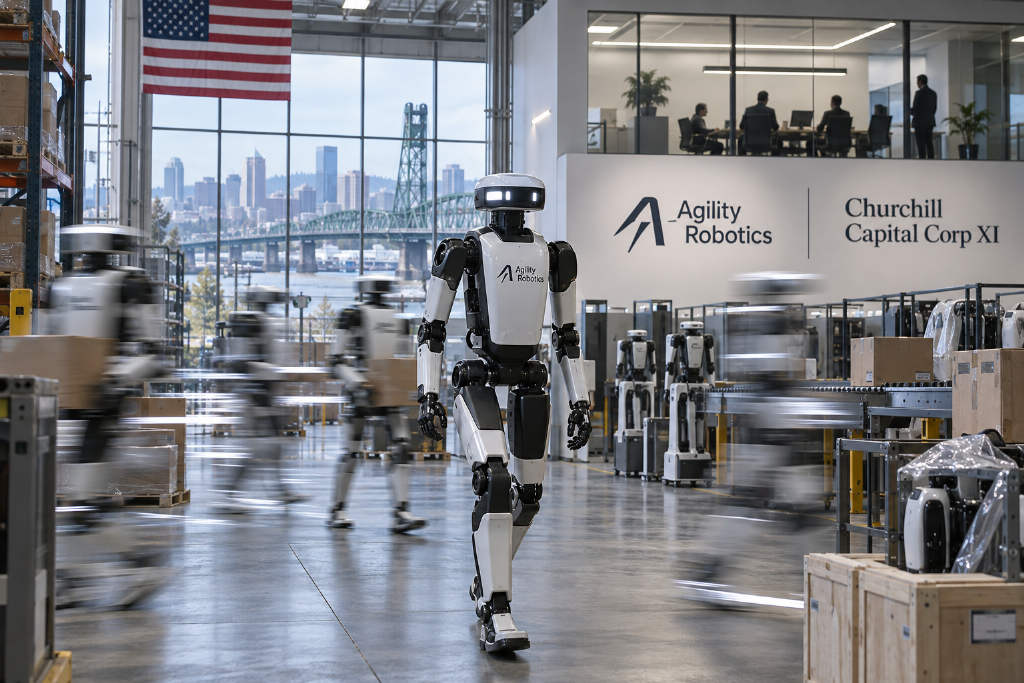
Agility Robotics has given public markets an unusually detailed look at the economics behind humanoid robot commercialization, and the numbers are still heavily tilted toward future promise rather than present revenue.
The company said in June that it would go public through a merger with special purpose acquisition company Churchill Capital Corp XI at a pre-money valuation of about $2.5 billion. Later, analyst Serenity, described in the source report as the 「white-haired stock god」, said Agility Robotics would be his preferred name in the robotics sector. A Form S-4 filed with the U.S. Securities and Exchange Commission on Sept. 4 then put hard operating figures on the table for the first time: about $1.78 million in net sales in 2025, alongside a net loss of roughly $138 million. At the same time, Agility said it had won more than $300 million in multi-year orders for Digit v5.
Digit entered real workplaces early, but with a narrow job scope
Founded in 2015, Agility Robotics grew out of the Dynamic Robotics Laboratory at Oregon State University. Founder Jonathan Hurst has long focused on bipedal locomotion control. The company’s early robot, Cassie, had only two legs and no torso or arms. Digit was built later on the same bipedal platform, adding an upper body and robotic arms so it could handle tasks such as moving totes and loading or unloading machine tools.
Digit was never designed to mimic the human form as closely as possible. It uses bird-like reverse-jointed legs, and its hands resemble industrial grippers more than human hands. That design choice set Agility apart from many other humanoid robotics companies. The company’s early target was straightforward: repetitive warehouse and factory work with clear processes, especially jobs that fixed robotic arms cannot easily cover.
That product direction helped Agility land several large manufacturing and logistics customers. GXO, a major U.S. logistics company, deployed Digit at a logistics center it operates for women’s apparel brand Spanx. German industrial parts maker Schaeffler and Japanese automaker Toyota introduced the robot into manufacturing settings. Latin American e-commerce platform Mercado Libre was also listed among early deployment customers.
Agility said Digit has accumulated more than 65,000 hours of real-world operating data, which can be used to train its perception and motion systems. In projects with GXO and Schaeffler, Digit achieved about 98% task accuracy and moved more than 100,000 totes and 25,000 totes, respectively.
Pilot programs still sit far from fleet-scale purchasing
Those deployments, however, do not mean customers are already buying robots at scale.
In robotics, pilot projects generally face much lower budget and decision thresholds than fleet purchases. Large companies may be willing to dedicate one warehouse, a few production lines and a limited test budget to evaluate a new system. Expanding that from fewer than 10 units to hundreds of robots is a different step. It forces buyers to revisit productivity, safety liability, systems compatibility and long-term maintenance costs.
Amazon invested in Agility as early as 2022 and ran multiple rounds of Digit testing in its own warehouses. But by June 2026, Amazon was no longer listed as an active commercial deployment customer, meaning the earlier pilot had ended. Agility said it hopes to continue advancing work with Amazon after launching the next-generation Digit v5 by the end of this year.
The $300 million order comes from one undisclosed customer
The company’s most eye-catching commercial figure is the more than $300 million in multi-year orders tied to Digit v5. The S-4 filing shows that this is not a diversified pool of orders from multiple buyers. Instead, it is linked to one undisclosed customer, a three-year Robots-as-a-Service, or RaaS, contract, and about 1,000 Digit v5 units. The agreement also includes warrants that vest gradually as robots are deployed.
That structure means one customer’s rollout schedule will play a large part in shaping Agility’s revenue over the next several years. It also means the more than $300 million cannot be recognized all at once. The contract depends on agreed product capabilities, technical specifications and other contractual milestones, so the order converts into revenue only as production, acceptance and operation move forward.
Apart from this agreement, Agility said it is in commercial discussions with more than 30 potential customers, but it did not disclose how many have signed binding purchase or deployment contracts.
Direct sales and RaaS lead to very different revenue timing
Agility has designed two sales models for Digit v5: direct robot sales and RaaS.
Under the direct purchase model, based on the company’s own estimates, a customer pays about $200,000 upfront for the robot, around $20,000 in deployment fees, and $36,000 per year for Arc software and maintenance. The hardware portion is generally recognized when the robot is accepted and control transfers to the customer. Deployment, software and maintenance revenue are recognized as those services are delivered. Over a five-year life, one Digit unit could bring in about $400,000 in cumulative revenue for Agility.
The filing shows Agility generated $1.782 million in net sales in 2025. Of that total, $1.55 million came from robot sales, accounting for roughly 87% of annual revenue. Another $213,000 came from deployment and professional services, while repair and maintenance revenue was about $14,000. One customer that is also an Agility shareholder bought five Digit robots under a contract worth $1.05 million, or roughly $210,000 per unit.
RaaS lowers the upfront spend for customers, but stretches out revenue recognition. In this model, Agility keeps ownership of Digit. Customers pay a monthly subscription fee of $8,500 and receive the robot, Arc software and maintenance services, plus they pay a one-time deployment fee of about $25,000. That translates to annual subscription revenue of $102,000 per robot. Including deployment, first-year customer spending comes to about $127,000. Over five continuous years, the total reaches about $535,000.
| Charge item | Robots-as-a-Service (RaaS) | Direct robot purchase |
|---|---|---|
| Robot ownership | Held by Agility | Held by customer |
| Hardware purchase price | None | About $200,000 |
| Subscription fee | $8,500 per month | None |
| Software and maintenance | Included in monthly fee | $36,000 per year |
| One-time deployment fee | About $25,000 | About $20,000 |
| Customer spending in year one | About $127,000 | About $256,000 |
| Total spending over five years | About $535,000 | About $400,000 |
Agility expects RaaS to take a larger role in its long-term commercial model. The same pricing framework also explains the composition of the headline order. At $8,500 per robot per month, 1,000 robots operating continuously for three years would generate about $306 million in subscription fees, broadly matching the amount Agility disclosed.
There is a catch: the 1,000-unit order is tied to Digit v5, which has not yet been formally released for commercial use. Agility has already built prototypes and plans to launch the product by the end of 2026, but it still has to complete production readiness, customer acceptance and scaled deployment. In practical terms, the order depends directly on development and manufacturing progress for the next-generation robot.
RoboFab gives Agility capacity, but not low costs yet
In September 2023, Agility formally unveiled RoboFab, a roughly 70,000-square-foot factory in Salem, Oregon, and said it would begin operating within that year. The company then started moving Digit production there. Agility initially expected output in the first year to reach only the hundreds. At full utilization, the factory was designed for annual production of more than 10,000 robots.
Agility views RoboFab as a domestic U.S. manufacturing asset. The company said about 75% of Digit components currently come from U.S. suppliers, and some higher-value hardware, including actuators, end effectors, whole-body control and safety systems, is developed in-house. That setup can help the company manage quality and delivery while reducing cross-border supply risk. It also means Agility is less able to tap into the dense Chinese supply clusters for motors, reducers, batteries and structural components.
Domestic components, labor costs and low-volume manufacturing may all be contributing to Digit’s current cost structure. Agility estimates that Digit v5 will carry a bill of materials of about $150,000 per unit at the start of commercial release. As a reference point, Unitree’s first-generation flagship H1, another full-size bipedal robot, was officially priced at less than $90,000 for the complete machine. On that basis, Digit v5’s bill of materials alone is about 67% higher than the public full-system price for Unitree H1, and Agility’s outright sale price is more than double that level.
The report notes that this price gap cannot be used on its own to judge performance or manufacturing efficiency. It does, however, show that the two companies operate in very different supply chain environments and production stages. Unitree can draw on China’s concentrated robotics parts ecosystem. Agility is building around U.S.-based production, industrial safety and customer deployment, and that currently leaves it with a higher per-unit manufacturing burden.
Agility hopes scale will change the equation. Based on company estimates, if annual Digit v5 output reaches 1,000 units, bill-of-materials cost per robot could fall from $150,000 to $75,000. At 10,000 units a year, that figure could drop again to $30,000. Each robot also requires about $15,000 in one-time deployment costs, plus roughly $15,000 per year in software, maintenance and on-site service costs.
$1.78 million in sales, $138.1 million in losses, and a funding push through public markets
Scaling from small-batch production for pilots and early commercial deployments to hundreds or even thousands of units a year requires more than just factory space. Agility also needs greater purchasing capacity, assembly throughput, quality control and field service capability. Those upfront costs are already visible in its financial statements.
The filing shows that in 2025, while Agility generated $1.782 million in net sales, direct costs tied to robot production, deployment and services reached about $4.5 million. Research and development expenses were around $91.6 million. Selling, general and administrative costs were about $45.8 million. Net loss for the year totaled $138.1 million.
That is the immediate backdrop for the company’s move toward public markets. Under the transaction structure, assuming no redemptions by SPAC shareholders, about $420 million in trust proceeds and roughly $200 million in PIPE financing would provide more than $620 million in total funding. Agility said it plans to use the money to fulfill existing orders, expand commercial deployments, raise Digit v5 production and continue investing in the robot body, Physical AI, enterprise software and safety systems.
At that point, the $2.5 billion valuation is not a reflection of Agility’s current revenue base. It is a bet on whether Digit v5 can move from pilot programs to large-scale deployment. What the market is being asked to finance is the unfinished jump from order book to delivered fleet.