
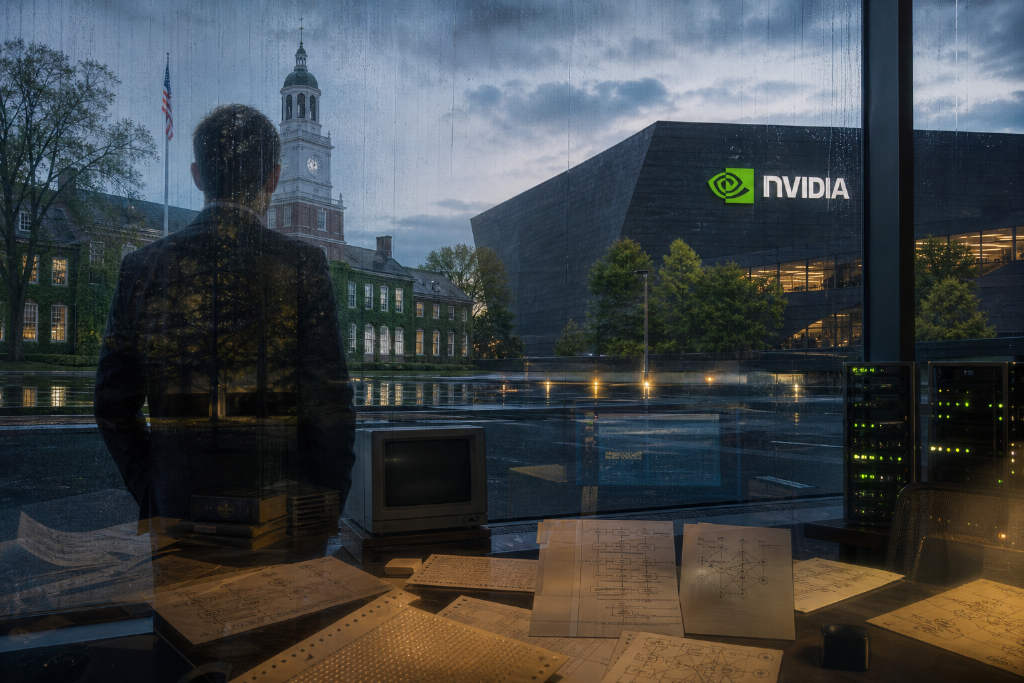
On Nvidia’s earnings call on August 26, 2026, Jensen Huang was asked how he viewed artificial general intelligence, or AGI. His reply was blunt: "For a lot of tasks, we can say that we have achieved AGI."
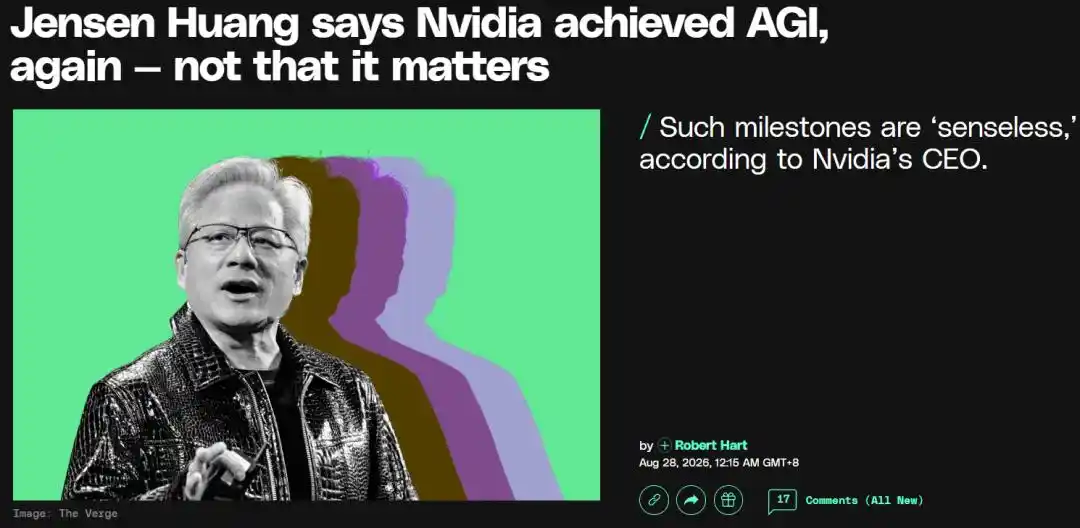
The claim is highly contested and far from broadly accepted. Even so, it captures how far AI systems have come, and it opens a longer question. Seen from that moment, artificial intelligence as a field has now lived through 70 years of surges, reversals, renamings and recurring arguments over what the goal even is.
The 1955 proposal that set the field in motion
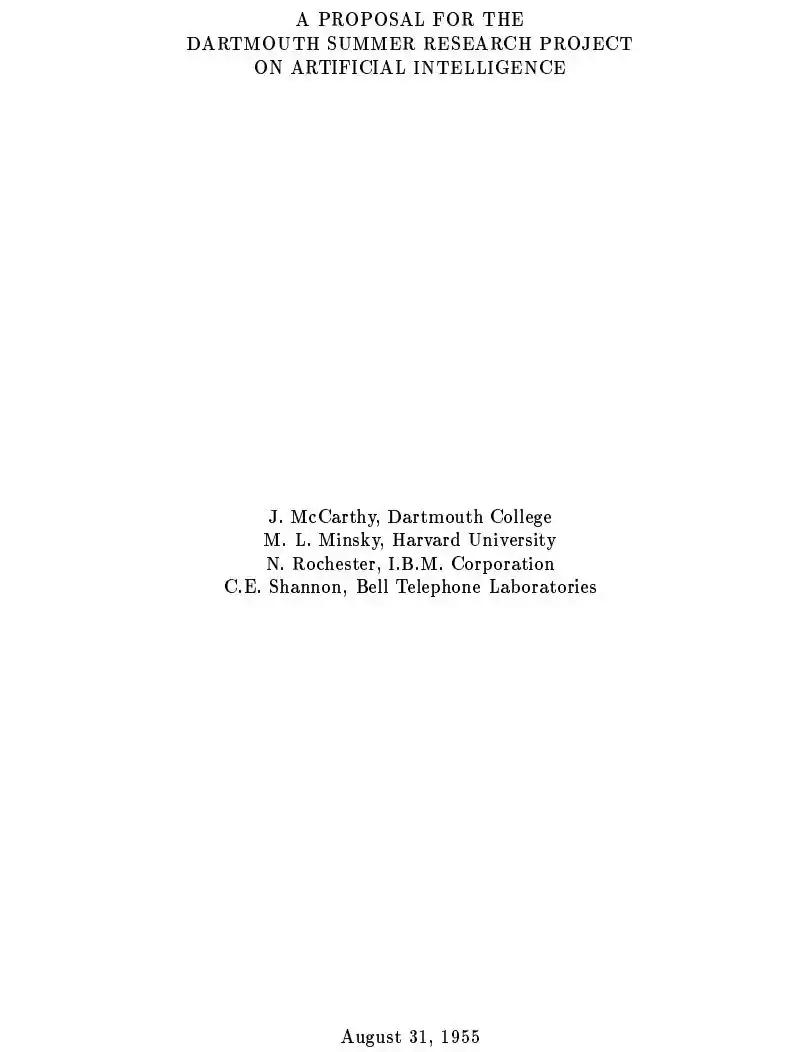
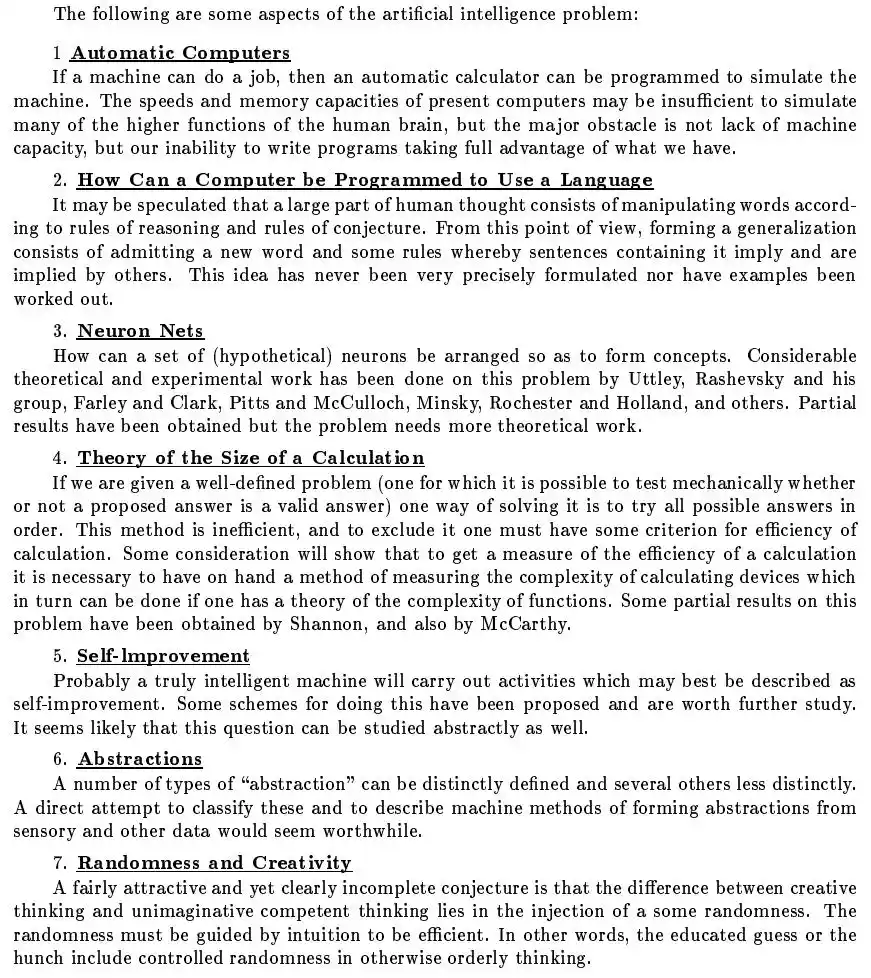
Seventy-one years ago today, on August 31, 1955, four young researchers mailed a proposal to the Rockefeller Foundation. Its title was "A Proposal for the Dartmouth Summer Research Project on Artificial Intelligence." The opening laid out a plan for a two-month study in the summer of 1956 at Dartmouth College in Hanover, New Hampshire, with 10 participants. The work would proceed from a bold assumption: every aspect of learning, or any other feature of intelligence, can in principle be described so precisely that a machine can be made to simulate it.
The four signatories were John McCarthy, then a 28-year-old assistant professor of mathematics at Dartmouth; Marvin Minsky, 28, a junior fellow at Harvard; Nathaniel Rochester, 36, director of information research at IBM; and Claude Shannon, 39, a mathematician at Bell Labs. Of the four, only Shannon was already a major public figure. By then, his 1948 paper "A Mathematical Theory of Communication" had already entered the canon.
The group asked for $13,500. The Rockefeller Foundation approved $7,500.
Ten people, two months, and $7,500 to solve intelligence. In hindsight, that may stand as the first and most famous underestimation in AI history. The tasks named in the proposal still read like a 2026 product roadmap: make machines use language, form abstractions and concepts, solve problems then reserved for humans, and improve themselves.
A term coined to draw a boundary
Before "artificial intelligence" existed, the area already had another name: cybernetics. Norbert Wiener’s 1948 book of that name was a foundational text, and a large academic circle formed around him.
McCarthy did not want to enter that circle. Later recollections describe a mix of motives: he did not want Wiener in the position of intellectual leader, he did not want a direct confrontation, and he also found Shannon’s information theory too abstract for the work he wanted to do. His focus was concrete. He wanted to build intelligence with computers.
That is where "Artificial Intelligence" came from. It was not a crisp technical definition. It was, in part, an academic act of separation.
That detail matters because it helps explain a difficulty that returned again and again over the next seven decades. From the first day, the field’s defining term had no operational definition. It could never be conclusively proven achieved, and it could never be conclusively proven dead.
The Dartmouth meeting in 1956
From June to August 1956, the Dartmouth meeting ran for eight weeks. It was nothing like a modern conference. There was no fixed schedule, no proceedings, and no stable roster. Researchers came and went. Some stayed a week, others spent most of the summer there. Sources disagree on the number of participants, giving totals from the teens to more than 30, because even the meaning of "attended" is fuzzy.
The most striking contribution came not from the proposal’s signers but from Allen Newell and Herbert A. Simon of Carnegie Institute of Technology. They brought a program called Logic Theorist. It could prove 38 of the 52 theorems in Chapter 2 of Bertrand Russell and Alfred North Whitehead’s Principia Mathematica. For one theorem, the program produced a proof that was shorter than Russell’s own.
Newell and Simon were excited enough to submit a paper to the Journal of Symbolic Logic, listing Logic Theorist in the author line. The journal rejected it.
In that sense, history got an early first: an AI system denied authorship.
Whatever the tensions and the loose structure of the gathering, the field of artificial intelligence was born after Dartmouth.
The first golden era
The years after Dartmouth were the happiest stretch the field would know for a long time. Funding was available, the community was still small, and results came fast. Nearly every demo looked like a trailer for the future.
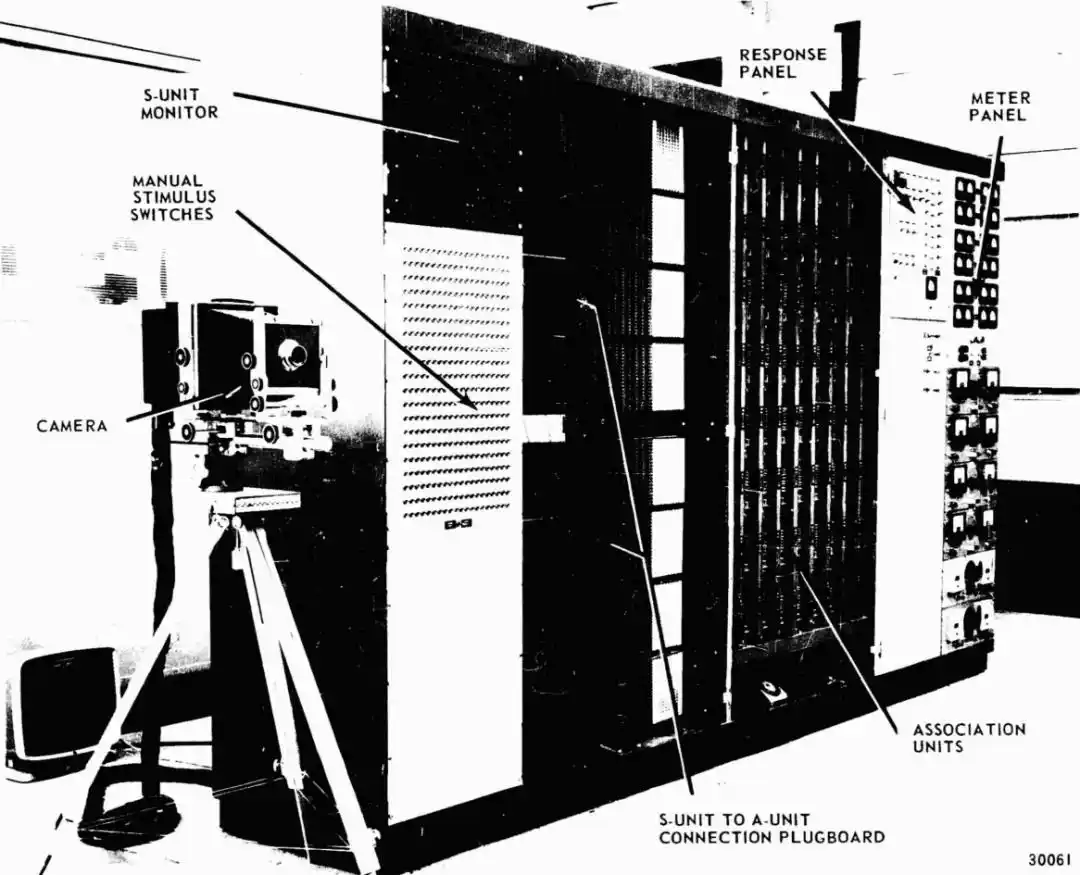
In 1958, Frank Rosenblatt of Cornell Aeronautical Laboratory built the perceptron. This was not an abstract idea but a physical machine: the Mark I Perceptron, with 400 photocells serving as a kind of retina, weights adjusted through potentiometers, and parameters updated by a motor-driven mechanism. It could learn to distinguish simple shapes. The New York Times, in a famous burst of enthusiasm, wrote that future versions would walk, talk, see, write, reproduce themselves, and be conscious of their own existence.
The same year, McCarthy created LISP, which would remain the main language of AI research for roughly the next 30 years.
In 1959, Arthur Samuel of IBM had a checkers program play against itself until it became strong enough to beat him. That gave "machine learning" a concrete example rather than just a phrase.
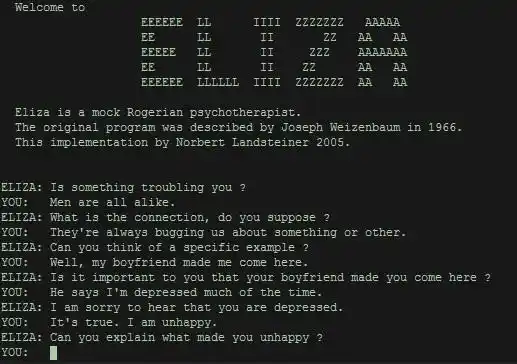
In 1966, Joseph Weizenbaum at MIT wrote ELIZA, a pattern-matching program of just over 200 lines of code that played a Rogerian psychotherapist by turning a user’s statements back into questions. Weizenbaum built it to mock the shallowness of human-machine conversation. Instead, the system startled him. After using ELIZA for a few minutes, his secretary seriously asked him to leave the room so she could speak with the program alone. The episode shook him deeply, and he later became one of AI’s sharpest critics.
By 1970, Terry Winograd’s SHRDLU could operate in a virtual blocks world, handling instructions such as "put the green large block on the red cube" and answering questions about why it had acted that way. Around the same time, the Stanford Research Institute robot Shakey could plan paths in hallways and push boxes, though it thought so slowly that the name explained itself.
In that atmosphere, prediction outran restraint. In 1965, Herbert Simon wrote that within 20 years machines would be capable of doing any work a person could do. In 1970, Marvin Minsky told Life magazine that in three to eight years there would be a machine with the general intelligence of an average human.
Perceptrons hit a wall, and neural networks lost ground
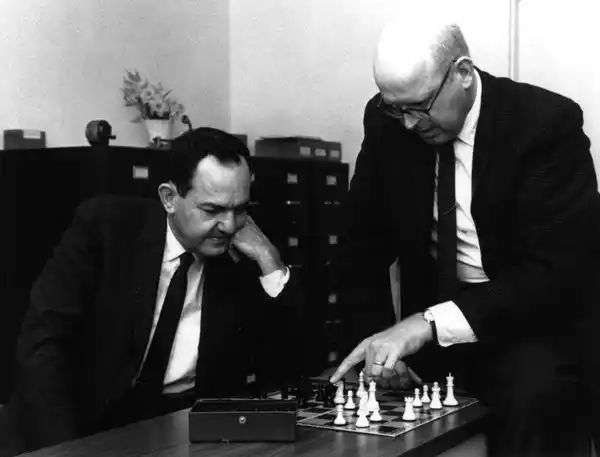
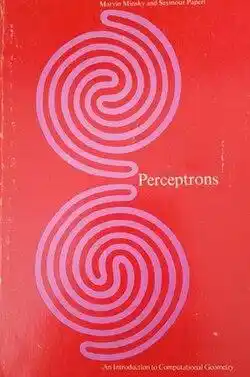
At the same time, Minsky was involved in another development with long consequences. In 1969, he and Seymour Papert published Perceptrons, showing with formal mathematics that a single-layer perceptron could not represent even simple logic such as XOR. The book did discuss multilayer networks, but in pessimistic terms. The training problem did not look solvable.
The impact far exceeded the mathematics alone. Funding for neural-network research largely dried up for more than a decade. On July 11, 1971, Rosenblatt died in a boating accident in Chesapeake Bay on his 43rd birthday.
Symbolic AI won that round. It also won too early, before it had learned how close it was to its own limits.
The first AI winter: ALPAC and Lighthill
The wall arrived quickly, and it had two faces: limited compute and combinatorial explosion.
In 1966, the ALPAC report from the U.S. National Academy of Sciences delivered an early blow to machine translation. After a decade of investment, it concluded that machine translation was not faster, cheaper, or better than human translation and recommended ending support for fully automatic translation.
In 1973, the UK Science Research Council asked applied mathematician James Lighthill to assess the value of AI research. The resulting Lighthill report was harsh. AI, it argued, had failed to deliver on its promises across the board. Methods that looked effective on toy problems broke down at real-world scale because the search space exploded combinatorially.
That was the central problem for this generation of AI. Playing chess, solving mazes, and proving theorems all reduce, in some form, to searching a huge tree. Toy trees are manageable. Real ones are not. Their size can rise to something on the order of the number of atoms in the universe, and the available compute of the time was vanishingly small by today’s standard.
After the report, UK funding for AI was cut back almost completely, leaving only two or three universities. In the U.S., DARPA also tightened broad AI funding around 1974. Carnegie Mellon’s Speech Understanding Research project, or SUR, was cut after failing to meet DARPA’s targets.
The first winter lasted until around 1980. Its cause was straightforward: a gap had opened between what AI had promised and what it could deliver.
Expert systems and a narrower strategy
The thaw came through a strategic retreat. If general intelligence was out of reach, perhaps a system that knew one thing very well could still be built and sold.
Edward Feigenbaum’s slogan was "knowledge is power." DENDRAL, begun in 1965, inferred the molecular structure of organic compounds from mass spectrometry data. MYCIN, started in 1972, diagnosed blood infections and recommended antibiotic dosages, performing near human experts in evaluations. Their design was clear: a knowledge base packed with if-then rules plus an inference engine.
The commercial breakthrough was XCON. In 1980, the system developed by Carnegie Mellon for DEC began automatically configuring orders for VAX minicomputers, reducing the high cost of human assembly errors. According to DEC’s estimate, XCON saved the company about $40 million a year.
That number electrified the market. In the 1980s, expert systems became a standard line item in enterprise IT buying. Dedicated LISP-machine companies such as Symbolics and LMI rose quickly, and the AI-related industry was said to have reached the scale of several billions of dollars by the second half of the decade.
Japan responded most aggressively. In 1982, its Ministry of International Trade and Industry launched the Fifth Generation Computer Systems project, aiming to build intelligent machines based on logic programming and large-scale parallelism, effectively trying to leap past the von Neumann architecture.
The second winter
Then it fell apart, faster than the first time.
In 1987, general-purpose workstations overtook expensive LISP machines on performance. The hardware case for companies such as Symbolics evaporated in a matter of months.
The deeper weakness was in software. Expert systems needed human experts to verbalize knowledge rule by rule and knowledge engineers to encode it rule by rule. That process was slow and expensive. As the rule base grew, rules started to conflict with one another. The systems could not learn for themselves, could not handle situations outside the encoded rules, and became more costly to maintain as they scaled.
By the early 1990s, the term "artificial intelligence" had become close to a stain in corporate procurement and venture capital circles. Japan’s Fifth Generation project ended in 1992 without reaching its stated goals.
The second AI winter had begun, and for much the same reason as the first.
The years when AI survived by changing its name
From the 1990s into the mid-2000s, the field adopted a practical tactic: stop calling itself AI. Researchers spoke instead of machine learning, data mining, pattern recognition, knowledge engineering, intelligent systems, or information retrieval. Avoiding the AI label in grant applications often improved the odds of success. Later, this period would be described as AI in disguise.
Paradoxically, the discipline became healthier in those years. Once the grand claim of building general intelligence was pushed aside, researchers concentrated on statistical methods and measurable benchmarks. Support vector machines, Bayesian networks, hidden Markov models and ensemble methods matured. Judea Pearl brought causal inference into probabilistic graphical models.
These methods did not promise intelligence. They promised accuracy on specific tasks, and they delivered it.
A public milestone came on May 11, 1997, when IBM’s Deep Blue defeated Garry Kasparov 3.5 to 2.5. But Deep Blue won by searching 200 million chess positions per second with specialized chips. It included almost no learning. At the time, the result was widely read as a victory for brute-force compute rather than intelligence, which was itself a familiar fate in AI history.
Also in 1997, Sepp Hochreiter and Jürgen Schmidhuber published the long short-term memory network, or LSTM, addressing the vanishing-gradient problem in recurrent neural networks. The paper drew little notice then. Two decades later, it would underpin large parts of speech recognition and machine translation.
The neural-network flame stayed alive through Geoffrey Hinton, Yann LeCun and Yoshua Bengio, who kept working in the area when much of the field had concluded that the path was a dead end. They were later jokingly called the "Canadian Mafia." In 2004, CIFAR in Canada supported a cross-institutional project organized by Hinton with a grant that looked small at the time. In 2006, Hinton and collaborators gave the direction a revived name in their work on deep belief networks: deep learning.
Data arrives: ImageNet changes the setup
Another key ingredient came from data. Around 2007, Fei-Fei Li began building ImageNet, a labeled dataset containing roughly 15 million images across more than 20,000 categories. Her bet was that algorithms were being held back not only by method but by a shortage of data.
At the time, many considered labeling at that scale unrealistic and not especially useful. The project at one stage depended on crowd workers on Amazon Mechanical Turk. The dataset was released in 2009, and the annual recognition competition began in 2010.
As the article frames it, the powder, the fuse and the match were prepared by three different groups over the decade before 2012, mostly without knowing how neatly the pieces would later fit together.
2012 and the AlexNet break
In September 2012, Alex Krizhevsky, Ilya Sutskever and Hinton at the University of Toronto entered an eight-layer convolutional neural network into the ImageNet contest. AlexNet posted a top-5 error rate of 15.3%. The runner-up was at 26.2%.
In a mature field such as computer vision, yearly gains of one or two percentage points were normal. A 10-point gap meant something much larger. A lot of what others got wrong, this system got right.
The algorithms were not all new. LeCun had used convolutional networks in 1989. Backpropagation came from a 1986 paper. The idea behind ReLU activation was not original to AlexNet either. What was new was the combination of two Nvidia GTX 580 GPUs for training and the scale of data supplied by ImageNet.
That same year, Andrew Ng and Jeff Dean at Google Brain built a network on 16,000 CPU cores that learned, from unlabeled YouTube video frames, a neuron sensitive to cat faces. Together, these results sent a single message: old algorithms plus new compute plus large data can produce new capabilities.
From Atari to AlphaGo to Transformer
The pace picked up sharply after that. In 2013, DeepMind used deep reinforcement learning to train an agent to play Atari games directly from screen pixels; the work appeared in Nature in 2015. In March 2016, AlphaGo beat Lee Sedol 4 to 1. In Game 2, move 37 became famous. AlphaGo played on the fifth line shoulder hit, a move many professional players first judged a mistake. Hours later it was accepted as a good move. It mattered because people could suddenly see a system reaching judgments from somewhere outside the history of human game records.
In October 2017, AlphaGo Zero was published. It used no human game records at all, starting from self-play and surpassing the version that had beaten Lee Sedol in three days.
That same year, eight Google researchers published a paper with a playful title: "Attention Is All You Need." It introduced the Transformer architecture, removing recurrence and relying on attention to model sequence relationships. Its practical advantage was straightforward: large-scale parallel training. At the time, the paper was framed as an efficiency improvement for machine translation.
The article notes that all eight authors have since left Google to start companies or join other labs.
Scale becomes the dominant logic
The five years after Transformer were organized around one central idea: make it larger.
In 2018, Google’s BERT and OpenAI’s GPT-1 each validated the route of large-scale unsupervised pretraining followed by downstream fine-tuning. When GPT-2 arrived in 2019, OpenAI released model weights in stages, citing concern that the system could be misused to generate false information. The article argues that, in hindsight, the fight around that release decision was more revealing than the model itself.
GPT-3, released in May 2020, marked a watershed. With 175B parameters, it could perform new tasks from a few examples in the prompt, without fine-tuning. That in-context learning had not been explicitly trained in. It appeared as a byproduct of scale.
That same year, Jared Kaplan and colleagues at OpenAI published the Scaling Laws paper, arguing that model performance follows predictable power-law relationships with parameter count, data size and compute. In 2022, DeepMind’s Chinchilla paper revised the ratio conclusions, arguing that many large models of the time were undertrained on data. The practical effect of both papers was to turn large-model training from a craft into an engineering program.
If the problem across AI’s first 60 years was that promises ran ahead of capability, the article says the pattern reversed after 2020. Capability growth began to show a curve that investors could project. That shift, in its telling, is the direct reason capital entered at the scale of hundreds of billions of dollars.
Diffusion models and ChatGPT
Image generation moved on a separate but parallel track. In 2021, CLIP aligned images and text. In 2022, diffusion models drove the rapid arrival of DALL·E 2, Midjourney and Stable Diffusion, making "AI art" a mainstream subject.
Then came November 30, 2022. OpenAI put a conversational demo based on GPT-3.5 on the web, expecting mainly to gather feedback. ChatGPT reached 1 million users in five days and 100 million monthly active users in two months, becoming the fastest-growing consumer application of its time.
Technically, the main additions relative to GPT-3.5 were reinforcement learning from human feedback, or RLHF, and a chat box. As a product, it did something simpler and more consequential: it gave nontechnical users access to a capability that had already existed for about two years.
The article puts it in one line: the most important delivery in 70 years of AI may have been an interface.
From conversation to work
The density of change over the next three years, in the article’s account, exceeded the previous 60 combined.
In 2023, model competition accelerated. GPT-4 was released in March and scored near the top on a range of human professional exams. In China, a "hundred-model battle" unfolded the same year, with launches coming from large technology firms and startups alike, at times on a weekly rhythm. Hallucinations, copyright disputes and labor displacement entered broad, serious discussion at scale for the first time.
Two turns came in 2024. One was technical. In September, OpenAI released o1, applying reinforcement learning to the reasoning chain so the model could "think" longer before answering. The route became known as test-time scaling, shifting part of compute demand from training to inference and producing a step change in mathematics and coding performance.
The other turn was symbolic. In October, the Nobel Prize in Physics went to John Hopfield and Geoffrey Hinton, while the Nobel Prize in Chemistry went to David Baker, Demis Hassabis and John Jumper. Neural networks and AlphaFold were recognized by two disciplines in the same week.
For 2025, the article identifies open source as the biggest variable. In January, DeepSeek-R1 was released, matching OpenAI o1 in performance while cutting training cost by an order of magnitude and being fully open source. The direct effect, in this reading, was to lower the threshold for reasoning models to the point that almost anyone could use them. The indirect effect was to challenge the assumption that catching up required brute-force spending on compute. After that, the share of Chinese open-source models in the global developer ecosystem kept rising.
The same year, several tasks long treated as markers of what AI could not do fell one after another. In July, an internal experimental model from OpenAI and Google DeepMind’s Gemini Deep Think each reached gold-medal level on the International Mathematical Olympiad, solving five of six problems. OpenAI stressed that the model had not been trained specifically for mathematics and instead relied on general reinforcement learning and test-time compute scaling. In August, the same model won gold at the International Olympiad in Informatics and ranked sixth overall among 330 human contestants. In November, DeepSeek Math-V2 was open-sourced and also reached IMO 2025 gold-medal level.
The speed mattered. In February 2025, MathArena evaluations still showed that all top models were below the bronze-medal line on real IMO problems. Five months later, they were at gold level.
By 2026, the center of gravity had moved again. At the AGI-Next summit hosted by Tsinghua in January, participating experts argued that the chat-centered paradigm had run its course and that competition was shifting toward agents that can get work done.
The article ties that judgment to several changes happening at once: tool-interface standards such as the Model Context Protocol, or MCP, allowed agents to connect to real systems rather than stay inside sandboxes; inference costs had fallen by more than 95% in two years, making the idea of an agent for every business process economically plausible; and enterprise AI governance and permission structures were beginning to take shape.
By mid-2026, model iteration cycles at frontier labs had compressed from quarterly to monthly. Million-token context windows had become standard in flagship models. Systems controlling computers, carrying out long-horizon tasks, and remaining embedded in collaboration software as persistent identities had moved from demos to paid features. On the physical-world side, including world models, embodied intelligence and robotics, the article sees a replay of the large-model path before 2020: architectures are broadly converging, and data is becoming the bottleneck.
That is the world in which Huang says AGI has, for many tasks, already been achieved.
Five recurring lessons from 70 years
The article closes by drawing out five repeating patterns.
First, every AI winter begins when promises outrun capabilities. What was cut in 1973 was not just search algorithms but claims such as "within 20 years machines will do any work humans can do." What broke in 1987 was not simply the commercial value of expert systems but the valuations built around them. Technology moves continuously; funding moves in jumps. The mismatch is where winters begin.
Second comes what Richard Sutton called, in 2019, "The Bitter Lesson." Methods that rely heavily on human knowledge often lead in the short run, but over time they are overtaken by more general methods that scale with compute. The article places symbolic rules losing to statistical learning, hand-crafted features losing to end-to-end training, and carefully tailored architectures losing to larger models into the same script.
Third, Moravec’s paradox still holds. Hans Moravec argued in 1988 that for machines, tasks humans regard as high-level, such as IQ-test questions or chess, may be easier than the perception and motor skills of a one-year-old child. Today’s models can reach gold-medal level on the IMO, yet getting a robot to fold a shirt reliably remains a research problem.
Fourth, the AI effect remains intact. McCarthy is often quoted as saying that once something works, no one calls it AI anymore. Speech recognition, machine translation, spam filtering, face unlock and recommendation systems all once belonged to the frontier of AI research; now they are features. Douglas Hofstadter put the idea more sharply: AI is whatever has not been done yet. That means the sentence "AI has not been achieved" can remain true at almost any moment because the definition keeps retreating.
Fifth, the route dispute never ended. Symbolism, connectionism and behaviorism were all present at Dartmouth. The argument between Minsky and Rosenblatt continues in altered form now. Yann LeCun has for years publicly questioned whether autoregressive language models alone can reach genuine intelligence, arguing instead for world models. Believers in scaling laws answer that history has repeatedly favored the side that bets on scale. Both camps cite the same past.
So, has AGI been achieved?
The answer depends on which standard is being used.
By the standard of the 1955 Dartmouth proposal, the answer is close to yes. The four tasks named there were using language, forming abstractions and concepts, solving problems then limited to humans, and self-improvement. On the first three, today’s systems would likely astonish McCarthy and the others. On the fourth, models improving themselves with self-generated data and their own judgments is no longer just an imagined possibility.
By Herbert Simon’s 1965 standard, however, the answer is clearly no. Machines still do not perform any work a human can do, and no date is in sight.
The article does not treat either answer as trivially right or wrong. Its point is that the field has never solved the problem McCarthy left behind when he coined the term. Because AI never acquired a fixed, falsifiable definition, it became a target whose boundary can be moved to suit the moment. When capability rises, the line is pushed back. When capability disappoints, the line is pulled forward.
That may not be entirely harmful. A blurred target made it possible for symbolic logic, perceptrons, expert systems, support vector machines, convolutional networks and Transformers to all describe themselves as parts of the same project across seven decades.
But by 2026, the cost of that blur is becoming concrete. When the phrase "AGI has been achieved" comes from the head of the world’s most valuable company, and lands next to earnings and expectations for chip orders, it is no longer just an academic judgment.
The sharper question, the article suggests, may not be whether AGI has arrived. It may be this: when a goal can be redefined at any time, what standard should be used to tell whether real progress is still being made?
Seventy years ago, those 10 people at Dartmouth gave themselves two months. They were wildly wrong about how hard the problem would be. But they did at least write down what problem they were trying to solve.