
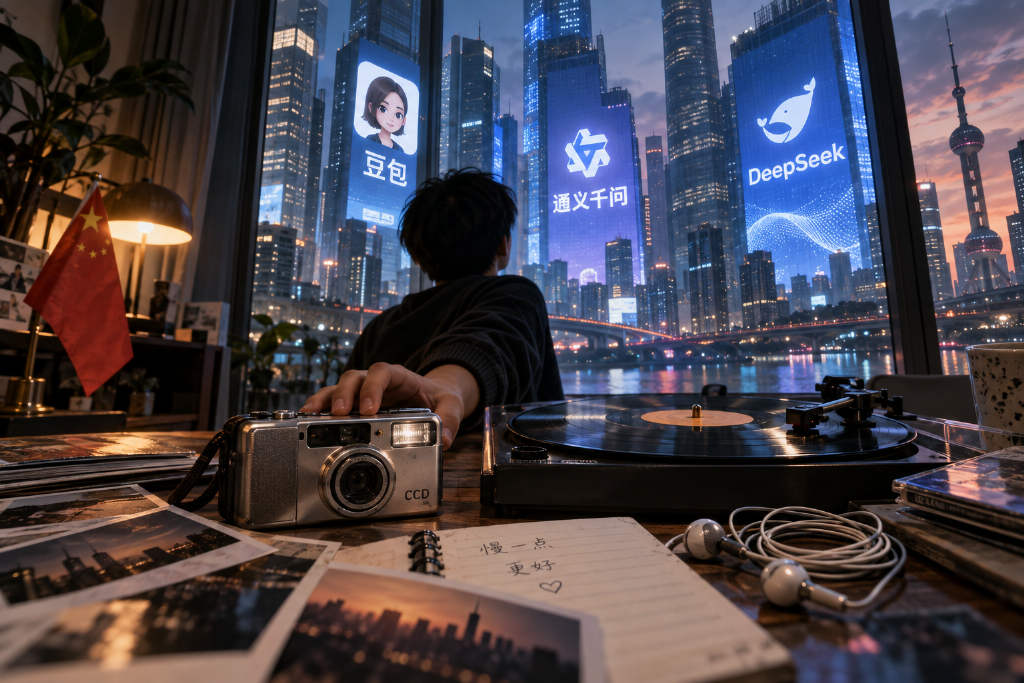
China’s AI-native app user base was close to 500 million in June. Doubao, Qianwen and DeepSeek recorded monthly active users of 382 million, 167 million and 129 million, respectively.
That surge has turned AI literacy into a subtle social pressure point. Job listings increasingly add lines such as “proficiency with AI tools preferred.” On short-video platforms, creators teach viewers how to build PPT decks with AI, mass-produce short dramas, or sell courses on how ordinary people can monetize AI.
Still, using AI and changing one’s fortunes through AI are not the same thing. The article argues that a distinctly modern anxiety has taken hold: many people do not know what AI can actually do for them, but they do not feel they can afford to ignore it.
Public attention is running ahead of real-world adoption
The piece says every major technology cycle creates a boom, but earlier booms often felt more distant from ordinary workers. During the rise of cloud computing, office workers did not need to worry about not knowing how to deploy servers. As electric vehicles spread, consumers could buy or replace cars without learning battery management systems to keep their jobs.
Even with AI now a mainstream topic, it has not fully entered everyone’s daily life. According to CNNIC, China had 602 million generative AI users as of December 2025, equal to a penetration rate of 42.8%. In other words, AI may dominate social media, hiring discussions and tech headlines, but more than half the country was still outside the generative AI user base.
The Report on the Development of Generative Artificial Intelligence Applications (2025) found that middle-aged and younger users with higher education levels remained the core user group. The article’s point is straightforward: the volume of AI discussion and the depth of AI’s presence in ordinary life are not fully aligned.
Many technology shifts first reshape how companies produce goods and services, with consumers feeling the change only after products mature. Generative AI has been different. It has largely skipped that long transmission process and landed directly on people’s desktops and workstations.
Rapid iteration is making stable habits hard to build
The speed of AI development has also made it difficult for ordinary users to settle into stable routines. Earlier this year, people were still discussing how to “raise lobsters” and how to install AI agents on their computers to handle tasks for them. Less than half a year later, OpenAI had already released GPT-6 Astra, pushing computer operation, research, coding and complex workflows into a more integrated system.
That sense of losing control is not limited to the general public. Jacob Coxon, who previously worked in research roles at Anthropic and OpenAI, said publicly after resigning that he feared the two companies were engaged in a race that was “gambling with our lives.” He went further, saying artificial intelligence could destroy everyone.
The article notes that this reflects the judgment of only some AI researchers on risk. Even so, it shows that people closest to the frontier still disagree sharply on how fast AI will develop and where it may end up.
If Coxon’s concern is where AI ultimately leads, the more immediate question for most people is simpler: will it change their jobs first?
Hiring data is already signaling pressure
The answer is beginning to show up in the labor market. PwC data cited in the article shows that in 2025, the share of AI-related roles rose across all industries in mainland China, with AI jobs increasing by 6.4% as a share of total recruitment. The more exposed a profession is to AI, the faster its skill requirements are changing.
Anxiety over skill depreciation has even surfaced inside the AI sector itself. A recent long essay by DeepSeek engineer Liu Sheng drew attention after he wrote that the issue was not that “programmers are about to lose their jobs,” but that the artificial intelligence he had helped optimize was rapidly mastering the professional skills he valued most and took the most pride in. He wrote, “I have no choice but to bury my talent in yesterday.”
At the same time, many jobs still lack a stable framework for evaluating AI capability. The result, the article says, is that AI has become a subject with no clear exam scope: no one can say with certainty what to study, how far to go, or whether it will lead to higher pay or new income.
Resistance to AI is spreading from creators to consumers
Not everyone responds to that uncertainty by trying harder to catch up. On social platforms, phrases such as “AI flavor,” “AI garbage,” “uncanny human feel,” and “boycott AI” are appearing more often. Among creators, the mood has moved well beyond casual complaints.
In 2024, more than 200 musicians, including Billie Eilish, Nicki Minaj, Stevie Wonder and Katy Perry, signed an open letter calling on AI developers to stop using artists’ works, voices and likenesses without authorization to train models, and opposing the replacement of human creation with AI-generated content. On another front, authors including George R.R. Martin and John Grisham became involved in copyright litigation against OpenAI over whether works can enter training datasets without permission.
Those actions are tied to clear copyright interests, but they have also made the question of whether a work was made by a person something consumers can notice and care about.
Games and short-video content are already showing the effect
The game market has produced one of the clearest examples. In 2025, Jurassic World: Evolution 3 disclosed on its Steam page that scientist portraits in the game used generative AI. Players reacted quickly, with some saying they removed the title from their wishlists because of that disclosure. After the controversy continued, developer Frontier said it would remove that generative AI content and use other methods to create the portraits.
By 2026, some market observers had begun describing this mood as an “AI stigma.” Game Oracle analyzed 9,879 paid games launched on Steam in 2025, of which 17.9% disclosed AI use. After controlling for publisher size, developer experience and game genre, titles that disclosed AI use received about 53% fewer user reviews and lower ratings overall.
The article is careful not to overstate the finding. It says the observation does not prove that using AI necessarily leads to poor sales. It does suggest, however, that for some players, AI use has become a factor worth reconsidering before making a purchase.
A similar pattern appears in social content. A 2026 study published in the Journal of Consumer Research analyzed more than 1 million TikTok posts and, together with multiple experiments, found that when content clearly disclosed the use of generative AI, users’ willingness to engage declined overall.
That points to a broader conclusion: wider AI adoption does not automatically make consumers more accepting of AI. Most people are unlikely to join an outright anti-AI camp or stop using the tools altogether, but the discomfort is showing up in quieter ways.
CCD cameras, vinyl and wired earphones are back in view
As learning AI starts to feel like a race with no finish line, the consumer market is also producing a choice that looks almost retro. On one side, phones, glasses, earphones and toys are all adding AI and promising to be smarter, more automatic and more attuned to users. On the other, products with no algorithms, no connectivity and little that would count as advanced by current standards are being bought again by younger consumers.
The shift is especially visible in imaging products. The article describes Shanshan, who lives in Beijing, pulling a Canon IXUS 110 back out of storage. The camera was released in 2009 and had been sitting unused for years. She told Yiyou that she had noticed the return of retro cameras on social platforms, remembered that her family had one, and decided to dig it out and try it casually.
Yiyou checked second-hand platforms and found that the model, despite being more than a decade old, had not clearly depreciated, with listings generally still around RMB 1,000. Beyond the price, Shanshan said she had started studying the camera itself again: “When you adjust the parameters, each result really is different. It may take some trial and error, but it does seem interesting.” She bought a battery and data cable so she could take the long-dormant camera outside again.
The article says this is no longer just a niche hobby. Xinhua, citing Xianyu data, reported that by the end of 2024, weekly CCD camera transactions on the platform had exceeded 3,000 units, while daily searches topped 19,000. In the first quarter of 2025, sales of items tied to the “Chinese dreamcore” trend on Xianyu rose 70% from the previous quarter, with CCD cameras leading the category. Buyers born after 1995 accounted for nearly 80% of purchases of related older electronics.
Streaming dominates, but vinyl has grown for 19 straight years
The same split is visible in music consumption. Global streaming revenue exceeded $22 billion in 2025, accounting for 69.6% of total recorded music revenue, and the number of paid streaming users worldwide reached 837 million.
Yet vinyl has now posted 19 consecutive years of growth. In the United States, vinyl revenue topped $1 billion in 2025, up 9.3% year over year. Unit sales reached 46.8 million, compared with 29.5 million CDs.
Once technology has made access to music simple enough, some consumers are willing to pay for the process beyond access itself. And the people buying vinyl again are not only those who lived through the record era.
A 2025 Vinyl Alliance survey of more than 2,500 vinyl enthusiasts worldwide found that among respondents aged 18 to 24, 76% bought vinyl at least once a month and 80% owned a turntable. Half of Gen Z respondents said one reason they liked vinyl was that it let them “temporarily step away from digital life.”
Vinyl is also becoming less of a pure music carrier and more of a combination of album, merchandise and collectible. Taylor Swift’s The Life of a Showgirl was released in multiple vinyl versions with different colors, covers and packaging, and some limited editions sold out in less than an hour.
The article points to similar examples in China. In 2026, Cai Xukun released the physical album KUN with a standard CD edition, a vinyl collector’s edition and a turntable bundle, selling more than 120,000 copies within three hours. Earlier, Hua Chenyu’s New World physical vinyl release sold 127,000 copies and generated more than RMB 35 million in transaction value. Lu Han and Jay Chou also released anniversary vinyl editions or vinyl bundles.
Low-tech consumption is not a rejection of AI
Renewed interest in low-tech products is spreading into more categories. This year alone, wired earphones and the iPhone 4 have both returned to the view of younger consumers.
After five straight years of declining sales, wired earphones rebounded in the second half of 2025, with sales up 10% year over year. Growth accelerated in 2026, when industry revenue rose 20% from a year earlier and product search volume increased 88% compared with 2025. The white cable once displaced by wireless earbuds has become, in the article’s telling, a new expression of taste and attitude.
The piece closes by arguing that this wave of low-tech consumption is not a denial of AI. It looks more like a rebalancing after a period of rapid technological acceleration. AI is making outcomes cheaper, while human participation may be becoming more valuable.
The race to keep up with AI may have no endpoint, but human tolerance does. What consumers appear to want is not a full escape from technology, but the ability to retain control over pace and participation in an increasingly intelligent world.
This article was originally published by the WeChat public account Yiyou (ID: i-yiou) and written by Li Qiongru.