
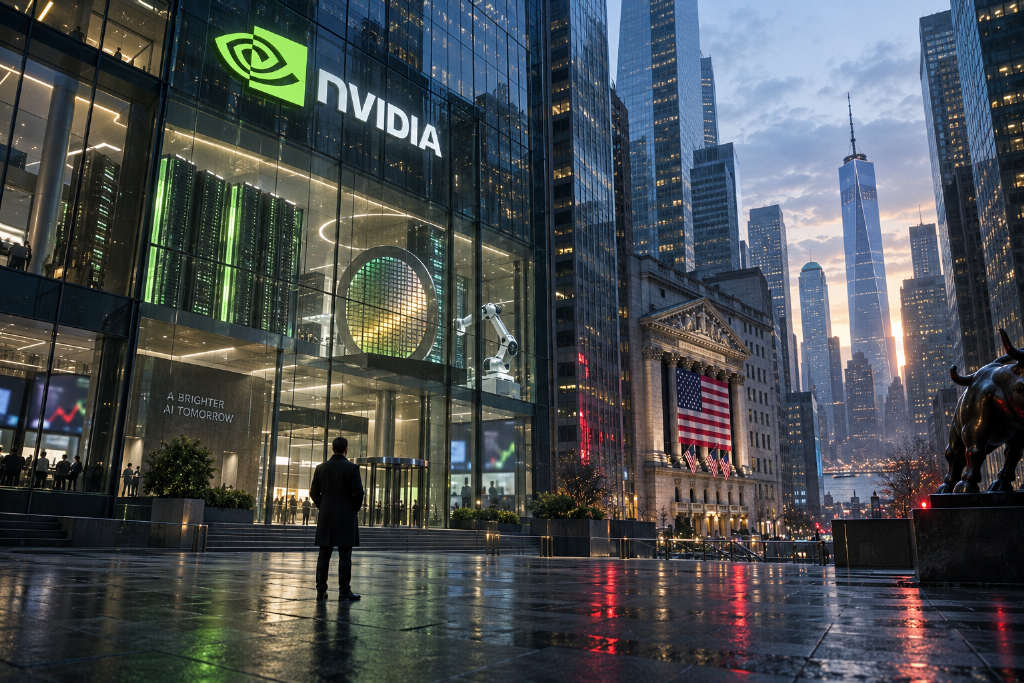
The market’s argument over artificial intelligence has sharpened: is this still an investable boom, or is it moving toward a bubble that needs hedging? Galaxy Digital CEO Michael Novogratz said AI is in a huge bubble, but he also said speculative enthusiasm is likely to keep expanding. Bridgewater founder Ray Dalio has issued a much harder warning, saying the combination of rising borrowing costs and higher interest rates is bringing the market closer to a breaking point.
The numbers behind the debate are large. Nvidia’s market value is nearing $6 trillion, and major global technology companies are expected to spend more than $1 trillion on AI infrastructure next year.
AI stocks keep driving US equity benchmarks higher
AI-linked shares have helped push both the S&P 500 and the Nasdaq to fresh highs, with Nvidia remaining the clearest bellwether in the trade. Its market capitalization is now close to $6 trillion.
Investors also expect global large-cap technology companies to spend more than $1 trillion on AI infrastructure next year. That spending wave has not gone unquestioned. Some companies are relying heavily on debt financing to support those plans, raising doubts over whether long-term profitability will be strong enough to justify the current infrastructure buildout.
Another camp sees the picture differently. In that view, major technology firms still have ample financial strength, earnings have risen sharply, and lower price-to-earnings ratios leave room for AI to deliver meaningful productivity gains over time.
Bulls say valuations are not yet in extreme territory
Some market participants remain relatively upbeat despite the bubble talk. Novogratz said AI-related stocks still look attractive on a price-to-earnings basis and that the bubble has not reached an extreme stage.
DBS Group Chief Investment Officer Hou Wey Fook made a similar case. He said Nvidia’s estimated earnings growth for next year is 70%, while its price-to-earnings ratio is near its lowest level since 2016, a sign that the market has not yet entered a full bubble zone.
He also pointed to US-China technology competition, saying the US is unlikely in the short term to slow AI industry development through regulation if it wants to preserve its lead.
Dalio calls it a classic bubble as rates rise
Dalio has repeatedly warned about the AI frenzy and has described it as a “classic bubble.” He said investors will face growing financial pressure to convert paper wealth into cash as long-term borrowing costs and interest rates continue to rise.
In his view, persistent rate increases will be the key trigger for a bubble break, and the market is gradually moving toward that threshold. That comparison between the current AI boom and the late-1990s internet bubble is also prompting some investors to revisit their asset allocation.
Institutions look to derivatives for protection
With views on AI stock valuations increasingly polarized, institutional investors are laying out more concrete responses. Bank of America strategists said investors worried about large technology holdings can use equity derivatives in portfolio positioning.
The idea is to stay involved in a market that is still making new highs while adding downside protection in case the bubble bursts or equities pull back.
Goldman Sachs has suggested a related approach: stay long nominal assets, avoid bonds, and pair that position with low-cost VIX derivatives as a hedge.