
Leverage Risks in the AI Bull Market
Global stock markets, driven by the AI wave, have repeatedly hit new highs. However, the fuel supporting this rally—leverage—is becoming increasingly dangerous. From the United States to South Korea, margin debt and the scale of leveraged ETFs have climbed to historic limits. The pro-cyclical nature of leverage is amplifying tail risks of market volatility exponentially. South Korea has already issued a warning, and Wall Street analysts are issuing dense alerts.
US Leverage Data: Margin Debt and ETF Surge
Financial Industry Regulatory Authority (Finra) data shows that US margin debt surged 54% year-over-year in May, reaching a record $1.4 trillion. Concurrently, total assets in leveraged ETFs nearly doubled in less than 70 days, exceeding $220 billion by June 3. The most sought-after products are concentrated in tech and semiconductor indices, as well as single-stock leveraged funds for Tesla, Nvidia, and recently SpaceX. The Direxion 3x Bull Semiconductor ETF gained approximately 700% between late March and late June, but plunged 31% in a single day on June 5, magnifying the benchmark index's decline threefold.
Leveraged fund operations further amplify market volatility. Barclays estimates that leveraged funds have purchased about $300 billion in derivatives tied to individual stocks and indices since late March. After accepting these contracts, market makers must buy spot stocks in the opposite direction to hedge their exposure, fueling tech stock gains. However, when the direction reverses, shrinking leveraged fund assets force position reductions, creating a negative spiral.
South Korea's Stress Test: Concentration and Circuit Breakers
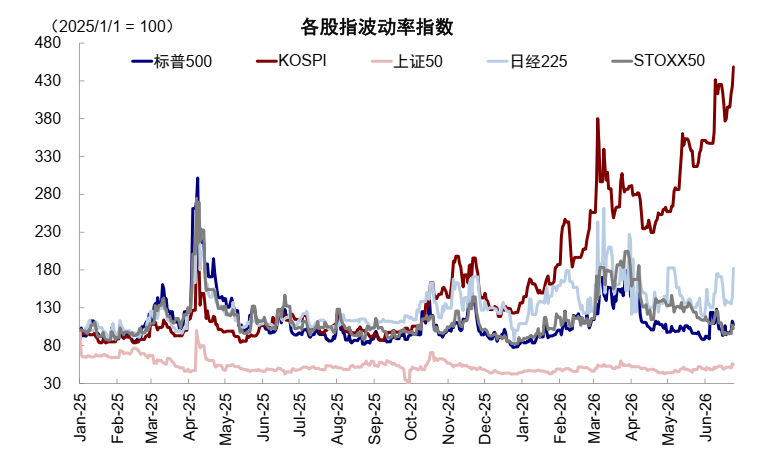
The extreme volatility in South Korea's market within a week is viewed as a stress test reference. The KOSPI index has gained 87% year-to-date, led by memory chip giants Samsung Electronics and SK Hynix. However, highly concentrated holdings combined with extreme leverage made the market acutely fragile: concerns over memory chip capacity expansion and a discussion on taxing unrealized gains triggered a 10% single-day crash and circuit breaker; the index then rebounded strongly over two days before another circuit breaker on Friday.

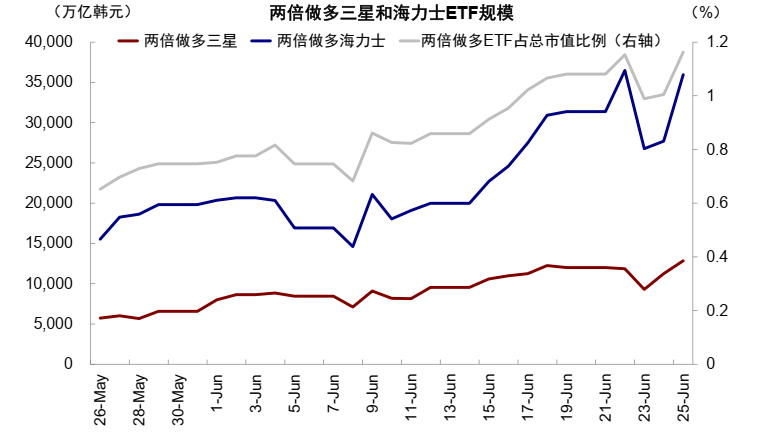
According to CICC estimates, Korea's onshore leverage multiples range from 2x to 5x, with broad leverage reaching 271 trillion won, a historical high—theoretically, a 16% to 36% decline in the underlying assets could trigger margin calls. Trading in leveraged funds tracking Samsung and SK Hynix recently accounted for 50% of average daily volume in those stocks, amplifying two-way volatility. Lee Chan-jin, head of Korea's Financial Supervisory Service, expressed regret at not blocking the issuance of single-stock leveraged funds, as about 92% of holders are retail investors.

Wall Street Warnings: De-leveraging Risk and Non-linear Shock
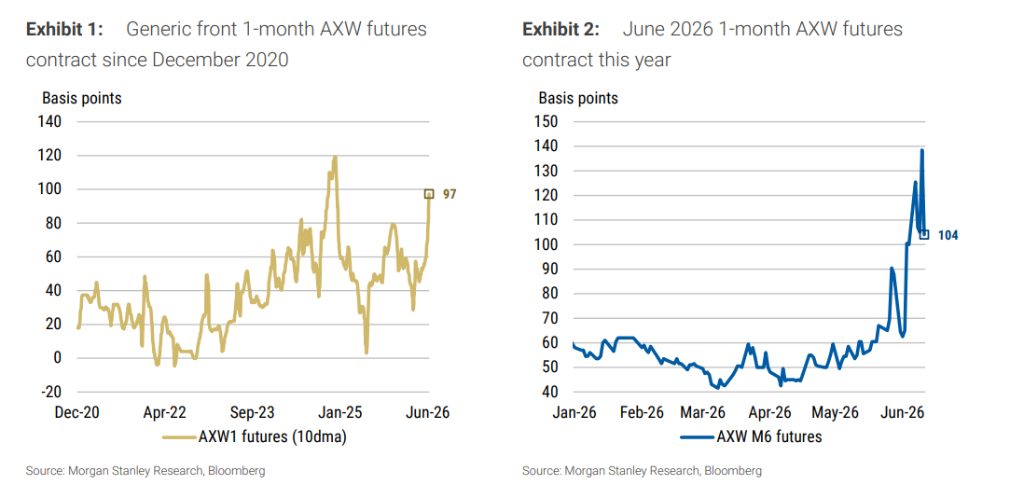
Barclays analyst Alexander Altmann warned clients that the $300 billion in derivatives accumulated by leveraged funds, if forced to liquidate in a short period, would deliver a 'chilling' impact, calling it the largest involuntary risk source in the market. Morgan Stanley also warned that the marginal buyers of US stocks are more dependent on leverage than ever, while financing is becoming more expensive and scarce. The AXW futures—measuring financing cost via the spread between S&P 500 total return futures implied financing rate and SOFR—for the June contract surged to +140 basis points, the highest since December 2020.

Morgan Stanley's 'equity financing dependency' metric (primary dealer equity repo divided by S&P 500 free-float market cap) has surged nearly 50% over the past year. Over the past three months, only the information technology sector among 11 GICS sectors outperformed the S&P 500, gaining 24.2% with 13.3% excess returns; on about 70% of trading days, fewer than 5 sectors beat the index. This means the market's rise is supported by leverage in a handful of sectors, and when those funds retreat, the shock is synchronously amplified. Morgan Stanley warns that the current situation constitutes a non-linear risk: high financing costs force leveraged buyers to stop adding positions, price corrections trigger de-leveraging, losses are magnified, and ultimately the decline may exceed expectations.