

Bank of America Securities chief investment strategist Michael Hartnett warned that global bond yields at two-decade highs are becoming the biggest threat to the AI capital spending boom, with the coming U.S. midterm election potentially serving as the market trigger.

In the latest edition of his Flow Show weekly note, Hartnett said a Democratic sweep of both chambers of Congress could send U.S. equities down more than 10%, weaken the U.S. dollar, push bond yields lower and leave the AI bubble exposed to a break. He called a Democratic sweep one of the market's largest tail risks and said investors have done little to price it in.
Polymarket data showed the probability of Democrats sweeping both chambers had risen to 50%, far above the 10% probability assigned to a Republican sweep. Trump’s approval rating is currently running in the 35% to 40% range, below the historical average of 53% seen two months before past midterm elections. Hartnett said that political backdrop reinforces his warning.
Bond markets are sending the first warning
Hartnett said the most important development last week was not stronger-than-expected jobs data, but the broad breakdown in global bond markets.
The U.S. 10-year Treasury yield climbed to 4.81%, near levels seen during the 2008 financial crisis, while the 30-year Treasury yield rose to 5.31%, the highest since 2007. In Japan, the 10-year government bond yield moved above 3.0% for the first time since 1996, and the 30-year yield reached 4.2%, about four times the Bank of Japan policy rate.
Europe was also under pressure. Germany’s 10-year Bund yield rose to 3.38%, the highest since 2011. The France-Germany spread widened to 88 basis points and the Italy-Germany spread reached 84 basis points, both touching levels seen during the 2012 eurozone debt crisis. The Bloomberg global bond yield index has climbed to its highest level since 2007 and now sits just 1 percentage point below this century’s peak.
Hartnett summed up the setup with a simple line: “Bonds drive bubbles.” In his view, long-end yields, not stock market storytelling, are the real anchor for the AI trade. Until global 30-year yields move back below 5%, he expects builders and financiers of AI infrastructure to keep lagging the companies that apply AI technology.
The midterm election as an underpriced market variable
Hartnett said this election is not a regime-change event on the scale of Thatcher and Reagan in 1980 or Brexit and Trump in 2016, and it will not fundamentally alter the upward path of U.S. government spending. Even so, he argued that differences in the election outcome still matter for asset prices.
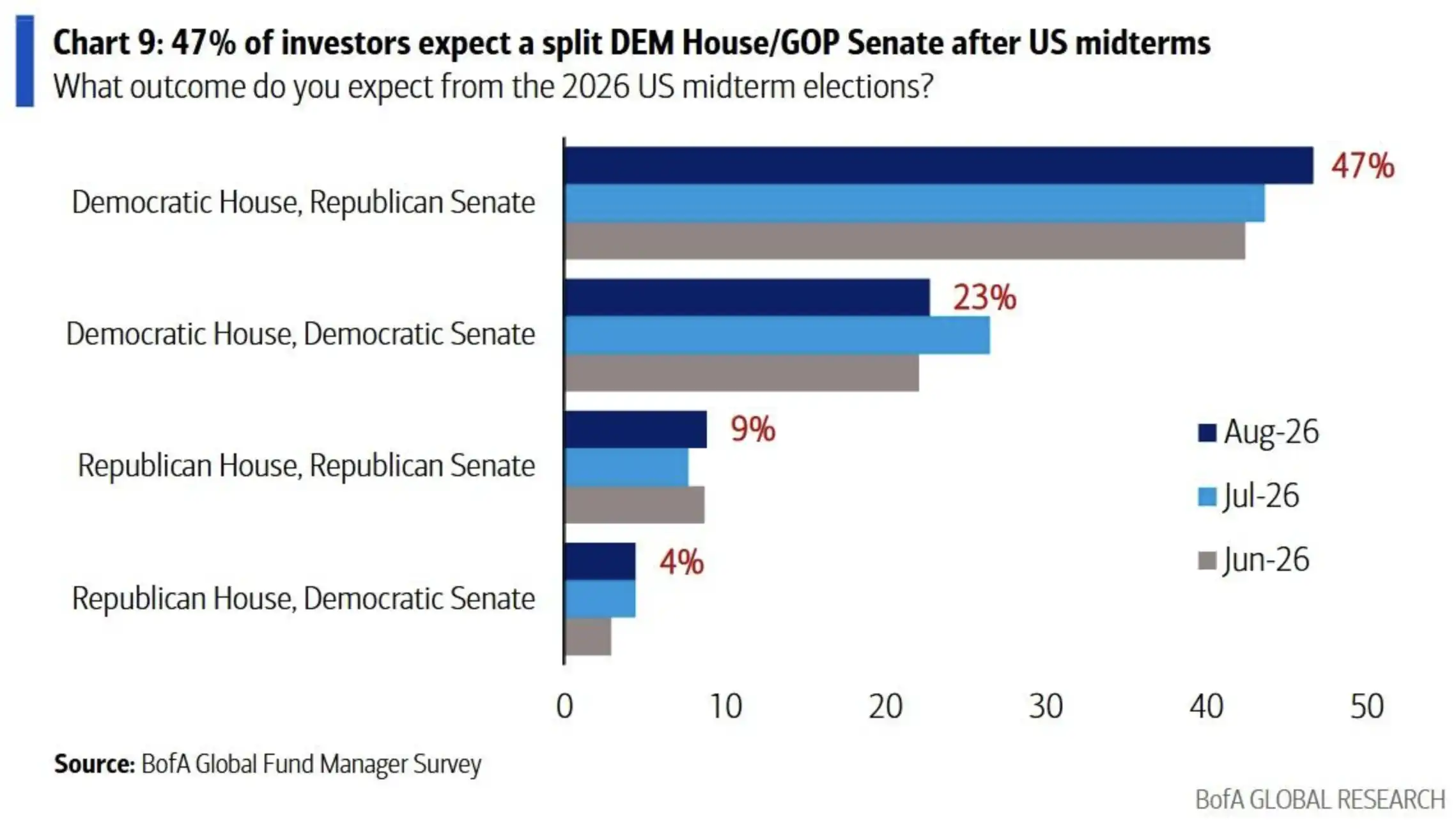
Bank of America’s August fund manager survey showed 47% of respondents expect a split result with Republicans controlling the Senate and Democrats controlling the House. Another 23% expect a Democratic sweep, while only 9% expect Republicans to retain control of both chambers. Republicans currently lead 53-47 in the Senate and 218-212 in the House.
For Democrats to secure a sweep, Hartnett said they would need to flip at least four of six vulnerable Republican Senate seats: North Carolina, Maine, Alaska, Ohio, Texas and Iowa, where flip probabilities are 92%, 69%, 64%, 55%, 51% and 37%, respectively. At the same time, Democrats would have to hold their own vulnerable seats in Georgia, New Hampshire and Michigan, with probabilities of 94%, 84% and 65%. He singled out Ohio, Texas, Iowa and Michigan as the key battleground states investors should watch.
Wall Street is also watching the Texas governor’s race. Incumbent Republican Governor Abbott has a 49% approval reading, compared with 45% for Democratic challenger Hinojosa. Hartnett said the contest is being viewed as an important signal for the future direction of AI data center expansion policy. Abbott has recently announced a pause on data center construction to stop further slippage in the polls.
How a Democratic sweep could hit markets
Hartnett laid out a direct transmission path for markets under a Democratic sweep scenario.
He said a shift from “populist capitalism” to “populist socialism” would mean taxes and regulation moving higher instead of lower, putting pressure on corporate profits. He also said policy priorities such as lower inflation, better healthcare access and relief for K-shaped wealth inequality would directly hit the AI capex boom and the “too big to fail” Wall Street model. In the same scenario, a loss of Trump’s political capital would weaken his ability to act on priorities tied to AI, resource concentration and external pressure in diplomacy.
Based on that framework, Hartnett’s asset-allocation recommendation under a Democratic sweep is to short financial stocks and the dollar as the preferred hedge. He said equities would fall more than 10%, the dollar would weaken and bond yields would decline. He also expects international equities to outperform, with Europe doing better than Asia.
If Republicans unexpectedly hold both chambers, Hartnett said that would signal a full rebound in risk appetite, give the AI bubble a green light and revive the narrative of U.S. dollar exceptionalism. The most likely outcome, in his view, remains a split government with Republicans holding the Senate and Democrats holding the House, a setup he described as a moderate-risk “Goldilocks” gridlock.
Allocation stance: long commodities and gold, cautious on crowded AI trades
Within that broader macro framework, Hartnett kept his cross-cycle core allocation unchanged: long commodities and gold as hedges against inflation and geopolitical risk.
He said governments’ willingness to intervene fiscally “at all costs” is suppressing long-end yields and supporting nominal GDP growth. Under that backdrop, his strategic view remains that “any asset is better than bonds.”
AI crowding risk and a tactical bond call
Hartnett was more blunt on AI positioning. He said hyperscale cloud companies have already seen free cash flow turn negative under the pressure of capex commitments, leaving the AI bubble vulnerable to breaking “at any time.”
He proposed a post-bubble framework of “long humiliation, short arrogance,” urging investors to rotate toward long-duration bonds and defensive sectors, including consumer staples, mining and materials, and healthcare, while avoiding crowded trades tied to AI infrastructure buildout.
From a longer-term perspective, Hartnett also highlighted a reversal signal. Over the past 10 years, rolling returns have been 15% for U.S. stocks, 11% for commodities and -2% for Treasuries, the worst bond record in nearly a century. Historical data show that when long-term bond returns turn negative, it has often marked favorable entry points for stocks, including 1939, 1974 and 2009, and for commodities, including 1933 and 2018. That, he said, provides the historical basis for his tactical bullish view on bonds in the fourth quarter.