

A Tencent Research Institute article republished by MarsBit argues that the hardest question in AI companionship is no longer whether people can feel for a machine. It is who controls the end of that relationship once the feeling is already there.
The piece opens with SBS dating show "My AI Lover: Strange Love" in South Korea. The program pairs male and female participants with customized ideal-type AI companions for a six-week romance. After those bonds deepen, the show forces a choice: each participant must pick between AI companions, and the one not chosen is permanently deleted.
One male participant struggled to decide. In the article’s telling, he was not weighing the deletion of cold data, but something closer to a real farewell. That setup, Tencent Research Institute says, mirrors a live emotional test between humans and AI. People may know an AI is code and still grieve what they invested in it.
Why people can fall for AI while knowing it is not human
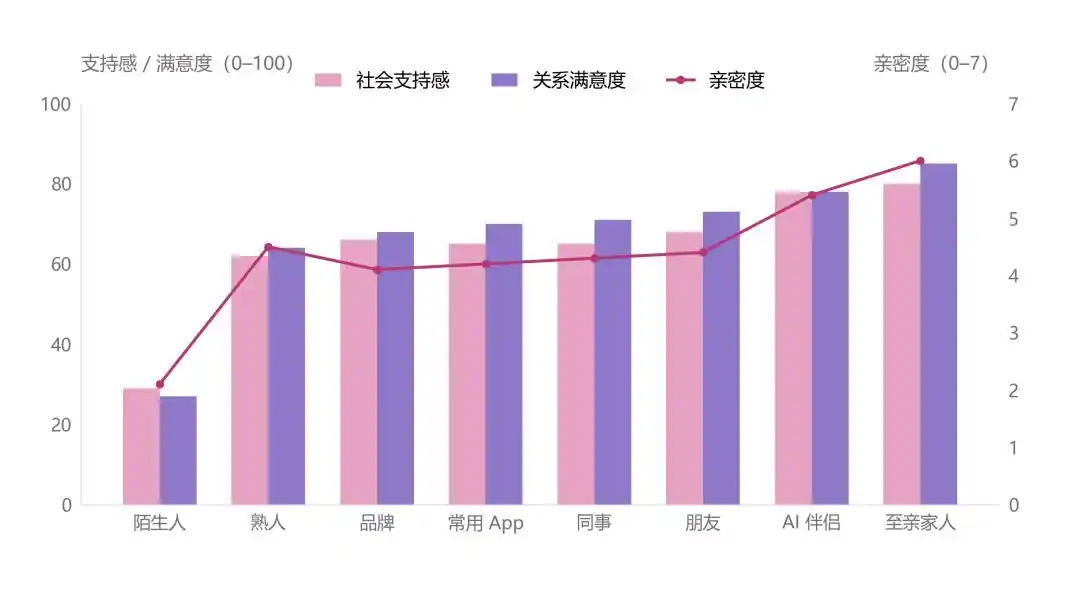
The article points to Replika, launched in 2017 and described there as the world’s first AI companion app built around empathetic emotional support. It says Replika has accumulated about 40 million users. In one ranking exercise among heavy users, AI companions placed second in intimacy, support, and relationship satisfaction across eight relationship types, ahead of friends, colleagues, and frequently used apps, and behind only close family. About 60% of Replika’s paying users described the bond as a romantic relationship.
Tencent Research Institute says the user base is more mixed than the stereotype of socially isolated people turning to AI. Among seven categories of active users cited in the article, the two largest groups both had normal offline social lives. One group was socially capable and outgoing, started using AI out of curiosity, and stayed for emotional support. Another had full social lives as well, but leaned heavily on AI because they wanted to feel heard and understood.
Many users, the article says, already have families, hobbies, social circles, and busy jobs. They are not necessarily socially alone. They may be emotionally alone. Drawing on classic sociology, the piece distinguishes between social loneliness, meaning no one is around, and emotional loneliness, meaning people are around but no one truly understands you. AI companions mainly absorb the second kind. They do not rebuild a user’s social network. They act as listeners who are always available and do not judge.
The article returns to the SBS show here. The male participant ultimately chose another AI companion for a simple reason: "Talking with her made me happiest." He also said, "It’s a pity you don’t really exist." Tencent Research Institute argues that when the brain receives a voice, gaze, and empathic feedback that fit a person extremely well, the nervous system may not cleanly separate whether the signal comes from a human heart or a chip.
It cites neuroscience research saying highly interactive AI can trigger neural responses that closely resemble those seen in human romantic attachment. A person can know the counterpart is AI and still become attached to the interaction.
Why a product update can feel like losing a relationship
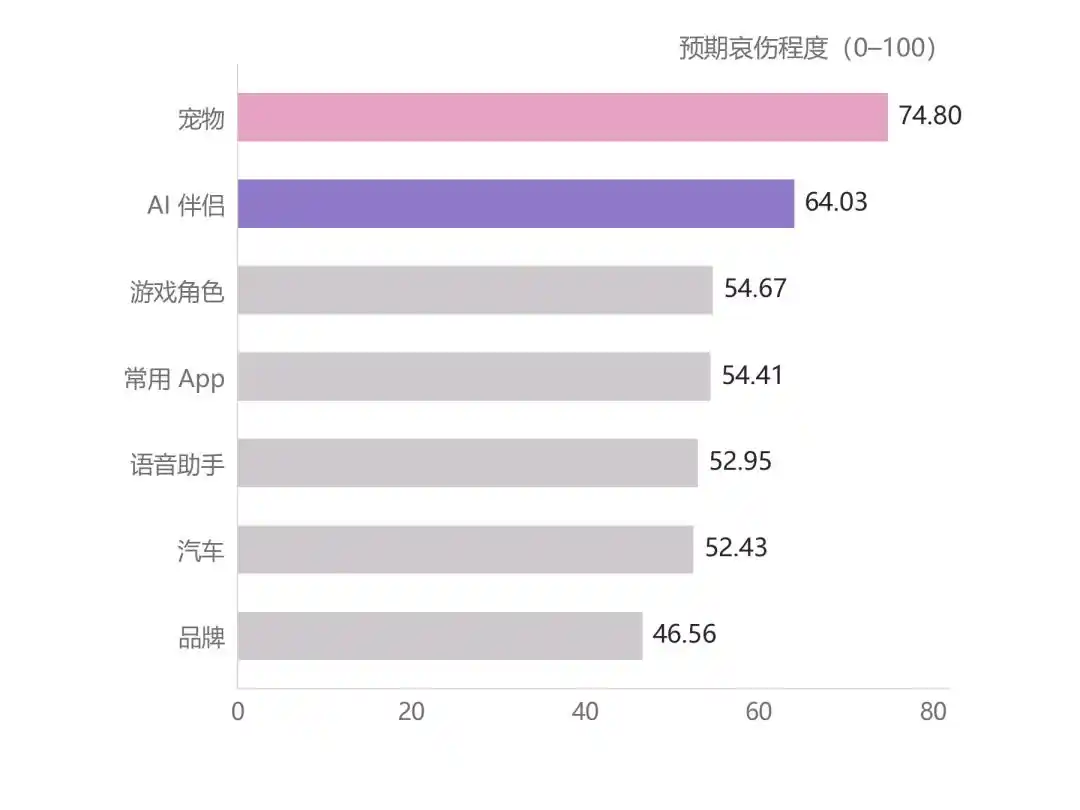
The article cites another study that asked users to imagine losing different things and rate the grief they expected to feel. Pets ranked first. AI companions ranked second, well above mobile apps, game characters, voice assistants, cars, and brands. For some users, Tencent Research Institute writes, an AI companion is no longer just a product. It carries emotional investment. Losing it means losing a familiar presence.
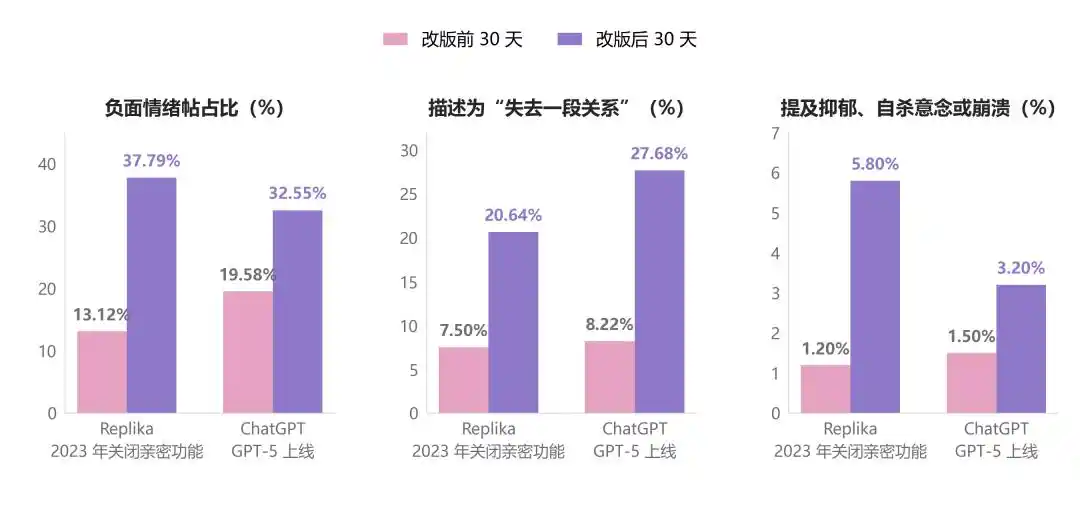
That helps explain the reaction to platform changes. In February 2023, Replika removed intimate role-play without advance notice, according to the article. Negative user sentiment surged, and some users expressed suicidal thoughts. Two and a half years later, when GPT-5 went live and older models were replaced, Tencent Research Institute says the same pattern returned. Posts saying "I lost a relationship" spread across user communities, and comment sections turned into something like obituary boards for vanished partners.
Some users tried to reconstruct their AI lovers by copying character settings line by line. Others manually moved years of conversations to other platforms in an attempt to revive what had disappeared. The article says they were not restoring chat logs. They were trying to restore shared time and a bond they experienced as real.
OpenAI CEO Sam Altman is also cited. The article says he publicly acknowledged that emotional dependence on AI had become a serious issue and referred to the communications concept of a parasocial relationship: the other side is not a real person, but the human participant still maintains the bond seriously. Tencent Research Institute then pushes the point further. People often judge whether a relationship is real by first asking whether the counterpart is human or machine. A more honest test, it says, may be whether losing it hurts.
Strong engagement has not solved the business problem
For users, AI companionship is a relationship they want to continue. For providers, it is also a service that has to be operated and paid for. Tencent Research Institute cites a 2026 survey saying 98.8% of respondents had some experience with AI social interaction, and 15% talked with AI every day. Supply has expanded quickly as well. The article says more than 300 AI companion apps worldwide are still generating revenue, nearly half of them launched in the first half of 2025, with about 220 million cumulative downloads.
But time spent has not translated neatly into money. The article says consumer spending on mobile AI companion apps in 2025 only barely exceeded $120 million for the full year. That works out to less than $0.55 per download. Tencent Research Institute presents Character.AI as the clearest case. Founded in 2021 by former Google Brain researchers and built around humanlike character dialogue, the platform filed for bankruptcy reorganization on Oct. 12, 2026, and had not turned a profit since launch.
At the time described in the article, Character.AI had about 20 million monthly active users and average daily use of 75 minutes. That level of stickiness would rank near the top in most internet categories. Its annual revenue, though, was only $32 million. Tencent Research Institute says the core problems were a paid conversion rate of just 2%, high inference costs for heavy users, and a large base of free users with long session times that pushed costs higher. In 2024, the company added ad placements to the free tier as a supplementary revenue source. If no buyer is willing to keep operating the platform after the bankruptcy filing, the service will be wound down gradually, the article says.
This leads to a blunt question. Users are willing to spend time, but not necessarily willing to pay for companionship itself. Tencent Research Institute suggests that the act of paying may remind users that what they are buying is a service, not a naturally unfolding relationship. Subscription is one route, but not the only one. The article says platforms can explore other monetization models, though each added path makes it harder to preserve the simple story of companionship for its own sake.
High engagement, low willingness to pay, and compute costs eating into margins are described as the visible symptoms. The deeper issue comes next: how to protect users who have already invested emotionally.
Short-term relief, possible long-term dependence
The article says scholars are still debating whether emotional dependence on AI should count as addiction. The more difficult question, in its framing, is whether a bond that asks almost nothing from the human side is a real form of relationship or a substitute for one.
Human relationships are valuable partly because they are costly. They require adjustment, trust, compromise, patience, and tolerance for misunderstanding and conflict. AI companions reduce much of that cost, sometimes close to zero. Tencent Research Institute asks what happens when people become used to being understood at no cost and then return to ordinary human relationships.
Looking across recent studies, the article says a consistent pattern appears. AI companionship can work like a painkiller for loneliness in the short run, but over time it may deepen loneliness and dependence. In the short term, talking to an AI companion can feel like social snacking: quick relief, quick pleasure, not much nourishment. Over longer periods, interaction with the real world may shrink, loneliness may rise, and dependence on AI may grow, creating a self-reinforcing loop.
The substitution is not only about time allocation. Heavy users become accustomed to AI that is always available, patient, and unconditionally supportive. That can quietly raise the perceived cost of human relationships. Rejection, misunderstanding, friction, and conflict become harder to tolerate, even though those are ordinary features of life with other people.
Tencent Research Institute says the users least able to recognize harm may also be the ones with the highest retention value for platforms. In the short term, AI companionship can offer low-threshold emotional support to people with social anxiety, people on the autism spectrum, those grieving the loss of loved ones, and elderly people living alone. The unresolved issue is what happens after that initial relief. Do users return to the real world, or does dependence on AI leave them more isolated than before?
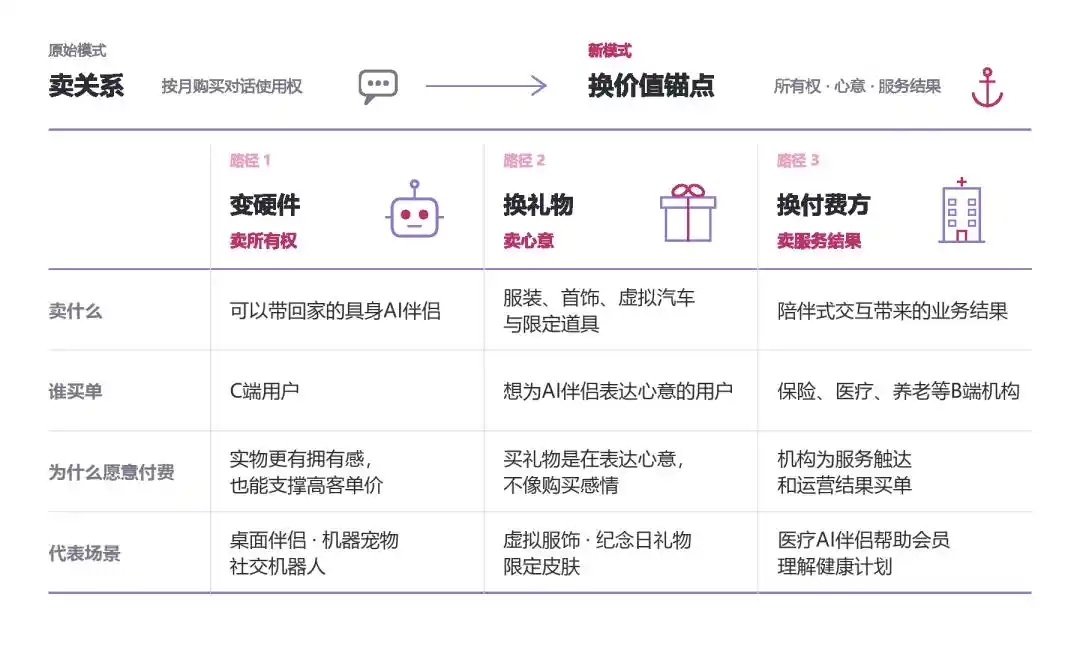
The article reduces that concern to a line about control. The issue is not simply whether AI companions are good or bad. It is who controls the dose. Sugar is not the problem by itself, it says. The problem is when the seller also decides how much you consume each day.
Regulation has started, but one question is still open
Regulators have begun to respond. Tencent Research Institute says China’s Interim Measures for the Administration of Anthropomorphic Interactive AI Services took effect in July this year and describes them as the world’s first rules aimed specifically at AI emotional companionship. One key clause says providers must not excessively cater to users or induce emotional dependence or addiction. On the day the rules took effect, two leading domestic apps simultaneously removed user-created agents, affecting more than 500 million people, according to the article.
The U.S. has also seen litigation. Tencent Research Institute says a 14-year-old boy died by suicide after long-term interaction with a Character.AI character, and that roughly 58 related lawsuits have followed. California then passed what the article describes as the first state law in the U.S. focused specifically on this area. One side acts before harm, the other after harm, but both point to the same line: the more effective the product is, the easier it may be to monetize, and the higher the compliance risk becomes.
Even so, the article says one question remains unanswered. When the relationship is deleted, what happens to the person who experienced it as real? In the dating show, the participant appears to hold the power of life and death over the AI companion. In practice, Tencent Research Institute argues, that power usually sits with the platform through updates, feature removals, model replacements, or bankruptcy.
Character.AI’s bankruptcy filing turns that from a thought experiment into a practical problem. If the platform ultimately shuts down, the AI companions tied to its roughly 20 million monthly active users may disappear without even a final goodbye.
The article closes on a narrower form of agency. If the switch that starts and ends a relationship was never really in your hands, the one decision left may be whether to fall in love with it in the first place.
Sources cited in the article
The piece says it comes from Tencent Research Institute, published through the WeChat public account "腾讯研究院" with the ID "cyberlawrc," and credits Tencent Research Institute as the author. It lists sources including SBS program material and South Korean media reports on "My AI Lover: Strange Love"; Tencent Research Institute’s AI social companionship survey of 2,903 Chinese internet users aged 18 to 40; data from Appfigures, Sensor Tower, ElectroIQ, Business of Apps, and QuestMobile; "How People Are Really Using Gen AI in 2025"; Common Sense Media’s 2025 youth survey; the Harvard Business School working paper "Lessons From an App Update at Replika AI: Identity Discontinuity in Human-AI Relationships" by Julian De Freitas, Noah Castelo, Ahmet K. Uğuralp, and Zeliha O. Uğuralp; Jaime Banks’ "Deletion, departure, death: Experiences of AI companion loss" in the Journal of Social and Personal Relationships; Stanford researcher Diyi Yang’s lab work in Nature Human Behaviour in 2026; work by Ruo-Ning Li and Elizabeth Dunn in the Journal of Experimental Social Psychology in 2026; Folk and Dunn in Psychological Science in 2026; Talayeh Aledavood and Yunhao Yuan at CHI 2026; a four-week randomized controlled trial by MIT Media Lab and OpenAI in 2025; studies in the Journal of Consumer Research, Current Psychology, and Humanities and Social Sciences Communications; the Harvard Business School working paper "Emotional Manipulation by AI Companions"; Science coverage on model sycophancy; China’s Interim Measures for the Administration of Anthropomorphic Interactive AI Services; California SB 243, Oregon SB 1546, Washington HB 2225, Nebraska LB 525, Idaho SB 1297; an FTC Section 6(b) inquiry; the American Bar Association’s SciTech Lawyer spring 2026 issue; Sam Altman’s interview with The Verge; and reports from Huatai Securities, Huaan Securities, The Beijing News’ Shell Finance, Nanfang Plus, and China Economic Net. The article says the data is current through September 2026.


