
Crypto’s AI problem may be less about breaking Bitcoin or Ethereum at the protocol level and more about making the rest of the stack harder to defend. That is the argument in a MarsBit article published after what it describes as the largest theft in the industry’s history, a raid that drained roughly $6.3 billion in multiple cryptocurrencies from a hot wallet.
A week after CZ’s comments, a record theft hit the market
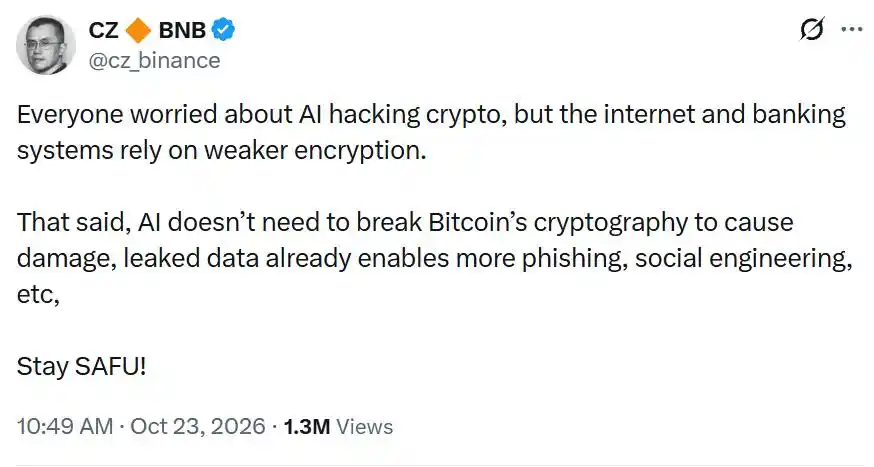
On Oct. 23, Changpeng Zhao, known as CZ, wrote that cryptocurrencies would not be threatened by AI and that their security was stronger than that of banks and the internet. Rather than worrying about AI attacking crypto, he said, users should be more concerned about phishing links.
One week later, the market was hit by what the article calls the biggest theft on record. A single transaction swept multiple crypto assets out of a hot wallet, with the total value put at about $6.3 billion.
For comparison, the previous industry record cited in the piece was a theft of about $1.5 billion in February 2025. This case was several times larger.
Chainalysis said the attacker completed high-frequency, large-scale transactions in an extremely short period of time, and the article says the firm viewed the operation as clearly AI-driven. Even with scripts, it argues, a human operator would not have been able to execute the same pattern.
After the incident, Bitcoin fell from above $81,000 to around $76,300 at one point, a drop of nearly 6% and a six-week low. About $1.5 billion in positions were liquidated over 24 hours.
Even so, the article says the theft should be seen as a “symbolic event,” not a starting point or an endpoint. In its telling, attacks on crypto are not about to stop.
Attack counts and vulnerability disclosures are rising
The piece cites a Blockworks report saying that more than 300 crypto attacks have taken place this year, up 111% from a year earlier. In the third quarter alone, it says, there were 255 security incidents.
It also cites Epoch AI, which reported about 1,500 high-severity and critical vulnerability disclosures across the industry in June 2026, more than 3.5 times the previous monthly record. The article says Epoch AI traced that jump to Anthropic’s Mythos and argued that stronger AI cybersecurity capabilities were exposing flaws that humans would have struggled to find.
Ethereum Foundation researcher Justin Drake is quoted in the article as saying AI may need only a few months to find ways to crack Bitcoin and Ethereum wallets. Even moving assets to fresh addresses whose public keys have not yet been exposed, a strategy he has described as “fortress mode,” would only buy time.
How the $6.3 billion theft unfolded
According to the report, the attacker was preparing as early as Oct. 28. A new on-chain wallet address was created to serve as the operational account for the theft.
Someone then sent a small amount of funds to that address. The purpose was to pay transaction fees for the later steps and to test whether the newly created wallet was functioning properly.
The actual attack began in the early hours of Oct. 30, Beijing time. Assets started flowing out across multiple blockchains, and the main phase took about 20 minutes.
Over the next several hours, the attacker returned to the same wallet and kept looking for more assets to move. On Ethereum alone, outflows exceeded $3.3 billion.
Platforms suspended withdrawals, while issuers and on-chain partners moved to freeze related assets. Roughly $3 billion was immobilized, and the rest began moving across chains, being split up, and exchanged.
Other major incidents in the third quarter followed a similar pattern
CertiK recorded 247 security incidents in the third quarter of 2026, with total losses of about $1.26 billion, the article says. September alone accounted for roughly $768.5 million.
Beyond the $6.3 billion case, the quarter’s two other major crypto thefts were said to have taken place at Bitget and Liquid Network, with losses of about $388 million and $319 million.
Bitget’s post-incident investigation found that the attacker exploited a zero-day flaw in a third-party security product, entered internal systems, obtained high-privilege credentials, and then sent forged withdrawal instructions into the wallet backend.
The article says private keys were not leaked and cold wallets were not breached. The weakness came from a product that had been deployed to protect the system.
At Liquid Network, the issue was described as a cache-key collision. The relevant code had entered the main development branch but did not appear in the production release, which meant it was not included in what would normally count as a formal audit scope.
In both cases, the attackers did not smash through the mathematical foundations of Bitcoin or Ethereum. They used side doors.
AI changes the economics of finding “side doors”
The article argues that these side doors have always existed. What changed is the cost of finding them.
They may sit inside third-party components, in unreleased branches, or in old code that no one has looked at for years. In the past, searching for them was like looking for a needle in a haystack, and platforms could afford to assume that if someone found one, that attacker had simply done something unusually difficult.
AI has altered that assumption.
On Sept. 8, 2026, Google’s Threat Intelligence Group disclosed a case in which attackers used AI to plan, build, and execute a large-scale credential theft campaign in under six hours, exposing thousands of third-party credentials.
In that case, humans were mainly involved at the beginning, supplying prompts and outlining the attack. The machine handled scanning, debugging, and rotating network addresses. During execution, human participation was minimal.
Anthropic’s September threat report described a similar method, saying attackers had begun chaining reconnaissance, exploitation, and data theft into workflows with multiple agents running in parallel.
Crypto has another feature that matters here: openness. Large amounts of code are open source, and on-chain assets, transaction paths, and protocol relationships are public. For AI systems that are good at collecting and organizing information, the article says, that is close to an open-book exam.
It also draws a contrast with ordinary software. If AI finds a flaw in a conventional system, defenders may still have time to respond by rolling back data or taking a website offline. In crypto, once AI finds a weakness, it can often move funds immediately without waiting for human approval inside a traditional financial system.
Bank transfers may still be intercepted, reversed, or recovered after an anomaly is detected. Once an on-chain transaction is confirmed, losses are usually limited only through asset freezes, coordination with platforms, or tracing the later flow of funds.
That is why the article argues that crypto, at a structural level, cannot fully defend against AI.
Anthropic’s contract tests and the jump in model capability
The piece says Anthropic had already foreshadowed the current situation. In December 2025, the company ran a smart-contract experiment using 405 contracts that had been attacked in the real world between 2020 and 2025. Ten frontier models were asked to reproduce the exploits.
The result, according to the article, was that the models generated directly usable attack scripts for 207 of those contracts, roughly half the sample, corresponding to simulated losses of about $550 million.
The article notes important caveats. These were historical samples, the attacks took place in a sandbox, and some cases may have appeared in training data.
Even after excluding the possibility that models were simply recalling known answers, Opus 4.5, Sonnet 4.5, and GPT-5 still produced usable attacks against 19 contracts, with the largest simulated loss tied to those cases at about $4.6 million.
The researchers then asked the models to inspect 2,849 new contracts with no known vulnerabilities. The models each found two new flaws.
Mythos, Glasswing, and cryptanalysis work
In April 2026, Anthropic released Claude Mythos Preview and Project Glasswing.
At the time, Anthropic said the new models could discover and help exploit previously unknown vulnerabilities in mainstream operating systems, browsers, and open-source software. Because of that, the company did not release them broadly and instead first shared them with a selected group of defensive partners.
The article returns to Epoch AI’s figures here. It says 21 major institutions disclosed about 1,500 high-severity and critical vulnerabilities in June, more than 3.5 times the previous monthly record, and that nearly 2,500 were found in July.
It also cites joint research by Florian Tramèr’s team at ETH Zurich and Anthropic, in which mainstream models were asked to solve 191 cryptanalysis problems.
Florian said model capability in cryptanalysis was improving quickly. In the summer of 2025, researchers were still unsure whether AI could reproduce relatively simple attacks. A few months later, models were already finding vulnerabilities that had previously gone unnoticed.
Anthropic later said Claude even found an attack against HAWK during that work.
HAWK is described in the article as an experimental signature scheme designed for post-quantum resistance, intended to withstand both current computers and future quantum machines with greater computing power.
Justin Drake and Vitalik offered different readings
Justin Drake has called for “fortress mode,” urging users to move assets to addresses whose public keys have not been exposed and to leave as few clues on-chain as possible.
The article says that approach is only a delaying tactic. It may reduce exposure for a time, but it does not stop AI from finding new weaknesses and stealing crypto assets through other paths.
Ethereum co-founder Vitalik Buterin took a different line in September. The article quotes him as saying, “AI hackers will not make cybersecurity fail,” and notes that he also said about 90% of his net worth remained in crypto assets.
In the article’s account, Vitalik believes that if defenders also use AI, and if “security” can be defined clearly enough, the long-term balance may actually tilt toward defense.
The bigger issue may be trust, not protocol collapse
The article draws a distinction between different meanings of “crypto dies.” If the claim is that Bitcoin or Ethereum’s base-layer algorithms are about to be broken and all assets will go to zero, it dismisses that outright.
But if the question is whether the assets and platforms that make up the crypto market can remain secure and credible, the situation already looks serious.
AI may not make blockchains disappear. What it can do, the article says, is make security maintenance progressively harder. Projects have to keep checking code and patching flaws. Even large institutions with the money to buy the strongest models, access more data, and hire specialized teams are not automatically safe. In some cases, they may become more attractive targets.
The article goes one step further and says crypto’s survival is no longer only about blockchain technology itself. It depends on asset credibility. If theft becomes more frequent and platform trust is wiped out, the market could unravel even without any direct break in the underlying cryptography.
Crypto is adopting AI tools, but that creates new dependencies
The piece says the industry is not standing still. Exchanges, custodians, and on-chain projects have started trying to strengthen their defenses.
After Mythos demonstrated its capabilities, large trading platforms, custodians, and blockchain projects all wanted access as early as possible. One custody company, the article says, used an earlier-generation model to inspect its systems and found issues that traditional audits had missed.
A Uniswap Labs executive even asked publicly on social media, “Does anyone know someone at Anthropic who can make an introduction?”
By October, Anthropic had launched OSS Scanner for critical open-source projects, allowing maintainers to apply for regular scans. Some crypto projects had already submitted applications.
Commercially, that is straightforward: Anthropic offers a tool and platforms use it. But the article says the arrangement is awkward for crypto’s own narrative.
In crypto, anyone is supposed to be able to deploy a contract without permission, and anyone should be able to run a node. The ecosystem’s self-image leaves little room for the idea of a license.
Yet if a project wants Anthropic’s security scanning capability, it must first accept Anthropic’s review process and rules.
The same tension is appearing in payments and distribution
The article says this dependence is not limited to security.
On May 1, Justin Sun announced b.ai, an AI relay platform that aggregates multiple models behind one interface and supports stablecoin payments and blockchain-based login.
In late October, OpenAI introduced a new rule saying that from Nov. 20, services such as model routers and AI gateways that provide third parties with direct model access would need prior approval. Platforms like b.ai were left with a choice: accept upstream identity, risk-control, and compliance requirements, or drop GPT-related models.
That side story makes the AI-crypto relationship more tangled than a simple question of one killing the other. Crypto offers payment rails and distribution channels to AI companies. AI companies, in turn, are setting new rules for crypto.
The article describes the result as a symbiotic relationship. Crypto wants model capability. Model providers want to know who is using that capability and how it is being used.
AI is also moving into on-chain investigations
Defense efforts are extending into fund tracing as well.
The article points to Chainalysis, which has already introduced agent-based functions into on-chain investigations. Using years of accumulated transaction and case data, those tools assist with cross-chain tracing, compliance analysis, and report generation.
Its conclusion is cautious. It says there is still no final answer to whether AI has sentenced crypto to death. What does look clear, in its view, is that AI companies are likely to gain more influence inside the sector, while platforms and institutions without AI capability will lose their ability to withstand risk.
The more accurate framing, the article says, is that a crypto industry built on a decentralization narrative has now received an ultimatum.
The original article was published by the WeChat account Zimubang (ID: wujicaijing) and written by Miao Zheng.