
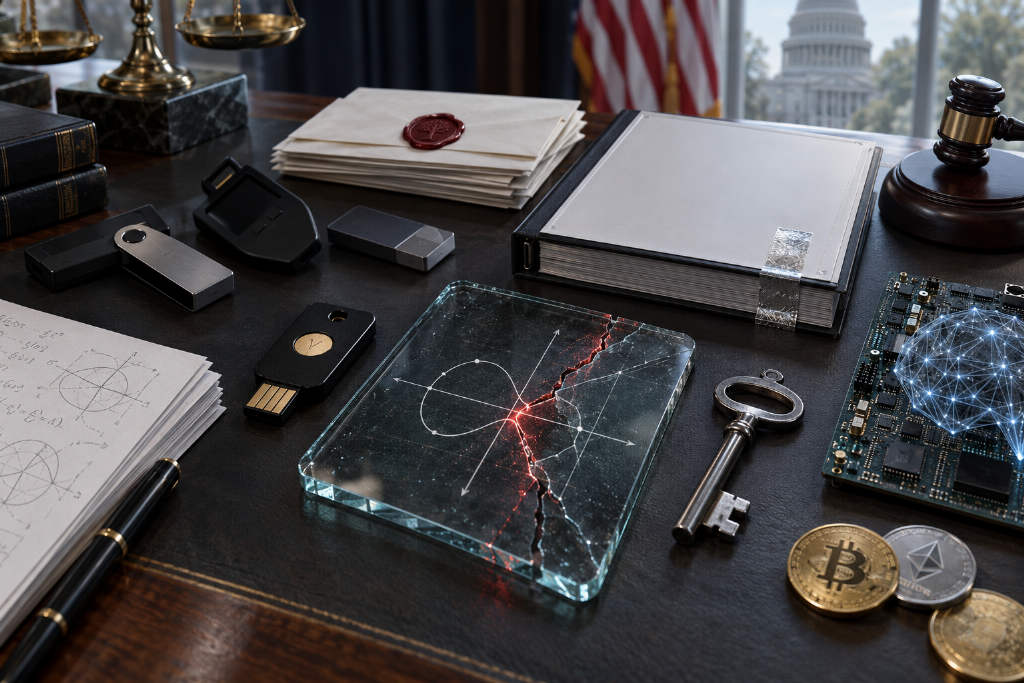
A PANews article translated from a piece by Dragonfly partner hosseeb says the crypto industry should begin preparing for a scenario in which AI-driven mathematical breakthroughs threaten the foundations of modern cryptography. The article says OpenAI released 722 mathematics papers two days earlier and described the moment as 「the most important moment in the history of mathematics」, with long-standing foundational problems reportedly solved using 3 hours of compute per problem.
Citing Scott Aaronson, the article says OpenAI has already turned its attention to breaking cryptography. The author frames the issue as a possible “mathematical doomsday” for crypto: what happens if superintelligent AI clusters start targeting the assumptions behind basic cryptographic systems?
The concern is not quantum acceleration, but an unexpected mathematical break
The article draws a line between two different risks. One is AI speeding up progress in quantum computing. The author says that remains plausible, but quantum computing still depends on major physical engineering work, cannot be achieved overnight, and would unfold in a way the public could see. Preparing for a quantum era still matters, but the path is relatively clear.
The more serious concern in the article is a different one: an unforeseen mathematical breakthrough that overturns the classic assumptions behind cryptography and lets ordinary computers compute discrete logarithms, breaking modern public-key cryptography. The author describes that outcome as an existential disaster.
The piece cites Matthew Green, who said on Oct. 8 in a reply to @kmad and @matthew_pines: 「I think we may lose public-key cryptography.」
Why “bunker mode” is not enough
Justin Drake said on Oct. 7 that the blockchain industry should calmly begin planning for “bunker mode.” As quoted in the article, his personal recommendation was to start a controlled migration of assets to new addresses where the public key remains hidden behind a hash. The author says that approach is, at its core, a way to protect your own token holdings first.
But the article argues that the real issue is not whether tail risk exists. It is what the industry should do if that risk is real. For the sake of discussion, the author assumes there is a 5% chance that public-key cryptography has some fundamental weakness, which implies a 95% chance that everything is fine. Even then, the article says, that would still be nowhere near an acceptable security standard for cryptography, where failure probabilities are expected to be on the order of 2^-128 rather than merely “probably safe.”
The piece also pushes back on the idea that if ECDSA were broken, banks, TLS and certificate authorities would have bigger problems than blockchains. That is not reassuring, the author says, because banks can recover, TLS can recover and certificate authorities can recover. They can redo KYC and move to new cryptographic standards. A blockchain cannot recover in the same way if public-key cryptography fails. In the worst case, anyone could derive anyone else’s key and take anyone else’s funds, while the system would lose the ability to prove ownership at all.
That is why the article says individual self-protection is not a complete answer. Moving your own funds to a fresh address may help you personally, but if the chain itself collapses and everyone else’s assets are being stolen and sold, your own coins may still lose their value. “Bunker mode” protects coins only while they remain untouched. It does not solve a chain-wide failure.
The author says governance has to change before any crisis arrives
The article argues that confidence in cryptography has historically rested on a slow social process. Cryptographers spend years trying to break a construction. If it survives, people say it is probably fine. If it survives for a decade, it is treated as highly trustworthy and eventually used in production. Even then, most cryptographic systems are gradually broken over time as attack methods improve and security margins shrink, forcing a move to better schemes.
That pace has been manageable for blockchains, the author says, because migrations could take years and social consensus could still keep up with changes in cryptography. The article argues that this assumption is now weakening. It says the world may soon face cryptanalysts stronger than any human, examining these systems with a level of rigor never seen before. The number of truly qualified human cryptanalysts is described as only a few thousand worldwide, and the article says that figure could rise by several orders of magnitude with AI.
In that setting, the governance tempo blockchains are used to would no longer work. The article says crypto is entering a wartime period for cryptography, where peacetime norms no longer fit. If social consensus can no longer keep up with the speed of technical and cryptographic change, then social consensus itself has to adapt immediately.
The author lays out three governance points:
- In a crisis, speed matters more than decentralization. Chains that can coordinate quickly will have an advantage, and governance may need to loosen decision rules or give validators more authority.
- The whole ecosystem has to move together. That includes protocol developers, wallets, exchanges, RPC providers, applications, asset issuers and end users.
- The plan has to exist in advance. If a chain waits until something has already broken, it will be too late.
The article says investors are already watching which chains are taking the issue seriously, and that the author has received questions from large investors who want to know whether the industry has an answer.
Vitalik warns against panic-driven migration
On whether users should rush to move funds now, the article cites Vitalik on Oct. 8: 「I do not recommend that anyone rush to move funds to a new wallet today. But we should take seriously the risk that AI-accelerated mathematics poses to cryptography, and reduce our exposure not only to quantum-vulnerable cryptography but also to cryptography that may be vulnerable to AI.」
The author agrees with that position. Encouraging panic, the article says, would likely cause users to lose funds through rushed migrations, and that could be worse than the actual present-day risk of ECDSA keys being intercepted. At the same time, the article says “the most important thing is not to panic” is no longer a sufficient response on its own. The industry should explain the risk plainly and push for system-level preparation.
The piece compares the situation to Cold War civil defense drills. Those drills may not have looked useful to most people, but broad participation helped society understand the seriousness of the risk and shifted politics toward avoiding catastrophe while still building shelters as a fallback. The article mentions the Cuban Missile Crisis and Stanislav Petrov as reminders that extreme-risk probabilities are not zero.
A proposed “cryptography recovery mode”
The article proposes that every major blockchain should add what it calls a “cryptography recovery mode,” a last-resort emergency framework for the worst case. The proposal has several parts.
First, in the next protocol upgrade, a chain would add a new and extremely simple hash-based public-key system. The article says hash-based signatures usually rely on fewer cryptographic assumptions, which makes them suitable as a minimalist backup. The tradeoff is severe: the system would be slow, expensive and awkward to use. If activated, the chain would crawl and DeFi would be largely disabled. Still, the author says, it would function at a technical level, which is better than having no fallback at all.
Second, every user would create a backup key under that hash-based scheme and link it to a normal address. At first this could be optional, but after a few months it would become mandatory. Once mandatory, users who have not set up a hash-based backup key would no longer be able to sign new transactions with ECDSA, and those transactions would fail.
The article says exchanges and wallet providers should do the same. It specifically names Coinbase, Metamask and Ledger as examples of services that could prompt users to create a backup key before signing if one is missing. Under that setup, everyone would have a fallback path while ECDSA remains the default in normal times.
Third, the chain would preconfigure an emergency switch. If AI discovers a vulnerability in ECDSA, validators could activate crisis mode by consensus without waiting for another protocol upgrade. Once the switch is turned on, all addresses would enter cryptography recovery mode and ECDSA would be treated as fully broken.
How recovery could work for users who did not migrate
The article says the chain would be chaotic after recovery mode is triggered. Very little would work well and the network would be hard to use, but it would still be running in a technical sense. Developers would then need to assess the damage, determine which cryptographic tools remain intact and work out how to transition to a new chain with acceptable performance. The key point, according to the author, is that balances would still have a path to safety and recovery.
For users who did not migrate in time, the article sketches two possible paths.
The first path is for users who still hold their seed phrase. The article says they could generate a hash-based zero-knowledge proof of the seed phrase, similar to a 2024 proposal from @VitalikButerin, and use that to assign themselves a new hash-based address. If the original address has never signed a transaction, which is the “bunker mode” case, recovery through a zero-knowledge proof would be relatively simple.
The second path is for users who cannot do that. In that case, the article proposes a recovery process that requires both an ECDSA signature and the solution to a proof-of-work hash puzzle before an address can be unlocked and assets moved. The difficulty of that puzzle would scale with the amount of native tokens held at the address. The article gives one example: if an address holds 100 ETH, the difficulty would be 100N.
That N would then grow exponentially over time. After 1 day it would be 100N, after 2 days 200N, then 400N, then 800N. Validators could vote to cap N or cap its growth rate depending on the shape of the vulnerability and their risk models. The article says the recovery window might be months, or it might be only hours.
In a real attack, the author says, this would become a race. An attacker who has found an efficient way to break ECDSA keys would still need to break the key first and then complete the proof-of-work step. The legitimate owner would only need to complete the proof-of-work step, so the owner should be faster. That would make large-scale theft harder to execute. If mass theft is detected, validators could sharply increase the growth rate of the difficulty to slow further outflows. If the situation becomes completely unmanageable, they could even raise the difficulty to infinity and permanently freeze all vulnerable coins.
The proposal is incomplete, but the author says chains need a plan now
The author says many important details are surely missing and explicitly notes that he is neither a cryptographer nor a protocol designer. Even so, he argues that some version of this mechanism should be implemented on every blockchain as soon as possible. Given the pace of change in mathematics, the market will soon demand a backup recovery plan from every chain, and consensus on that plan needs to be reached before any emergency begins.
The article also says the industry should not delay action in pursuit of a perfect design. If OpenAI is already working in this direction, nobody knows how long it will take before an unexpected cryptographic breakthrough appears. A first version of a cryptography recovery mode can be rough, the author says, and then improved over time. He adds that the same framework could also apply if a sudden quantum breakthrough arrives, even though the main target is a fundamental break in the assumptions behind existing cryptography.
“Nothing is one-and-done”
Near the end, the author says he had argued a few weeks earlier that Zcash should complete its post-quantum migration and then stop changing. He now withdraws that view. In a period when the mathematical ground under cryptography appears unstable, he says, nothing can be treated as permanent.
The article closes on a qualified note. Most likely, it says, nothing will happen and AI will spend enormous compute only to confirm that current cryptography is secure enough. But the industry still has to make sure that even in the worst case, blockchains remain safe.




