
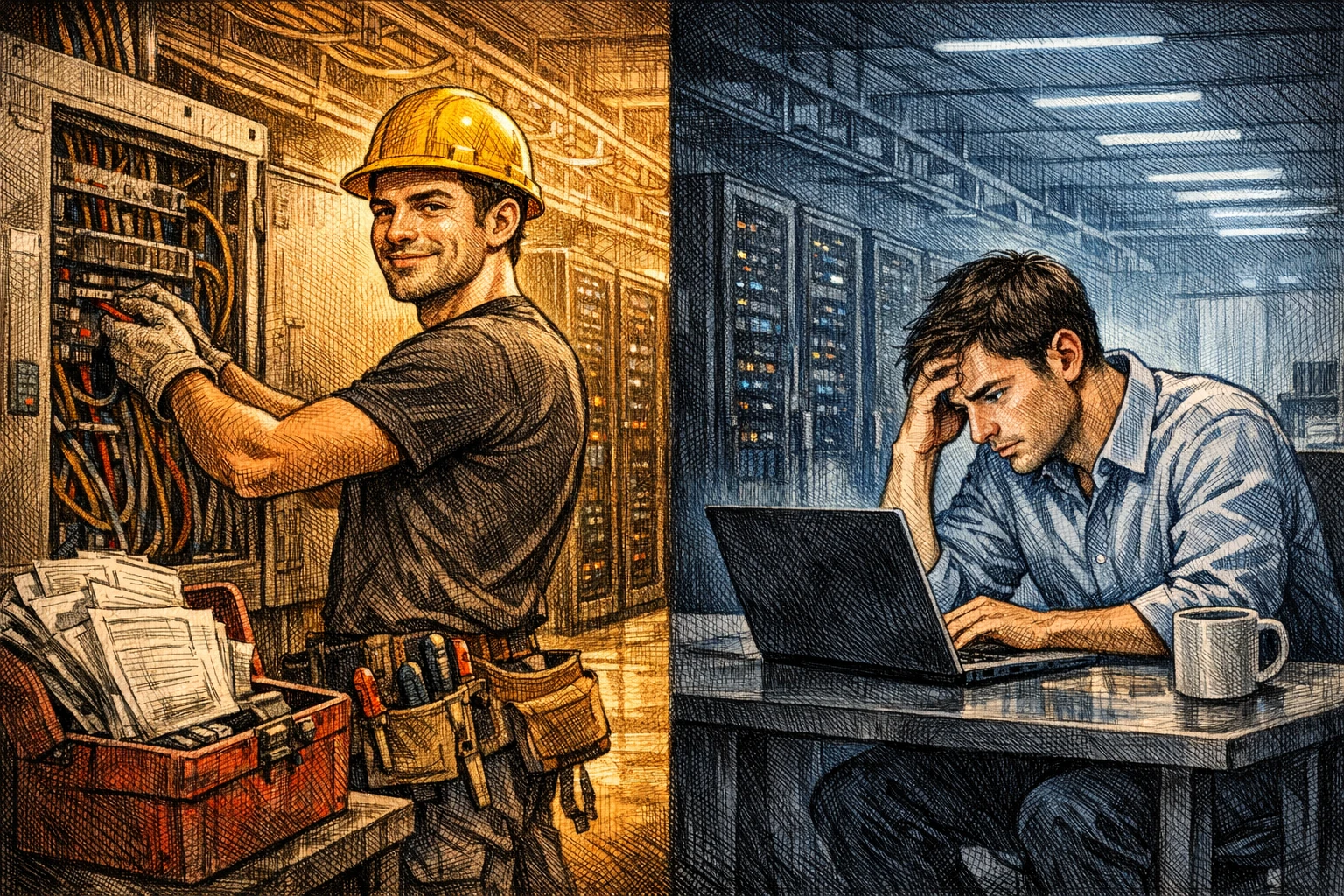
At an AI data center in Plano, Texas, three on-site electricians under the age of 30 are making $240,000 to $280,000 a year with no student debt, according to Mike Rowe. Rowe, host of Dirty Jobs and CEO of the mikeroweWORKS Foundation, used those figures in a Fox Business interview to contrast the surge in skilled-trade pay with shrinking hiring demand for entry-level software engineers as AI coding tools spread.
Data center construction is lifting pay for physical infrastructure jobs
Rowe framed the numbers as part of a broader labor shift rather than a one-off case. His point was simple: the buildout of AI infrastructure is raising the market value of trades that have to be performed on site. Data centers need power distribution, wiring, switchgear installation, and high-voltage work. Those tasks cannot be outsourced to a chatbot.
Reporting cited a Randstad study that found six-figure salaries are becoming common for electricians, HVAC technicians, and data center operations engineers. Demand is being driven by AI infrastructure expansion, while supply remains constrained by a long-running shortage of trained workers. Over the last decade, younger workers were steered heavily toward university paths, leaving vocational training with a thinner pipeline.
Pressure is building at the entry level of software hiring
The article also noted that tools such as GitHub Copilot and Cursor are already automating parts of repetitive coding work. That has added pressure to junior programming roles. Still, the source made a distinction: the current squeeze is affecting the number of entry-level openings more than it is erasing the engineering profession as a whole.
Some of the anxiety in white-collar hiring also reflects a cyclical slowdown in the job market, not only AI substitution. Electricians sit in a different position. Their work is hard to do remotely and cannot be completed by large language models. AI data centers need people on the ground to pull cable, assemble panels, and handle live electrical systems. The contradiction is hard to miss: stronger AI requires more physical infrastructure, and more infrastructure requires more electricians.
School-to-career messaging is lagging behind labor market signals
Rowe said he agreed with Bernie Sanders that the U.S. is on the edge of a revolution, though he was referring to a structural reversal in the labor market rather than politics. The article argued that education messaging has not kept pace with current wage signals.
If a starting electrician job in Texas can rival software pay for a four-year college graduate, while avoiding student debt, then the old assumption that college is the only reliable path upward looks weaker than before. The source did not dismiss higher education outright. It argued that labor markets are repricing scarcity, and that practical technical skills have been undervalued. How long the wage surge lasts will depend on two variables identified in the piece: the speed of AI infrastructure expansion and the speed of worker training. For now, the first is moving faster.