
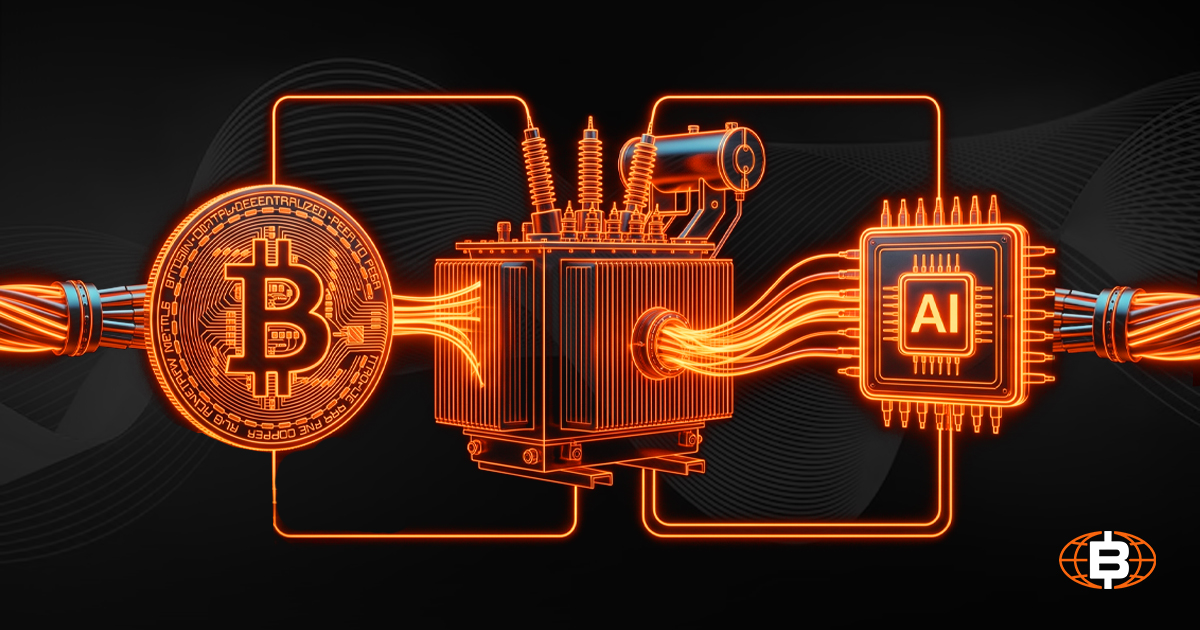
Bitcoin Magazine has published an opinion piece by Nick Ward arguing that the common market reading of the mining-to-AI shift gets the underlying economics wrong. Over the past year, the dominant narrative has been that Bitcoin miners are leaving their core business behind and moving into AI data centers, a move some have treated as evidence that proof-of-work is retreating. Ward’s argument is the opposite: viewed through power infrastructure and thermodynamics, the shift is not a sign of weakness in Bitcoin, but a structural rebalancing in how energy is priced and allocated.
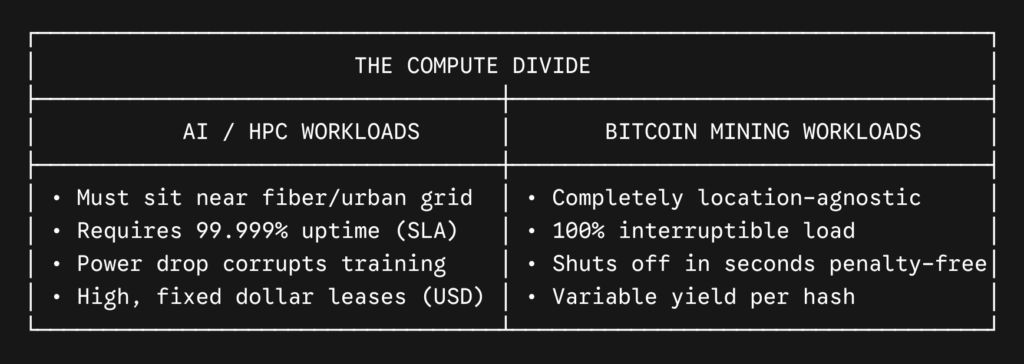
The piece says the market confusion begins with a false assumption that all digital workloads need the same kind of physical and network environment.
AI clusters and Bitcoin mining require different physical setups
According to the article, AI training clusters and Bitcoin mining rigs sit at opposite ends of the infrastructure spectrum. Ward writes that an AI training cluster is fragile: if a 100-megawatt facility loses power in the middle of a run, millions of dollars of training state can be lost. Because of that, AI facilities need high-grade baseload power, ultra-low-latency fiber connectivity, and 99.999% continuous uptime.
Bitcoin mining is presented as the inverse case. The article says ASIC miners do not care about latency, location, or uninterrupted runtime in the same way. They can run in remote deserts, next to stranded hydro dams, or on off-grid flare gas pads. If grid power prices spike, miners can shut down within seconds without losing data or damaging hardware.

Ward’s thesis: AI is bidding miners away from prime grid power
The piece argues that Bitcoin miners spent the last decade on major power grids largely because substations and transmission infrastructure were already there. Even so, Ward says using prime grid-connected baseload electricity for an interruptible, location-agnostic workload was always economically inefficient.
He points to a bottleneck now facing AI hyperscalers: utility approval for new grid interconnections above 100 megawatts can take 3 to 5 years. In that setting, the article says, hyperscalers are buying up as much prime grid-tied power real estate as they can.
That is the basis for the article’s central claim that AI is pricing Bitcoin off the main electrical grid. Ward does not frame that as a destructive outcome for mining. He frames it as a return to Bitcoin’s ideal thermodynamic role, where miners move toward energy that other buyers cannot easily use.
The examples given in the article are stranded wind in West Texas, flared natural gas in remote oil fields, and off-peak hydro in mountain ranges. In Ward’s formulation, AI takes expensive grid power while Bitcoin absorbs wasted, stranded, or curtailed energy at the edge of the system and serves as a buyer of last resort.
The article says AI revenue could reduce miner sell pressure
Ward identifies a long-standing weakness in pure-play Bitcoin mining companies: balance sheet volatility during bear markets. When hash price falls, he writes, debt-heavy miners are often forced to sell their mined BTC reserves on the open market to cover electricity bills and corporate overhead. In his view, that creates artificial downward pressure on Bitcoin’s price.
The piece argues that an AI pivot changes that equation in three ways:

- Fixed USD cash flow: multi-year hosting leases with AI companies can generate steady, high-margin dollar income.
- Less forced liquidation: if overhead and debt service are covered by AI lease revenue, operators no longer need to sell Bitcoin treasury holdings at market bottoms.
- A hybrid operating model: the article describes a “Mullet Data Center” structure in which operators place high-margin AI workloads on grid-tied power to pay fixed bills while keeping flexible Bitcoin operations to monetize off-peak power and help balance local grids.
Why the piece says hyperscalers may eventually hold Bitcoin
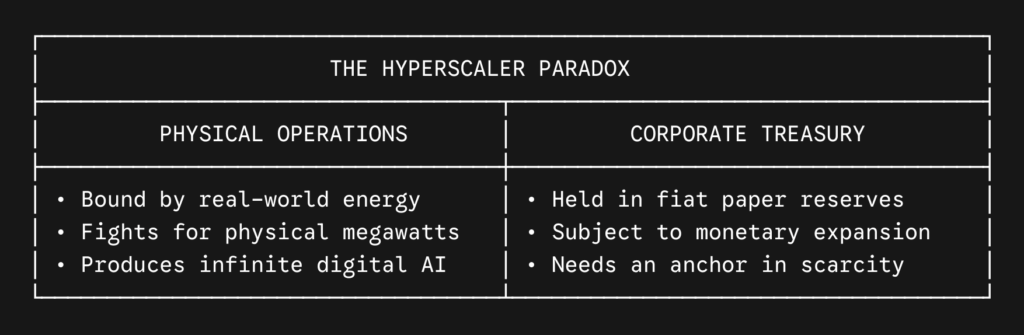
The article then moves from miners to large technology firms. Ward says Big Tech is spending hundreds of billions of dollars to build AI infrastructure that makes intelligence and digital content “infinitely abundant.” His argument is that when a digital good becomes infinitely abundant, its marginal cost tends toward zero, raising a balance-sheet problem for companies whose core output is no longer scarce.
Against that backdrop, Ward contrasts AI with Bitcoin. AI, he says, drives digital intelligence toward abundance, while Bitcoin imposes hard digital scarcity through a fixed cap of 21 million units. He also argues that Bitcoin is the only monetary asset whose issuance is directly tied to the same thermodynamic laws of work and energy that govern data centers.
Amazon example cited in the article
To support the treasury argument, the piece cites data from Bitcoin for Corporations. It says that if Amazon (AMZN) had allocated its $123.03 billion cash reserve to Bitcoin over a 3-year period rather than holding cash and short-term Treasuries, its treasury productivity would have risen from 12.21% to 119.55%. The article describes that as a 10x increase in capital efficiency and says it would represent more than $132 billion in unrealized gains.

The piece also references a Bitcoin Treasury Simulator that readers can try with any stock ticker, though no additional tool details are provided in the supplied text.
Ward compares this logic to a long-term Power Purchase Agreement, or PPA. Just as a technology company signs a PPA to lock in electricity costs, he argues, holding Bitcoin can function as a PPA for monetary value. In his view, companies that sit on large cash balances earning nominal paper returns while spending billions to secure physical energy are leaving hundreds of billions of dollars in value on the table.
Framed as optimization rather than substitution
The article closes by arguing that the shift inside data centers is not a trade in which one technology wins and the other loses. Ward calls it a market optimization: AI gets the fast, grid-connected infrastructure it needs to build synthetic intelligence, while Bitcoin is pushed deeper into the energy frontier, where miners can capture cheap wasted power without having to sell coins simply to keep operations running.

He adds that as the opportunity cost of holding depreciating fiat cash becomes harder to ignore, hyperscalers may come to see grid access as only part of the problem. In the article’s own framing, an empire built on infinite compute ultimately needs a reserve asset defined by hard digital scarcity. That conclusion is presented as the author’s analysis.
Disclaimer and attribution
The original disclaimer says the content was prepared on behalf of Bitcoin For Corporations for informational purposes only and reflects the author’s own analysis and opinion. It should not be relied on as investment advice, and nothing in the article constitutes an offer, invitation, or solicitation to purchase, sell, or subscribe for any security or financial product.
The post first appeared on Bitcoin Magazine and is written by Nick Ward.