
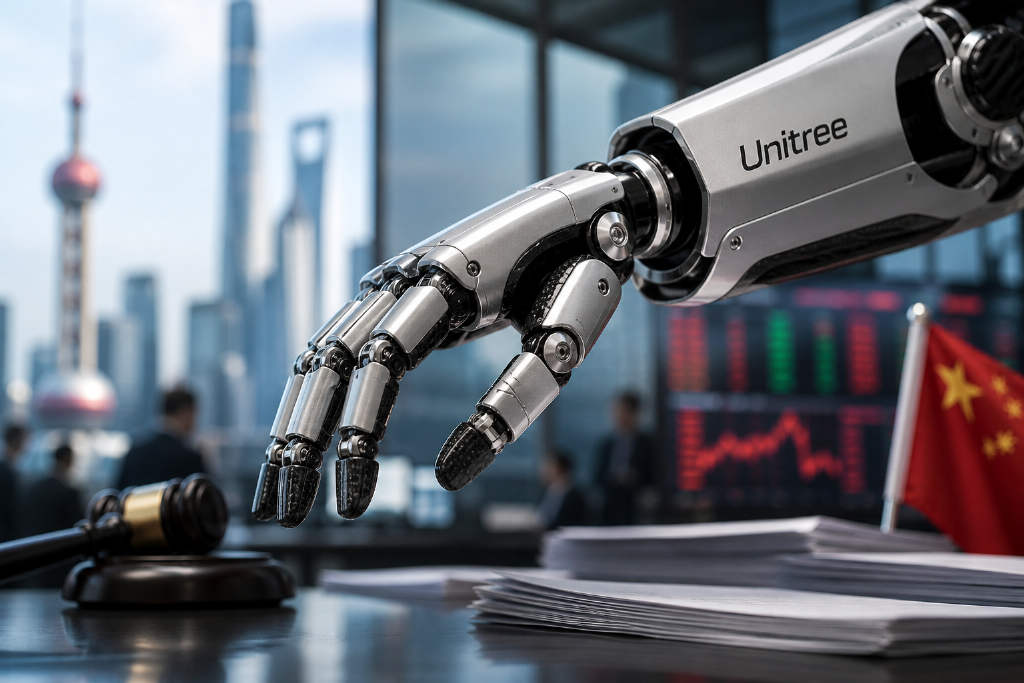
Unitree Robotics made its trading debut on China’s STAR Market on Aug. 19, opening at RMB 1,100 a share against an IPO price of RMB 150.80, up 629.44%. The stock later closed at RMB 845, leaving it 460.34% above the offering price by the end of the session. During the public offering phase, the retail tranche was oversubscribed by more than 8,000 times, a level the source article described as rare for China’s hard-tech sector in recent years.
The article, written by the MEXC Crypto Pulse research team and dated Aug. 19, 2026, argues that the market reaction was driven by Unitree’s product lineup, cost structure and its position in the global embodied AI buildout.
Trading debut brought sharp gains, heavy turnover and a fast pullback from the high
Unitree, described in the source as a global embodied AI and legged robotics unicorn, completed its initial public offering and began trading with immediate buying pressure. The stock opened with a gain of more than 600% and saw wide intraday swings. Before listing, demand had already been intense: preliminary valid online subscriptions in the public offering exceeded 8,000 times.
According to the figures cited in the article, RMB 1,100 was not only the opening print but also the session high. At that level, Unitree’s market capitalization briefly reached RMB 444.9 billion. The stock then retreated through the day, touching an intraday low of RMB 800.08 before ending at RMB 845, which implied a closing market value of RMB 341.7 billion.
The day’s trading was marked by both high turnover and high volatility. Turnover reached 85.28%, while total trading value hit RMB 23.16 billion. The article says reporting by Bloomberg and Reuters on the technology sector framed the rally as part of a broader search for hard-tech assets tied to potentially disruptive breakthroughs.
Why public markets are treating Unitree as a core humanoid robot listing
The source attributes Unitree’s valuation premium to commercialization and execution rather than to concept alone. Unlike many robotics startups that are still in the lab stage or remain dependent on external financing around future narratives, Unitree already has a cash-flow base in consumer and industrial quadruped robotics.
The article places particular weight on the company’s ability to carry over motion-control experience from quadruped robots into bipedal humanoids. Unitree has released the full-size general-purpose humanoid H1 and the mass-production-oriented humanoid G1. The report says these systems can perform high-dynamic movements such as running and backflips, while also advancing mechanical structure and perception algorithms to the point of commercial use. On public-market standards, the article describes Unitree as one of the few humanoid robot manufacturers with real mass-production shipment data.
From quadruped robots to H1 and G1, the product path matters
The article presents Unitree’s product evolution as a clear engineering progression. Citing company technical documents, it says Unitree first built a global market presence through the Go1 and Go2 consumer quadruped robot lines. It later expanded with the B2 industrial quadruped platform for use cases such as power inspection and fire rescue, and says the company holds a leading position in global legged-robot shipments.
On the humanoid side, the H1 is described as having set a world speed record for a full-size humanoid robot through its powertrain performance. The newer G1 combines multimodal foundation models with reinforcement learning algorithms. The article says the G1 has 23 to 43 degrees of freedom and can handle coordinated robotic-arm work and fine object manipulation, showing a path from pure locomotion toward more general labor applications.
Pricing is central to the investment narrative in the source report. It says the base version of the G1 starts at roughly RMB 99,000, or about $16,000, a level presented as a break from the cost barriers that have held back broader humanoid robot deployment.
In-house hardware development and supply-chain depth are presented as the moat
The article says one of the biggest constraints on scaling humanoid robotics globally is manufacturing cost. It notes that some traditional industrial robots and certain high-end overseas humanoid machines can cost hundreds of thousands of dollars per unit to assemble, limiting their penetration into factories and household service use cases.
Unitree’s answer, as laid out in the report, is deep in-house development of core components. The company is said to have developed high-torque-density outer-rotor motors, precision planetary reducers, high-performance magnetic encoders and integrated drivers. The article also says Unitree has achieved a high degree of end-to-end internal development across core parts including motors, reducers and controllers. Combined with precision manufacturing capabilities and a consumer-electronics supply-chain network, that structure has helped push the G1’s entry price down to the RMB 99,000 range. The report treats that cost position as a key support for scaled production.
Tesla and Nvidia are part of the broader macro setup behind the trade
The source names global technology companies’ push into embodied AI as a major catalyst behind the valuation reset. It points to Tesla’s work on Optimus and notes that Elon Musk has repeatedly said the humanoid robot could account for a large share of Tesla’s long-term value, while field testing has moved ahead in automotive manufacturing facilities.
The article also highlights Nvidia’s Project GR00T, described as a foundation model for general-purpose humanoid robots, along with a toolchain built on the Isaac simulation platform for synthetic data generation and model training. In the report’s framing, this combination of computing infrastructure, base models and end hardware has shortened the path from simulation to deployment in the physical world and pushed investors to reconsider the market size for Physical AI.
It adds a broader asset-allocation point: as growth slows in traditional consumer electronics and general software, global growth capital has been searching for new narratives, and embodied intelligence has become one of the places where cross-market liquidity is concentrating.
What investors are being told to watch next
Once first-day excitement fades, the article says Unitree’s long-term investment case will be judged on fundamentals. The first variable is how quickly backlog turns into actual deliveries. While lower pricing may help win share, the report says yield rates in large-batch assembly, after-sales maintenance costs and supply-chain resilience will directly shape blended gross margin.
It also says operational reliability in real-world industrial manufacturing, warehousing, logistics and special operations matters. Average mean time between failures, or MTBF, is presented as a deciding metric for whether enterprise customers place repeat orders.
After an 8,000-times retail subscription, volatility risk remains high
The article warns that growth technology listings that post extreme first-day gains often go through sharp swings and valuation resets in early trading. It says the more than 8,000-times retail demand and the 629.44% opening jump included a meaningful share of short-term speculative and arbitrage capital. By the close, the stock had already fallen about 23% from the day’s high.
As trading normalizes, the report says the share price may move closer to intrinsic value based on fundamentals. Investors are urged to keep track of lock-up expiration schedules tied to early venture capital holders and cornerstone investors, while also considering the impact that rate volatility could have on richly valued growth stocks through tighter liquidity conditions.
Technology-path risk and commercialization uncertainty are still part of the story
The article cites industry research organizations and the Financial Times in arguing that the humanoid robotics technology path has not fully converged. Sensor choices, including pure vision versus lidar-based multimodal systems, joint actuation approaches such as electric drive versus electro-hydraulic drive, and dexterous-hand design all remain in flux.
If downstream customers fail to see the expected return on investment from humanoid robots and delay procurement, or if rivals make major gains in end-to-end embodied AI algorithms, Unitree could face both a longer monetization cycle and adjustments to its technology roadmap, according to the report.
The source outlines two broad stock scenarios from here
Based on current sector liquidity and risk appetite, the article lays out two broad paths for Unitree’s post-listing performance.
In its base case, the company keeps winning batch orders in industrial manufacturing and research-and-education markets through its cost advantage, annual humanoid shipments rise steadily, and overseas quadruped business continues to generate stable cash inflows. Under that setup, the stock could consolidate after its first-day spike and then track business growth more closely over time.
In the bearish case described by the article, the debut may have pulled forward too much valuation too quickly, prompting institutional profit-taking just as industrial deployment progresses more slowly than optimistic expectations. If revenue growth then moderates in quarterly reports, the stock could face a longer period of weakness and a compression in valuation multiples.
James Mitchell’s commentary in the article links the move to a shift in AI capital flows
The report closes with an exclusive view attributed to James Mitchell. He says that from the perspective of market microstructure and cross-asset cycles, Unitree’s 629% opening surge reflects a broader shift by global capital toward physical monetization vehicles as the marginal effect of software-only AI narratives starts to fade.
In his reading, the more important point is not the emotional spike created by an 8,000-times subscription but a change in the economics of robot manufacturing. He says Unitree brought humanoid pricing below RMB 100,000 by combining in-house components with China’s mature precision-manufacturing supply chain, and treats that price threshold as a critical point for moving embodied intelligence from lab prototypes toward general-purpose production tools.
He also argues that the market may be underestimating the difficulty of software-hardware co-evolution. The article says humanoid robots have made major progress in physical motion, but the generalization ability of embodied AI “brain” and “cerebellum” systems is still at an early stage. End-to-end reinforcement learning models still face limits in unstructured environments, and lower hardware cost alone does not solve that quickly.
The commentary then draws a parallel with blockchain systems. It says Bitcoin relies on an underlying compute network, while Ethereum’s ecosystem depends on decentralized physical infrastructure, or DePIN, and distributed execution layers. In the same way, the article argues, the ultimate form of Physical AI would also need coordination across decentralized data collection, edge computing and physical hardware endpoints. It goes on to say that as embodied AI devices are deployed at scale globally, machine-to-machine micropayments through smart contracts and decentralized coordination of compute could open a new cross-asset fintech narrative.
Even so, the article’s practical takeaway is restrained: investors should stay disciplined and focus on production delivery rates, hardware gross margin trends, and how efficiently research and development spending turns into actual commercial orders.
FAQ points included in the source article
What kind of robotics company is Unitree?
The source describes Unitree Robotics as a globally recognized legged robotics and embodied AI company focused on consumer and industrial quadruped robots, general-purpose humanoid robots, and core power-joint components across research, production and sales.
Why did Unitree’s stock surge on the first day?
The article points to the scarcity value of a “first humanoid robot stock,” retail demand exceeding 8,000 times during the subscription period, and a broader valuation reset linked to major technology companies stepping up investment in embodied intelligence. The stock opened up 629.44% and still closed 460.34% above the IPO price.
What is the key price point for Unitree’s humanoid robot?
The base version of the G1 humanoid robot starts at about RMB 99,000, or roughly $16,000, according to the report. The article contrasts that with competing systems that can cost hundreds of thousands of dollars.
What hardware advantages does the company claim?
The report says Unitree has developed and produced core drivetrain components such as motors, reducers, controllers and encoders in-house, while also building strength in supply-chain integration and bill-of-materials control.
What commercialization challenges does the industry still face?
The source highlights weak generalization by end-to-end large models in unstructured environments, lengthy validation cycles for reliability and safety in industrial and home-service settings, and the need to manage yield and supply-chain stability during early mass production.
What does an 8,000-times retail subscription imply for secondary trading?
According to the article, it signals very high attention and heavy short-term speculative participation. That can power a sharp debut, but it also points to intense turnover. Unitree’s first-day turnover rate was 85.28%, which the report says could translate into higher volatility as early enthusiasm cools and lock-up dates approach.
Which financial and operating metrics matter next?
The article says investors should watch actual shipment volumes for both humanoid and quadruped robots, commercial order conversion in enterprise scenarios, changes in blended gross margin, and the effectiveness of R&D spending in producing software and hardware upgrades that turn into revenue.
Source note: The article states that it is for reference only and does not constitute investment advice. Product specifications, pricing and industry data were taken from public materials and third-party statistics. First-day trading data reflect closing information from Aug. 19, 2026, while forward-looking paths are scenario assumptions rather than confirmed outcomes. The piece adds that newly listed IPO stocks can see intense volatility and may face lock-up and valuation-reset risks.