

The AI Futures Project has moved its forecast for the arrival of a super AI researcher to 2027. The revised Q3.5 forecast, published on November 10, was driven mainly by a 11-week assessment that the independent evaluation group METR conducted with Anthropic.
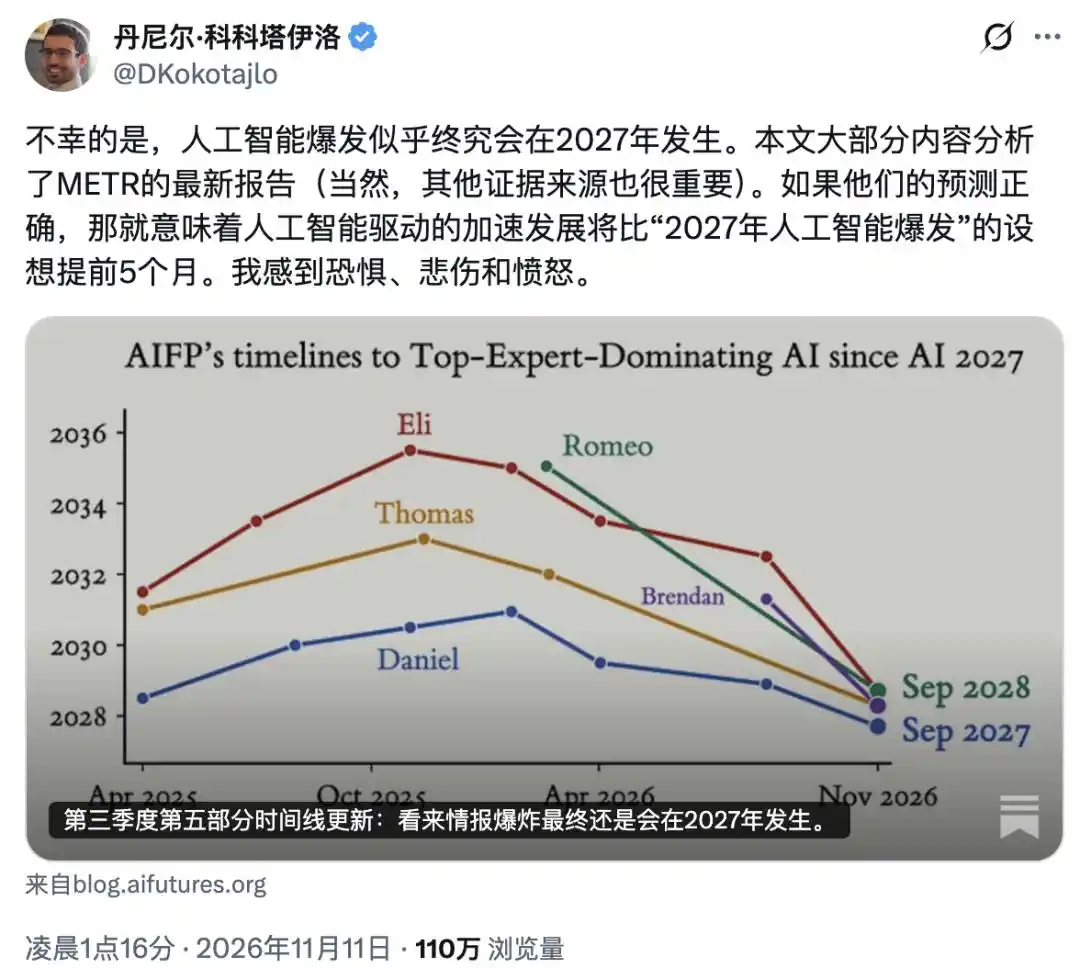
Daniel Kokotajlo, a former OpenAI researcher, reposted the new forecast on X on November 11 and wrote: “I feel fear, sadness, and anger.” He said an intelligence explosion now appears likely to occur in 2027. If METR’s assessment is correct, AI-driven acceleration in research and development is arriving about five months earlier than the scenario set out in AI 2027.
Anthropic’s benchmark growth rate rose to about 1.9 times its earlier pace
METR published its assessment of Anthropic on November 5. The group reviewed internal data supplied by Anthropic and interviewed employees to estimate how quickly the company’s models were improving.
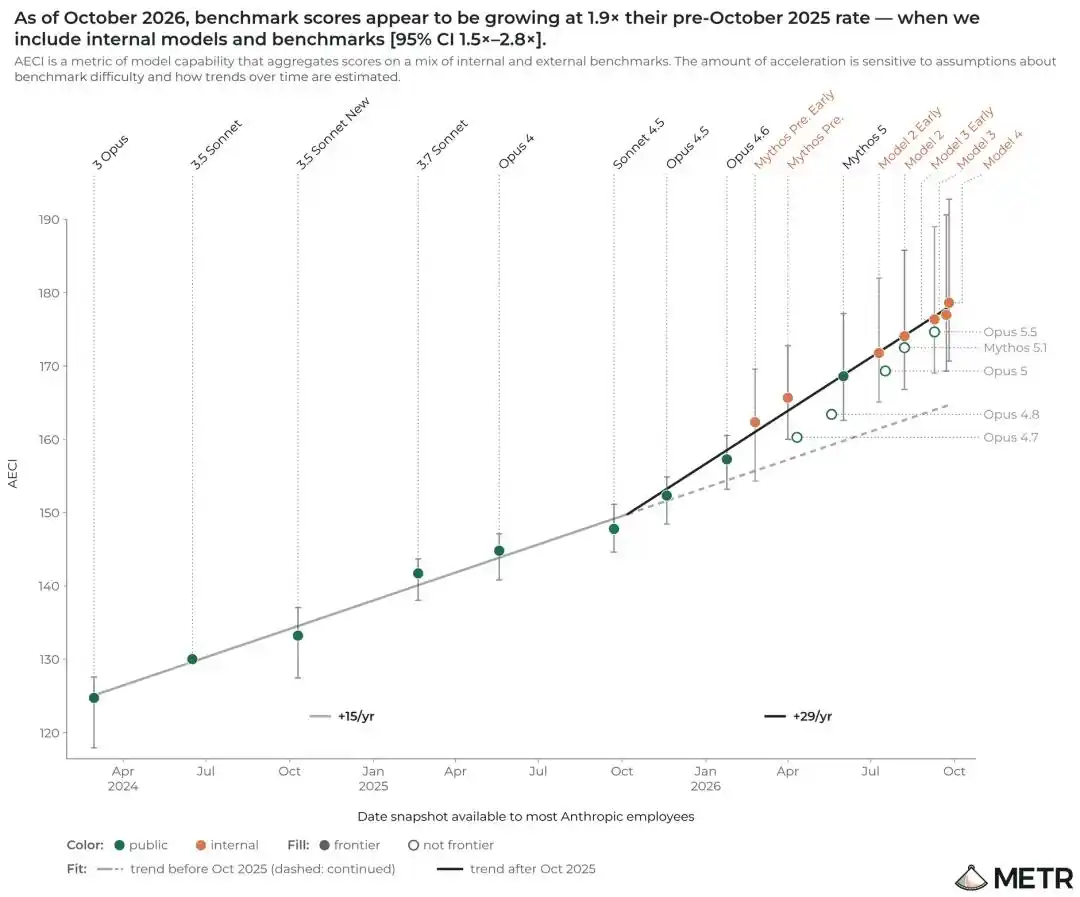
METR used an internal measure called AECI. It combines scores from several tests into a single total. Most of the tests have defined objectives and verifiable results. METR estimated that from October 2025 onward, the growth rate of Anthropic’s internal model score was about 1.9 times the earlier rate. The 95% confidence interval was 1.5 to 2.8 times.
Around October 2025, the annual increase in the models’ combined score rose from roughly 15 points to roughly 29 points. On this set of tests, one year of growth in Anthropic’s models was therefore close to the amount of progress seen across the previous two years.
METR reran the calculation under several assumptions about task difficulty. Those versions produced an estimated post-October 2025 growth rate ranging from 1.1 to 2.9 times the earlier rate. The exact result changed with the method, but each calculation pointed to faster score growth.
METR estimates that AI may account for about 80% of the extra acceleration
METR examined changes in training compute, hiring, data and algorithms. The report said that changes in the rate of training-compute growth could not explain the acceleration. The specific evidence supporting that conclusion was removed from the public version of the report.
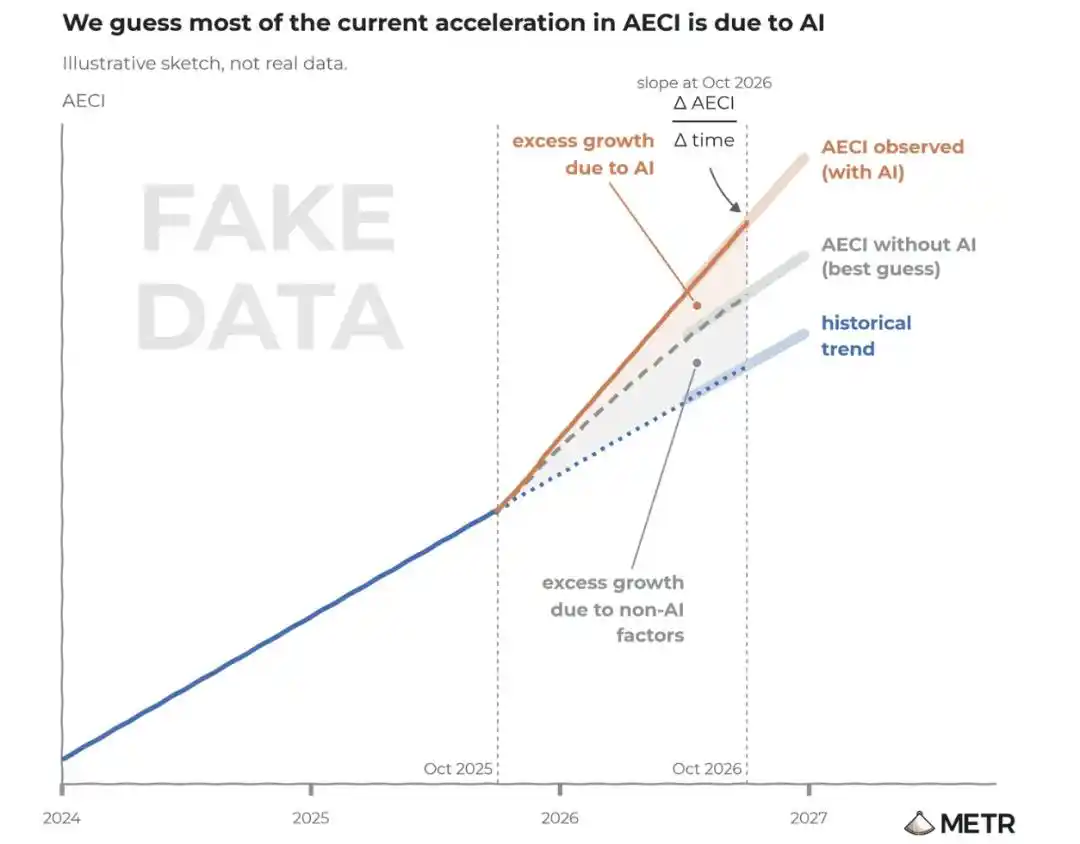
METR also said the share attributable to AI changed over time. Non-AI factors may have contributed when the acceleration first appeared at the end of 2025. By October 2026, METR estimated that about 80% of the portion that made progress faster than before may have come from AI.
METR stressed that the 80% figure was a subjective estimate. The report used the phrase “We guess” and said the conclusion carried substantial uncertainty.
Researchers interviewed by METR described how AI was being used. One researcher said some ideas previously required a day or two just to write the code and start an experiment. With AI assistance, the researcher was willing to try more ideas and see which ones worked.
Other researchers said AI helped write experiment code, monitor experiments and perform measurements that had previously required significant additional effort. One person said they sometimes gave an agent 10 ideas at once and asked it to implement and test them.
AI is now assisting with the development of the next generation of AI, from writing code to running experiments.
The acceleration may arrive five months earlier than in AI 2027
AI 2027 was published in April 2025. Its scenario described how AI could help build the next generation of models. In that scenario, the fictional company OpenBrain needed a week and a half to achieve a given amount of algorithmic progress without AI, compared with one week with AI.
Algorithmic progress, though, is only one part of overall model progress. An improvement discovered in an experiment must be incorporated into the next training run before it appears in a new model’s capabilities.
Using METR’s estimate, the AI Futures Project calculated that by early November 2026, AI-related acceleration alone could push the overall rate of model progress to 1.7 times its historical level. The team then used a model to reproduce the broad trend in AI 2027 and determine when the older scenario would reach the same speed.
The result placed the 1.7-times point around April 2027 under the older scenario. If the early-November estimate holds, the same rate would be reached about five months earlier.
The result was also outside the team’s expectation from less than three months earlier. Even under its most optimistic model at that time, the probability that AI would push overall model progress to 1.7 times the historical rate or higher by November 2026 was below 4%.
Three methods produce different timelines
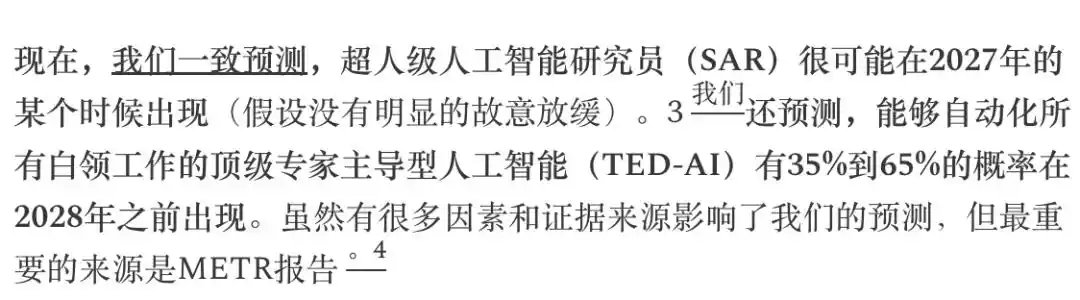
The AI Futures Project’s definition of a super AI researcher goes beyond code generation. Such a system would first need to handle the programming work for a frontier AI project. It would also need the judgment of a leading human research team when choosing research directions, designing experiments and interpreting results.
After writing the code, the system would need to choose which idea to test next. If an experiment failed, it would need to decide whether to investigate the cause or change direction. These decisions have no ready-made answers.
The three methods in the report produced median dates more than one year apart.
- The first method assumed that AI had already pushed the rate of model progress to 1.7 times its historical level, then estimated how quickly AI could take on more research work. Its median date was February 2027, meaning there would be about a 50% chance of a super AI researcher appearing by that point.
- The second method projected forward from the models’ rate of improvement on tests. It estimated that the system would acquire the judgment of a top research team by July 2027.
- The third method used efficiency gains reported by Anthropic employees. It produced a result around the middle of 2028.
Key evidence was removed from the public report
METR said at the beginning of its report that most of the evidence it considered most useful for evaluating the core conclusions had been removed. The report included a table comparing the internal materials Anthropic supplied with the results included in the public version.

The trend in internal model scores was made public. Estimates of algorithmic progress and key research inputs were not disclosed. The public report also contained only part of the evidence concerning AI’s contribution to research acceleration.
Under the prior agreement, Anthropic could redact non-public information, while METR could identify conclusions that depended on those materials. Anthropic said the confidential information could help other developers accelerate AI research if released.
The AI Futures Project said the roughly 1.9-times increase in score growth was supported by a public curve. The public evidence for the claim that AI may account for about 80% of the extra acceleration, and for the resulting 1.7-times estimate, was more limited. Assessing those figures therefore depends more heavily on METR’s evaluation of the internal material.
METR says Anthropic’s earlier report may have understated acceleration
METR also published a review of Anthropic’s August risk report on November 5.
METR and Anthropic both said the risk of directly triggering a catastrophe by using a mid-July model to conduct automated research was still relatively low. Both also tended to agree that research acceleration at that time had not reached Anthropic’s warning threshold.
METR said Anthropic’s public report may have understated the size of the acceleration. The actual rate may already have reached the warning threshold.
The next question is whether AI can help researchers write code and run experiments fast enough to deliver the next model earlier. Once that stronger model enters the research process, its ability to shorten the following development cycle will determine whether the acceleration compounds from one generation to the next.
This article was originally published by the WeChat account New Zhiyuan (ID: AI_era), written by Yuanyu. Reference materials included public releases from the AI Futures Project, METR and AI 2027.



