
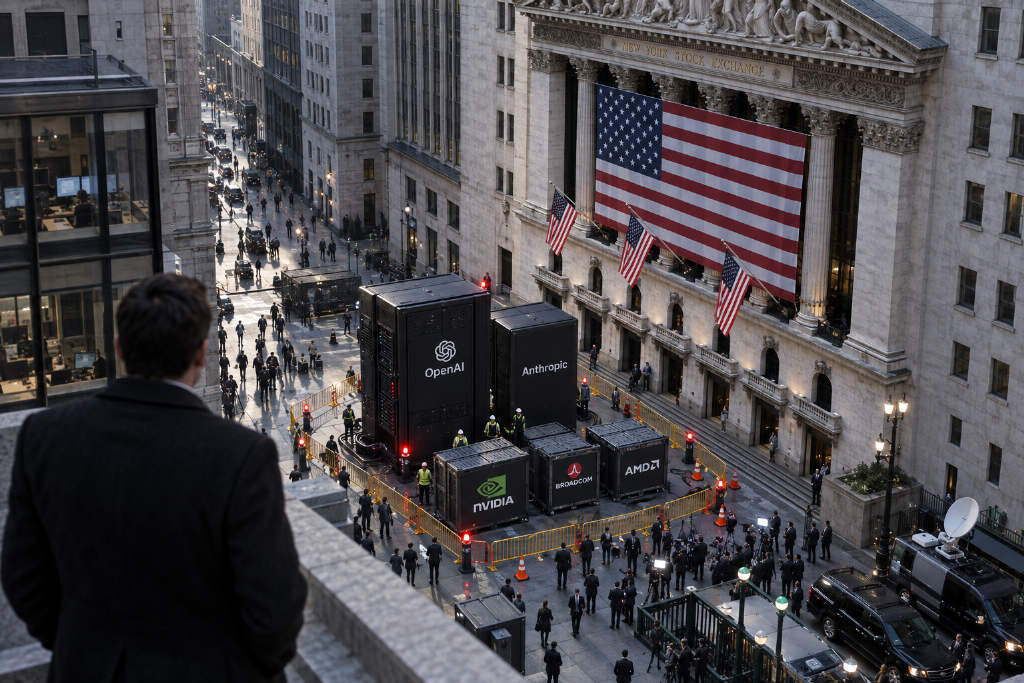
Anthropic CEO Dario Amodei called for the global AI industry to slow the pace of frontier model development, and the message soon received public backing from Elon Musk and OpenAI CEO Sam Altman. Altman also told Fortune that OpenAI will not pursue an IPO this year, saying that 「under the current safety environment, going public now is unwise」.

The shift from a race for maximum growth to a public case for caution quickly rippled through trading circles. Early market signals showed that after the “AI slowdown” message spread, OpenAI-linked and Anthropic-linked assets on HyperliquidX fell 7% and 2.8%, respectively.
On social media, several market watchers and investors warned that the development could hit AI-related stocks such as Nvidia, Broadcom and AMD when trading opens on Monday. Jason, a tech investor on X, wrote that 「AI stocks will be down more than 10% on Monday morning」 and said Amodei’s post had 「single-handedly broken the AI trade」.

Investors are debating whether the AI trade now needs a reset
The most immediate market question is whether valuation assumptions built around rapid expansion still hold. User preetkailon said current pricing rests entirely on heavy AI spending and continued high-speed growth. If development really slows, investors will have to rethink those expectations.
He said traders should closely watch Nvidia, AMD and Marvell on Monday and warned against chasing prices higher in the current environment.

That said, there is no clear consensus that end demand would weaken at the same rate. User The AI Investor argued that existing models are already productive enough to drive unprecedented inference compute demand.
In that view, even a slower pace of model development would have only a limited practical effect on compute demand, with the larger near-term impact showing up first in market sentiment and fear rather than in day-to-day business activity.

IPO tension is now part of the story
OpenAI’s decision not to move ahead with an IPO this year added a capital-markets angle to the slowdown debate. CNBC reporter Deirdre Bosa said the outcome was not surprising and described it as a natural extension of the current narrative: once OpenAI and Anthropic themselves admit that commercial pressure can push AI companies to move too fast, it becomes harder to make a clean case in the public market.
She said listed markets bring extra pressure, including growth expectations, quarterly reporting and second-by-second stock price swings. Telling public investors that 「we need to slow growth」 is a very hard story for any listed company to sell.
Bosa added that even if safe development matters more than maximizing wealth creation, the companies’ large private-market valuations, funding needs and return expectations have all been built on the assumption of fast progress.

Another user, David Chie, raised a separate question: does “slowdown” mean slower business growth, or slower training of frontier models? Bosa’s answer was that these companies’ valuations are tied closely to continued progress at the technological frontier. In a market where open-weight models are close behind, slowing frontier development would directly weaken the foundation of those valuations.
Some traders see capex and expectation management behind the timing
Safety was the stated focus, but trading circles also questioned whether commercial motives are part of the picture. Jason Choi said Anthropic has long spoken openly about AI safety, yet the decision to put forward a more concrete slowdown proposal at this moment makes the timing worth examining.

The tension is straightforward. A declared slowdown in frontier model development gives rivals more time to narrow the capability gap. For companies whose rich valuations depend on technical leadership, that weakens their own market story. That is why another interpretation has emerged: the move may amount to corporate-level IPO expectation management, while also creating room to reduce future capital expenditure.
With AI infrastructure spending growing larger, slowing down in the name of safety could help highly valued startups ease the financial pressure of continued cash burn. As the article put it, saying 「we are slowing down voluntarily for safety」 is easier for the market to accept than saying 「we can’t afford to keep spending」.

Monday’s market reaction is the next test
The split in views remains sharp. One camp sees the episode as a challenge to AI valuation logic, growth assumptions and the public-market story attached to leading model developers. The other argues that current models already deliver enough productivity to support demand, which would keep the real business impact limited and leave sentiment as the main pressure point.
For investors, the central question has not changed: is this slowdown call a real inflection point for AI development, or a narrative reset that benefits the industry’s biggest names? The original article said the first clues may come when the market opens on Monday.