
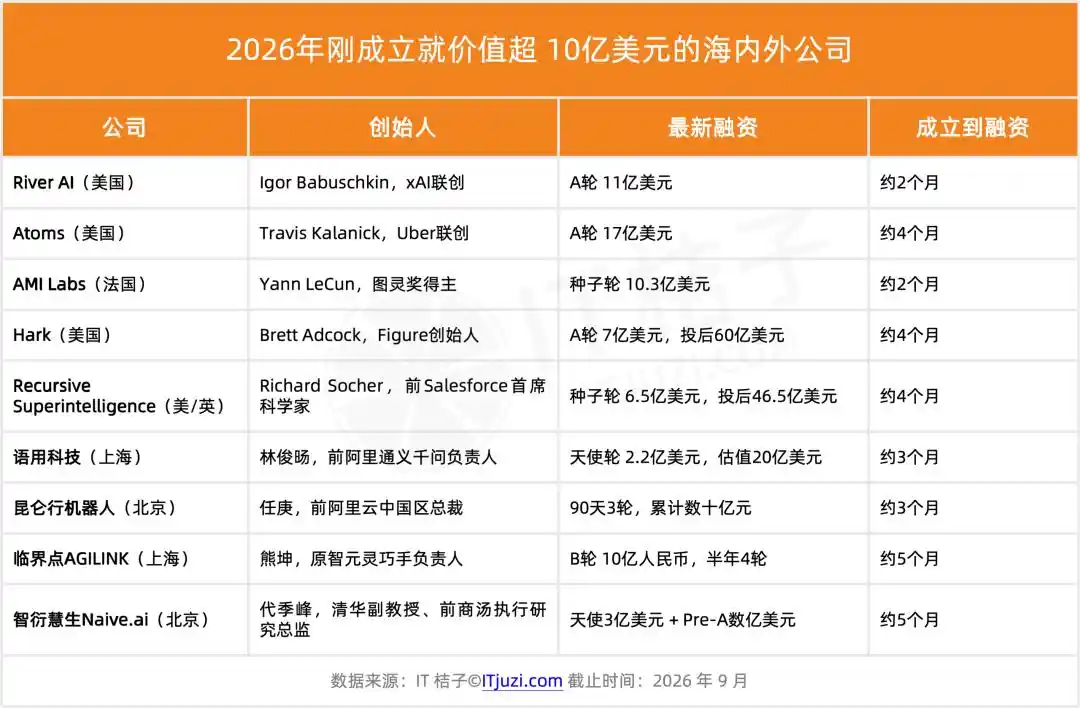
How long does it take for a newly registered company to reach a $1 billion valuation? MarsBit, citing a feature published by the WeChat account IT Juzi, said the answer in 2026 can be just a few months rather than the roughly five years once associated with successive angel, Series A, B and C rounds.

The report opened with Yuyong Technology, founded by former Alibaba executive Lin Junyang. Lin left Alibaba in March, registered the company in Shanghai’s Xuhui district on May 13, and by the time the company was publicly announced in August, the startup, just over three months old and still without a product, had reached an about $2 billion valuation. Gaorong Ventures and Sequoia China each invested $100 million, while Tencent added $20 million, according to the article.
IT Juzi said Lin is not an isolated case. As of early September 2026, it counted at least nine companies in China and overseas that crossed the unicorn line within six months of being founded. The founders include a Turing Award winner, an xAI co-founder, the Alibaba executive credited with building Qwen into the world’s top open-source model family, a former Li Auto autonomous driving executive, and the head of a business line spun out from a robotics company.
Four China-based examples with different paths
Yuyong Technology: about $2 billion in roughly three months
The report said Lin Junyang was born in 1993, studied English at the University of International Relations and linguistics at Peking University, then joined Alibaba’s DAMO Academy in 2019. Over six years, he rose four levels and became Alibaba’s youngest P10 at age 32.
IT Juzi said Lin led the Qwen family. It wrote that derivative models based on Qwen exceeded 200,000 on Hugging Face, downloads topped 1 billion, and the family ranked first among open-source models globally. It also said Qwen3-Max in 2025 had more than 1 trillion parameters. After leaving Alibaba in March, Lin founded Yuyong Technology in May. Its website listed only four directions: digital agents, physical agents, frontier research and real products.
The company has no products and no revenue, the report said, yet carries an about $2 billion valuation. One detail it flagged as unusual was ownership: Lin reportedly controls about 88% through direct holdings and two affiliated entities. The article added that the company’s Chinese name comes from Lin’s early training in linguistics and reflects a pragmatic view of where AGI should go.
Kunlunxing Robotics: a pairing of business operations and autonomous driving
Kunlunxing Robotics took a different route built around two founders. The article said Ren Geng previously held core business roles at Huawei and Alibaba, including president of Alibaba Cloud China and chief of staff, and also served as president of ENN Group. Co-founder Lang Xianpeng was described as a former senior vice president at Li Auto and president of autonomous driving, one of the few executives to bring autonomous driving AI from zero to one and then into scaled deployment.
The company was registered on March 16 in Beijing E-Town. By the end of June, it had completed three financing rounds totaling tens of billions of yuan, according to the report. Investors named in the article included Gaorong, Hillhouse, CAS Star, QD Capital, Huaye Tiancheng, Innovation Works, Xin Capital and C&D Capital. It added that every investor that joined the first round also followed on in the next two rounds.
On technology, the company is betting on what the report called “physical endogenous causality.” Its core system is the Kunlun World Model, or KWM, which adds physical causal modeling to mainstream vision-language-action models and is paired with a counterfactual evaluation system using real physical outcomes to test whether generalization is genuine. On hardware, the company is developing the robot body, motion control and integration testing in-house with mass production as the stated goal.
The article quoted Gaorong partner Xin Wang as saying embodied intelligence is hard to commercialize because a team needs to understand AI, hardware and commercialization at the same time. In his description, Kunlunxing combines “someone who has managed a business worth hundreds of billions” with “someone who has mass-produced autonomous driving AI.”
AGILINK: the only company in the group already making money
Among the four Chinese companies, AGILINK stood out because it was spun out of another business. IT Juzi said Zhiyuan Robotics separated its dexterous hand unit on Jan. 14 and set up the new company. Founder Xiong Kun graduated in 2018 with a master’s degree from the Hong Kong University of Science and Technology robotics institute, joined Tencent Robotics X when it was newly formed, and took part in building it from zero to one. He later worked at IDEA Research Institute and Inovance Technology, then joined Zhiyuan in November 2024 to lead dexterous hand operations.
Within half a year, AGILINK completed four financing rounds: an angel round in January, a Series A worth several hundred million yuan in February, an A+ round in May and a 1 billion yuan Series B in June. Investors listed in the piece included Tencent, C Capital, PwC, Kailian, SAIC, Joyson Electronics, Longcheer, Baidu Ventures and Yunfeng. The report said it took just five months from registration for the company to exceed a 10 billion yuan valuation.
What separates it from the other eight companies, the article said, is revenue. In less than six months, more than 8,000 units of the OmniHand dexterous hand series had been delivered, more than 10,000 grippers had shipped, and the company was profitable from inception. Xiong described dexterous hands as the “last 10 centimeters” for embodied intelligence entering factories and homes. The report argued that competition in this category sits on production lines rather than in laboratories, which helps explain why industrial investors such as SAIC and Joyson were at the table with financial investors.
Naive.ai: a professor’s bet on post-training and agents
The report said Naive.ai founder Dai Jifeng has one of the strongest academic records on the list. Dai studied automation at Tsinghua University, worked on computer vision at Microsoft Research Asia, and was a main author of deformable convolution and R-FCN. The article said both later became standard operators in PyTorch and that the related papers have been cited more than 50,000 times. In 2019, Dai joined SenseTime as executive research director and led a 150-person team. During that period, he proposed BEVFormer, which the report said became close to a standard paradigm for autonomous driving perception and was praised publicly by Jensen Huang. In 2022, he returned to Tsinghua as a tenured associate professor and led work on the open-source multimodal model InternVL at Shanghai AI Lab.
Dai started the company in January this year, focusing on post-training for open-source models and on agents. In June, Naive.ai raised a $300 million angel round from Tencent, Huakong, Boyu and Wanwu, according to the report. A month later, it closed a pre-Series A worth several hundred million dollars from Sequoia China, IDG, Matrix Partners China, Legend Capital and Oriza Fuhua. Two rounds in half a year brought total funding to more than $500 million, the article said. It argued that investors were backing Dai’s ability to turn theory into engineering results and pointed to a previous deep research system built by his team that ranked first among open-source systems on an authoritative benchmark.
Five overseas companies tied to top AI labs
River AI: two months from emergence to a $1.1 billion raise
The article said Igor Babuschkin left xAI in August 2025 after a career that included work on generative modeling and reinforcement learning at Google DeepMind, large-scale training leadership at OpenAI, and the co-founding of xAI with Elon Musk in 2023.
He registered a new company in Nevada in April 2026, the startup became visible in June, and in August it announced $1.1 billion in financing, a roughly two-month sprint, according to the report. The product is River AI, a platform that helps enterprises run LoRA fine-tuning and reinforcement learning on top of open-weight models. IT Juzi said tasks that would normally require a dedicated infrastructure team and months of work could be completed on the platform in 15 to 20 minutes, at one-quarter to one-half the cost of closed-source alternatives, with pricing based on actual token consumption.
The company has around 20 employees, most of them from xAI and Tesla, the article said. The latest round was led by General Catalyst and AMP PBC, with strategic investments from Nvidia and AMD Ventures, and participation from Y Combinator and Temasek. Babuschkin was quoted as saying, “AI should belong to the people using it, not to the labs training it.” The report also noted that General Catalyst’s CEO described the investment as a priority for U.S. AI resilience.
Hark: $6 billion valuation with a 70-person team
Another company on the list is Hark, founded by Brett Adcock, who previously built Figure AI and Archer Aviation. IT Juzi said Adcock put in $100 million of his own money at the end of 2025 to start Hark, and in May this year the company announced a $700 million Series A at a $6 billion post-money valuation. At that point, it had 70 employees and no shipping product.
The article broke the figure down to say that each engineer was effectively being valued at about $85 million. In its view, that only makes sense if investors see Hark not as a hardware company but as a frontier lab.
The shareholder list is what caught the report’s attention. Nvidia, AMD, Intel Capital and Qualcomm Ventures all appeared in the same consumer hardware financing, something it said would have been unusual in the past. Hark plans to release multimodal models and software first, then hardware, reversing the sequence used by Humane’s AI Pin and Rabbit R1. It also brought in AT&T as an investor responsible for cellular connectivity and device certification, giving the device independent network access without relying on a smartphone or Wi-Fi. The company wants to build what the article called a universal interface between people and the digital world, one that remembers the user and sees what the user sees.
AMI Labs: Yann LeCun’s Paris wager on world models
AMI Labs was described as the most different of the five overseas companies because even its final product direction is not fully set. The report said Yann LeCun walked into Mark Zuckerberg’s office in November last year to say he was leaving Meta after 12 years. During that period, he built one of the world’s most respected AI research organizations and became one of the best-known critics of the large language model route. In the article’s retelling of his view, LLMs amount to a statistical illusion: impressive to watch, but not truly intelligent.
AMI Labs launched in Paris in January and announced a $1.03 billion seed round in March at a $3.5 billion pre-money valuation, which the report described as the largest seed financing in European history. It said LeCun initially sought €500 million, but demand was far above expectations and the final amount rose to €890 million.
One detail the report emphasized was that LeCun declined to become CEO. He was quoted as saying, “I am a scientist, a dreamer. I am too disorganized, and too old, to manage people.” CEO duties went to Alexandre LeBrun, founder of healthcare AI company Nabla. Most of the core team came from Meta’s AI research organization, while chief scientist Saining Xie was recruited from Google DeepMind.
AMI is building a world model based on the JEPA architecture that LeCun proposed in 2022. The approach does not predict the world pixel by pixel or token by token, the report said. It learns how the world works in abstract space instead. One result already produced by the team is a system that can use a 16-second first-person video clip to coherently predict the next 10 seconds of a scene, including object trajectories and lighting changes.
The company said it would spend its first year on research only, start discussing commercialization with industry partners after one to two years, and aim to build a “fairly general intelligent system” within three to five years. The investor roster included Cathay Innovation, Greycroft, Hiro Capital, HV Capital and Bezos Expeditions as co-leads, with Nvidia, Toyota, Samsung, Temasek and Bpifrance participating. Individual backers named in the report included Eric Schmidt, Mark Cuban and World Wide Web inventor Tim Berners-Lee.
Recursive Superintelligence: letting AI improve AI
Recursive Superintelligence, or RSI, surfaced on May 13 and announced a $650 million seed round at a $4.65 billion post-money valuation, according to the report. GV and Greycroft led the financing, and Nvidia and AMD both appeared again.
The founding lineup is led by Richard Socher, known for GloVe and recursive neural networks, and previously chief scientist at Salesforce as well as founder of You.com. Co-founders include Yuandong Tian, who led Meta FAIR research for eight years, former DeepMind researcher Tim Rocktäschel, former OpenAI researcher Jeff Clune, and vision transformer paper author Alexey Dosovitskiy. The company has fewer than 30 employees.
The article reduced RSI’s ambition to a single line: let AI improve itself. Today’s major labs still rely on human researchers to evaluate systems, pick datasets and design experiments, which limits iteration speed. RSI wants to remove humans from that loop. Its first public project is to train a system with the capabilities of 50,000 doctors, not to practice medicine, but to do the work of AI scientists by reading papers, designing experiments and analyzing results.
At the time of publication, the company had no public product, model or paper, but had already reached a $4.65 billion valuation, the report said.
Atoms: Travis Kalanick returns, with Uber among the backers
Atoms was presented as the most unusual of the overseas five because founder Travis Kalanick no longer needs to prove that he can build a company. He already built Uber. The report said Atoms operated in stealth for eight years, surfaced in March and announced $1.7 billion in financing in July. Andreessen Horowitz led the round, Ben Horowitz joined the board, and Goldman Sachs, JPMorgan and three other banks provided debt support.
One investor name stood out in the article: Uber. Nine years earlier, Uber’s board had forced Kalanick out. Kalanick described Atoms as “building a computer for the physical world — CPU is manufacturing, storage is real estate, network is transportation.” The company combines three business lines: CloudKitchens, which the article said was valued at $15 billion in 2022, Pronto, an autonomous mining company acquired from Anthony Levandowski, and a newly created logistics unit. Its robotics route uses wheeled industrial robots rather than humanoids.
The report also flagged open questions around the financing. No valuation was disclosed, and Atoms did not announce any launch cities, commercialization timeline or consumer product. By contrast, the article noted, Waymo spent more than a decade and many billions of dollars to reach paid autonomous driving in a handful of cities. Atoms had been visible for six months.
What investors are paying for
Looking across all nine companies, IT Juzi argued that the clearest fact is what they do not yet have. Most have no meaningful financial data. Many have no products. Some have not moved beyond a technical paper or thesis. The thing investors are pricing, the article said, is the person.
It pointed to LeCun’s 12 years at Meta, Lin’s role in making Qwen the top open-source model family, Socher’s 50,000 citations, Ren’s management of businesses worth hundreds of billions, and Kalanick’s history of building two companies valued in the tens of billions. When product, revenue and users are all at zero, founder pedigree becomes the only asset available for pricing, which is why some of these financings can happen in one or two months, the report argued.
The second common thread is sector concentration. All nine companies fit into three lines, according to the article: making AI personal and customizable, represented by River AI, Hark and Naive.ai; bringing intelligence into the physical world, represented by Atoms, Kunlunxing and AGILINK; and betting on next-generation AI foundations, represented by AMI Labs’ world models, RSI’s recursive self-improvement and Yuyong Technology’s digital and physical agents.
A third pattern is the changed posture of major corporates. The report said Nvidia invested in four of the nine, AMD in three, while in China Tencent appeared three times and Hillhouse twice. Chip companies backing AI hardware are looking for the next generation of endpoints. SAIC and Joyson investing in dexterous hands are trying to secure places in the supply chain. Uber’s backing of Atoms was framed as a bet on a future transportation supplier.
The article also said financing labels are losing their old meaning. A $650 million round can be called seed, $1.7 billion can be called Series A, and $300 million can still be an angel round. AGILINK completed four rounds in half a year, Kunlunxing raised three rounds in 90 days, and Naive.ai closed two rounds in one month. Funding is no longer simply a milestone, the report said. It is becoming an ongoing competition for scarce resources.
China also has an additional path that the overseas examples do not: internal incubation. AGILINK was spun out from Zhiyuan Robotics with an existing team, existing technology, existing customers and endorsement from its parent company. The article said the model is not new and cited SenseTime’s “1+X” strategy, which has already spun out Xiwang, Daxiao Robotics and SenseTime Medical, with total SenseTime-affiliated financing in the first half of this year exceeding 47 billion yuan.
The real test has not started
The report closed with a warning that what these companies have secured is a unicorn ticket in valuation terms, not in operating terms. Of the nine, only AGILINK has real revenue. AMI Labs plans to spend its first year on research. RSI has no public model or paper. Hark has not released a product. Yuyong Technology was still at zero products and zero revenue three months after its founding. Atoms has not disclosed any launch cities or commercialization schedule. The rest are also waiting for their first delivery milestone.
Corporate money carries conditions too. The report said that once companies bring in Nvidia or Tencent as shareholders, they are tied to specific ecosystems from day one, leaving less room to stay neutral. If those large companies develop internal projects that are good enough, outside enthusiasm can cool quickly.
There is also the risk embedded in valuations that come before verification. If prices already reflect heavy expectations, any wrong turn in technology or delay in delivery can be amplified. Hark will have to face Apple and Google. River AI must prove that enterprises are willing to pay for owning their own models. Atoms is up against Waymo, which has been working for more than a decade. The article said the market may need 12 to 24 months to see how those questions are answered.
Still, the report argued that a market capable of moving a startup through what used to be five years of fundraising in just half a year is making a statement of its own: capital has shifted from proving first and paying later to paying first for scarcity. Whether that turns out to be efficiency or illusion will depend on the first real products these companies deliver.
The original article was published by the WeChat account IT Juzi (ID: itjuzi521) and written by Judy.