
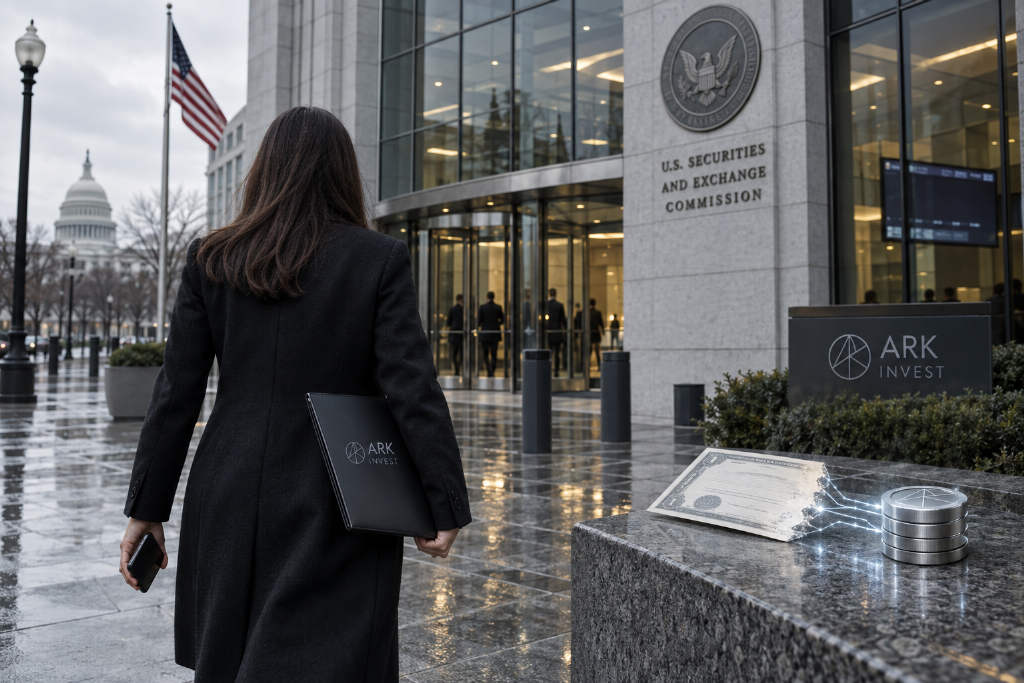
ARK Venture Fund and ARK Investment Management are asking the U.S. Securities and Exchange Commission to amend a prior exemptive order so the fund can add tokenized shares recorded on distributed ledger technology, according to an SEC filing published on Aug. 24.
The filing surfaced as The Rollup founder Andy said on Sept. 8 that a large fund had received an SEC “green light” to place its fund shares on-chain in tokenized form. Around the same time, the SEC’s latest filing showed ARK pursuing its own exemptive relief. If approved, ARK would become the first major U.S. asset manager to bring tokenized securities to market through a case-specific exemption.
ARK wants to add exchange-traded and tokenized share classes
This is not ARK’s first exemptive order. Last year, the firm received SEC relief allowing a multi-class fund structure. At that stage, however, the shares were neither listed on an exchange nor designed for a secondary market.
The new application would expand that structure with two additional share classes. One is an Exchange Class that could list on a national securities exchange. The other is a Tokenized Class, where ownership would be recorded using distributed ledger technology, or DLT. That tokenized class is the center of the current request.
Under the proposal, tokenized shares could trade on regulated alternative trading systems, or ATSs. They could also move through other quotation mechanisms and be transferred peer to peer between eligible wallets.
Transfers would require KYC, AML checks, and wallet whitelisting
The plan does not create unrestricted circulation. ARK’s filing says the fund and its transfer agent would need to complete KYC and AML reviews for wallets that hold tokenized shares. Only wallets placed on an approved whitelist would be allowed to hold those assets.
In practice, the structure connects the legal rights embedded in a traditional fund, transfer registration, and compliance review with blockchain-based account infrastructure and settlement functions. The result would be a regulated on-chain securities market rather than a free-floating crypto token.
The filing also makes clear that tokenized shares would remain fund shares under securities law. Blockchain would serve as the infrastructure layer for ownership records and transfers. The SEC has already stated that tokenization does not change the legal nature of a security.
ARK flags possible deviations from NAV in secondary trading
On-chain fund shares could, in theory, later connect with stablecoins, lending protocols, and other on-chain financial products. That would create combinations that are hard to replicate in traditional markets. But the filing also points to a core risk.
Traditional funds are subscribed and redeemed at daily net asset value, while tokenized shares that trade in a secondary market may transact at prices above or below NAV. ARK said in the filing that prices on an exchange, on an ATS, or in peer-to-peer transactions may differ from the fund’s net asset value.
The request is still under SEC review. According to the filing, interested parties may request a hearing by Sept. 18. If the SEC does not hold one, it typically publishes the result of the application or its next step not long after.
Why ARK is pushing to move fund shares on-chain
ARK Venture Fund, backed by Cathie Wood, is an interval fund launched in 2022. The product was built around the idea of broadening access to venture-style investing, with a minimum investment of $500. Its portfolio includes OpenAI, Anthropic, Figure AI, chip startup Tenstorrent, and pre-IPO SpaceX.
Its current structure limits liquidity. Investors cannot freely transfer or exit on a daily basis and instead rely on a standing quarterly repurchase offer capped at 5%, with proceeds distributed pro rata. For a vehicle holding technology equity exposure, that creates a mismatch between liquidity expectations and the structure of the fund. ARK’s application appears aimed at that problem.
ARK has also been active in tokenization infrastructure. Last year, ARK Venture Fund invested about $10 million in RWA infrastructure platform Securitize, which now provides tokenization services to major asset managers including BlackRock, Apollo, and Hamilton Lane.
That sequence matters. ARK first backed the infrastructure layer, then moved to test tokenization directly in one of its own products.
The SEC’s broader innovation exemption is still pending
Interest in ARK’s filing is also tied to a wider regulatory question. SEC Chair Paul Atkins has repeatedly said this year that he wants a regulatory framework better suited to blockchain-based trading.
In March, Atkins said the SEC was considering an innovation exemption that would allow limited trading of some tokenized securities under clear time and scope limits, using real-market experience to shape longer-term rules. In April, he said that framework was close to launch.
That process has not moved on the schedule many expected. The planned rollout was delayed after the SEC canceled its Aug. 14 meeting.
Securitize President Brett Redfearn said the delay was partly tied to concern that the policy could affect the progress of the Clarity Act in Congress. He said the innovation exemption is more likely to arrive after related legislation advances, with a possible window around early October.
From tokenized assets to tokenized fund shares
Viewed over a longer period, the U.S. asset-management industry’s move on-chain is starting to look like a three-step progression.
The first phase was product validation. Tokenized fund products such as BlackRock’s BUIDL and Franklin Templeton’s BENJI showed that, under the current securities framework, funds can be tokenized and on-chain shares can operate on a legally workable basis.
The second phase is case-by-case testing. ARK’s application fits that stage. By granting individual exemptive relief, the SEC can let firms such as ARK test secondary-market trading, peer-to-peer transfers, and compliance boundaries for on-chain shares while gathering evidence for broader rules.
The third phase would come if a general innovation exemption is formally adopted. In that scenario, more tokenized securities could enter on-chain markets within defined limits, and major firms such as Fidelity, WisdomTree, and BlackRock could expand their tokenized fund lineups.
That path still depends on open questions, including whether ARK’s request is approved, whether Congress advances relevant legislation, and when or whether the SEC adopts a broader exemption. What is already visible, though, is the direction of travel: asset managers are moving beyond issuing tokenized assets and are now testing whether the fund share itself can become an on-chain, transferable security.