



AI Agent tokens reached a market capitalization of about $15.7 billion in January 2025. That figure has since dropped to roughly $3.65 billion. In a report by Sparsity Data, authors Conviction and Kioto argue that the market took a simple lesson from that collapse: abandon the category. Their point is that this blanket discount now groups together projects doing measurable work on-chain with the attention-driven token stories that defined much of the previous cycle.
The report, translated by TechFlow, does not claim every AI token is undervalued. Its argument is narrower and more specific. The underlying conditions have changed: open models are stronger, inference is much cheaper, autonomous execution lasts far longer, and on-chain infrastructure has improved enough for some tokens to sit inside working systems rather than around social media activity.
Why the previous cycle was discarded
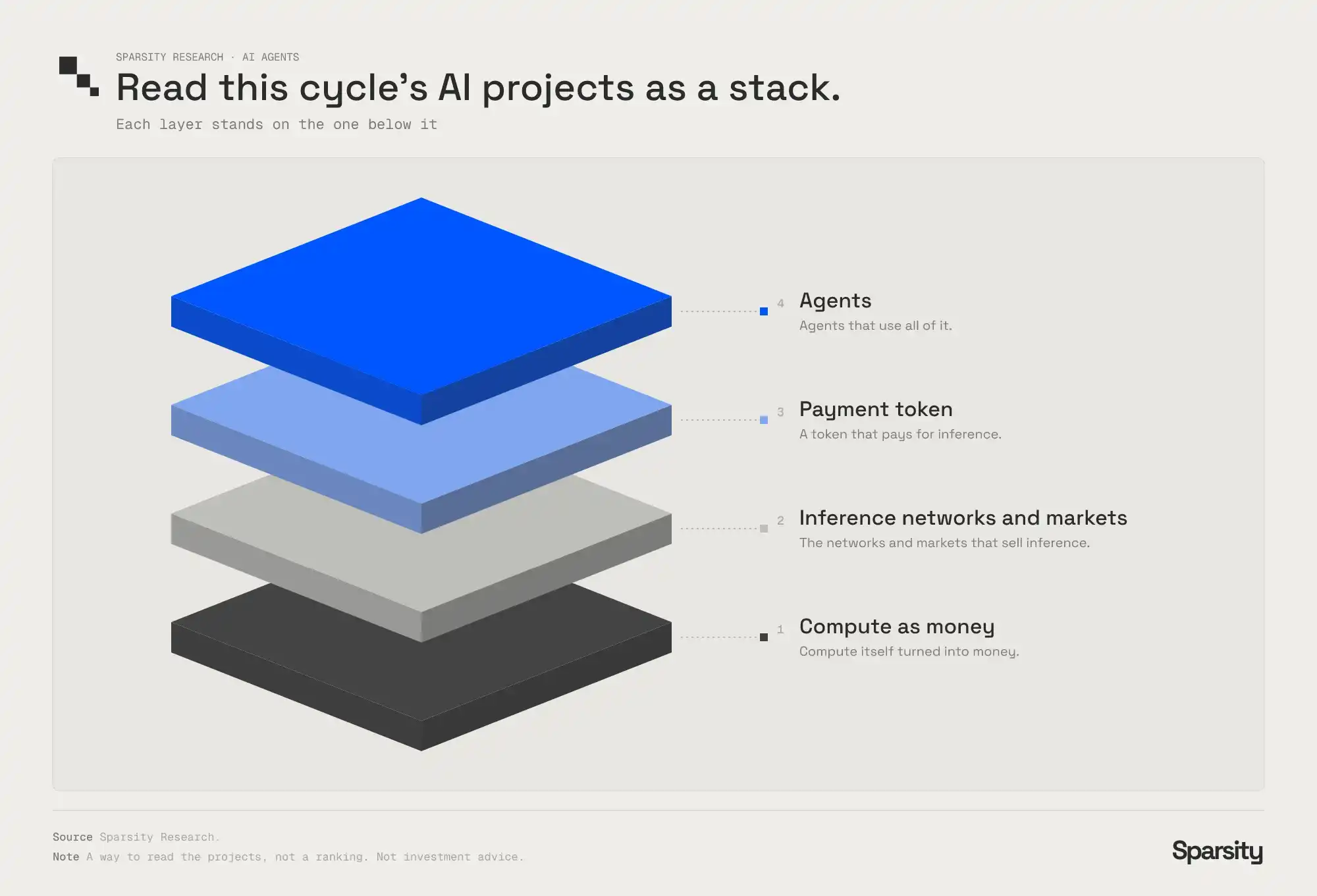
The report starts with the names the market has already written off. At their peaks, $VIRTUAL reached a market capitalization of $4.62 billion, $ai16z hit $2.59 billion, $GOAT climbed to $1.22 billion, and $AIXBT reached $745 million. As of Oct. 9, those figures had fallen to $467 million for $VIRTUAL, $20 million for $AIXBT, $16 million for $GOAT, and about $4 million for $ai16z. The four best-known names from that cycle were all down more than 90% to 99% from their highs.
The authors describe most of those projects as chatbots with token tickers attached. Agents posted content, the posts drew attention, and the tokens traded on that attention. They also push back on the idea that the entire category should be called a scam. After reviewing the record, they say they found no documented case in which a team admitted, or was proven, to have manually written posts while claiming full automation. The closest example, they write, was Andy Ayrey’s public statement on July 14, 2024 that Truth Terminal had “not yet achieved fully unattended autoposting.” In the report’s framing, that was a disclosure, not a confession.
The software itself was real as well. Eliza, Rig, and Swarms were all open-source frameworks that developers actually used. What was missing was model capability. Those frameworks wrapped models that still could not do much sustained, useful work on their own, so token pricing rested more on the idea of an agent than on output produced by one.
Models got stronger, cheaper, and able to work longer
The report uses three benchmark comparisons to show what changed between cycles.
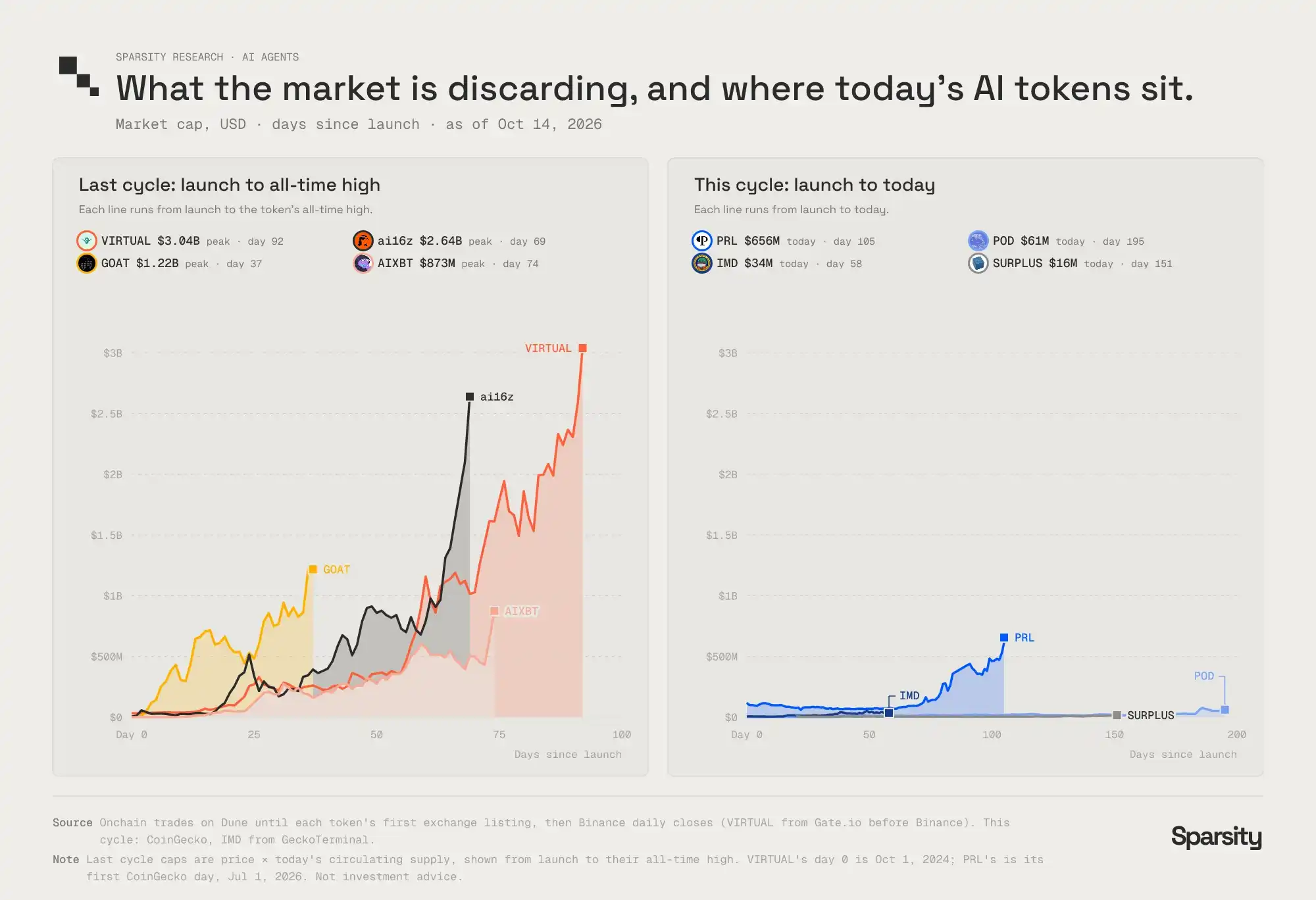
First is the Artificial Analysis intelligence index. In November 2024, GPT-4o scored 8, the same as DeepSeek V3. By August 2026, the open-weight model GLM-5.3-Flash scored 42 while costing $0.50 per million output tokens, versus $10 for GPT-4o at the earlier point. In the report’s telling, that means more than a fivefold score increase at one-twentieth of the cost, with downloadable weights available to anyone.
Second is SWE-bench Verified. GPT-4o solved 21.6% of tasks in the same test environment at a cost of $1.53 per task. MiniMax M2.5, released in February 2026, reached a 75.8% success rate at $0.07 per task. The report treats that as a sharp jump in both effectiveness and cost efficiency.
Third is autonomous work duration. METR estimated that Claude 3.5 Sonnet in October 2024 could sustain task execution for about 21 minutes. Claude Opus 4.6 could operate for about 12 hours. For the authors, that is the decisive break. An agent that lasts 21 minutes still needs close supervision. One that can run for 12 hours can be trusted with a real assignment.
The report also notes what did not change much. Model output speed has not improved materially since late 2024, so speed is not central to the thesis. Capability and economics are.
Blockchain infrastructure changed too. Uniswap v4 Hooks went live on mainnet on Jan. 31, 2025, allowing smart contracts to run custom code inside liquidity pools. One of the five projects in the report, IMD, is built on that foundation. Put together, the authors say, ordinary users can now access high-capability AI, and agents themselves can control wallets and modify liquidity-pool logic in real time.
A four-layer on-chain AI stack
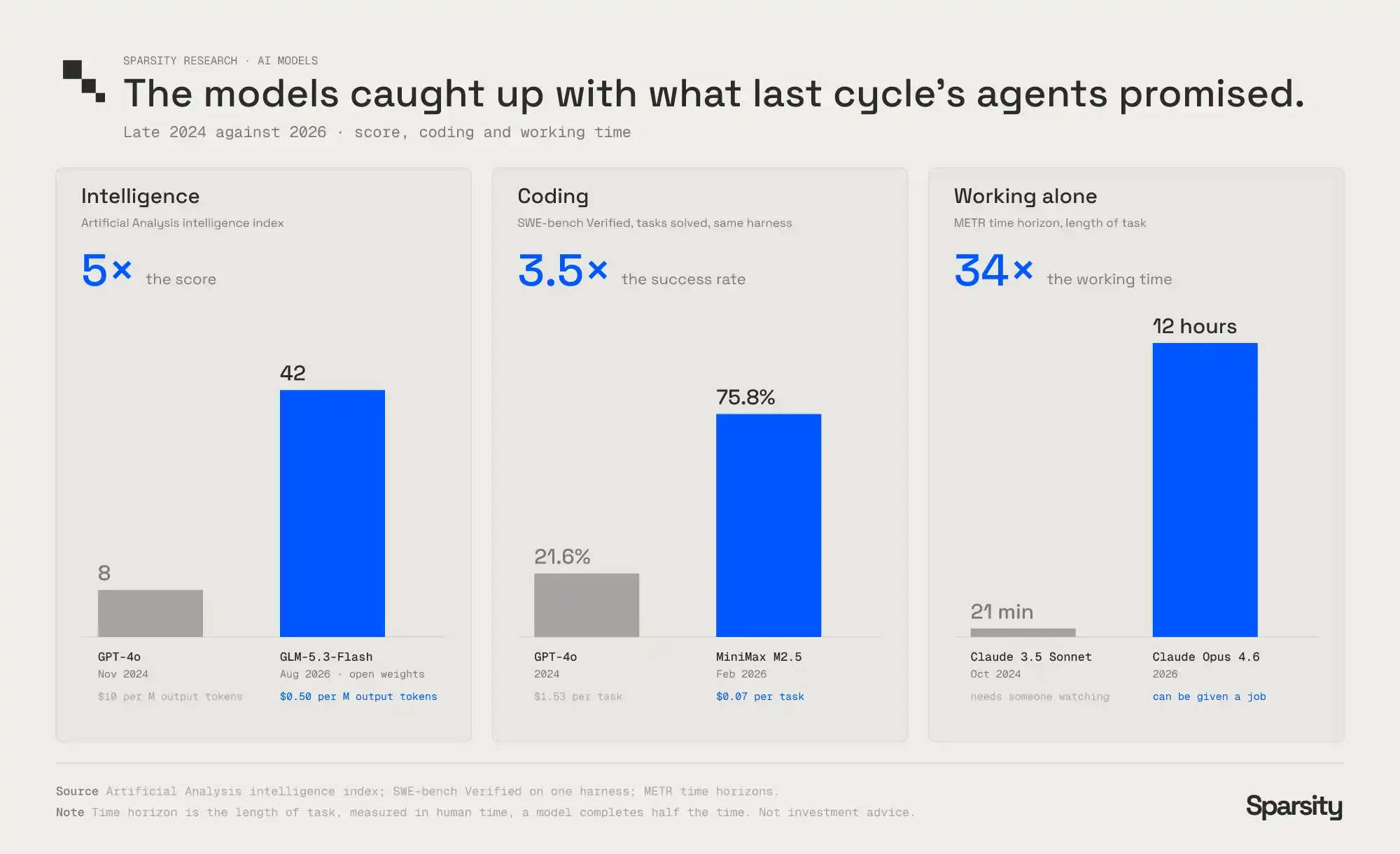
The report frames the sector as a stack. At the bottom is compute turned directly into money. Above that sit decentralized networks and marketplaces that sell inference. Above those are functional tokens used to pay for inference. At the top are agents that coordinate across the rest of the stack.
Using that structure, the report walks through Pearl, POD, Surplus, ORBIO, and IMD, focusing on what is already working and what remains unfinished.
Pearl turns proof-of-work into useful compute
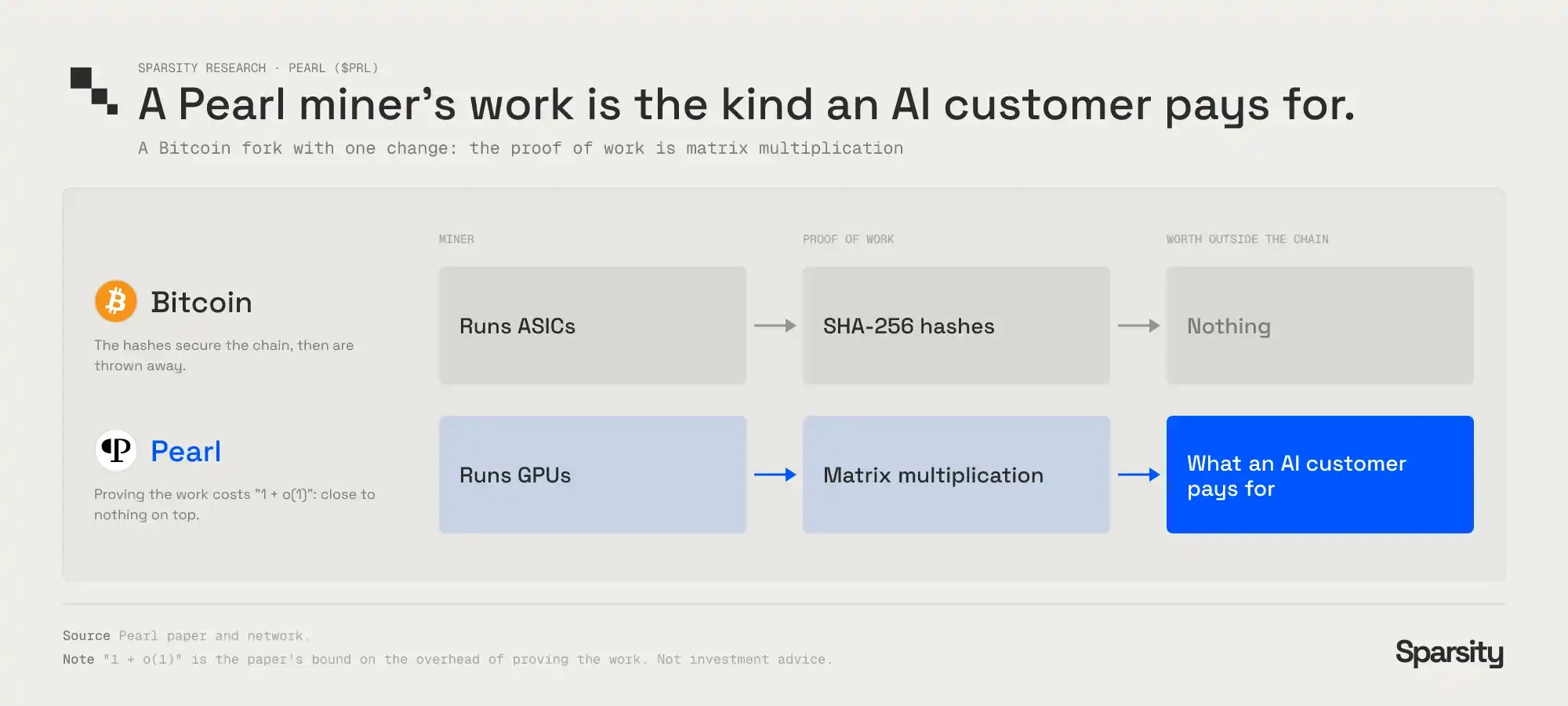
Pearl is described as a Bitcoin hard fork whose proof-of-work uses matrix multiplication, the same core computation that powers AI models. Bitcoin miners produce hashes with no practical use outside the chain. Pearl miners, by contrast, produce compute that AI customers are willing to buy.
The report says the academic paper behind the system shows verification overhead of only “1 + o(1),” meaning the extra burden beyond the useful computation is close to negligible.
Pearl has a hard cap of 2.1 billion tokens, a smoothly decaying issuance curve, and no halving. The chain launched on April 27, 2026 and currently runs at about 49 EH/s. $PRL trades around $1.89, giving it a circulating market capitalization of roughly $653 million.
What has already been delivered, according to the report, is an active public chain backed by large-scale compute and two interfaces that at one point used that compute to serve external customers: Pearl’s own API and an endpoint on Together AI, though the latter is now offline. The missing piece is a two-sided marketplace that directly matches compute buyers with miners.
Most of the network’s compute currently comes from independent miners using RTX and AMD consumer GPUs. The report adds that the Kryptex pool mined 51% of blocks over the past 24 hours. The closest comparison is Bitcoin: the same economic security model, but with useful compute preserved for outside demand. Until the decentralized marketplace is live, though, real buyer demand has only appeared through two service interfaces, one of which no longer operates.
POD and Surplus sell inference from opposite directions
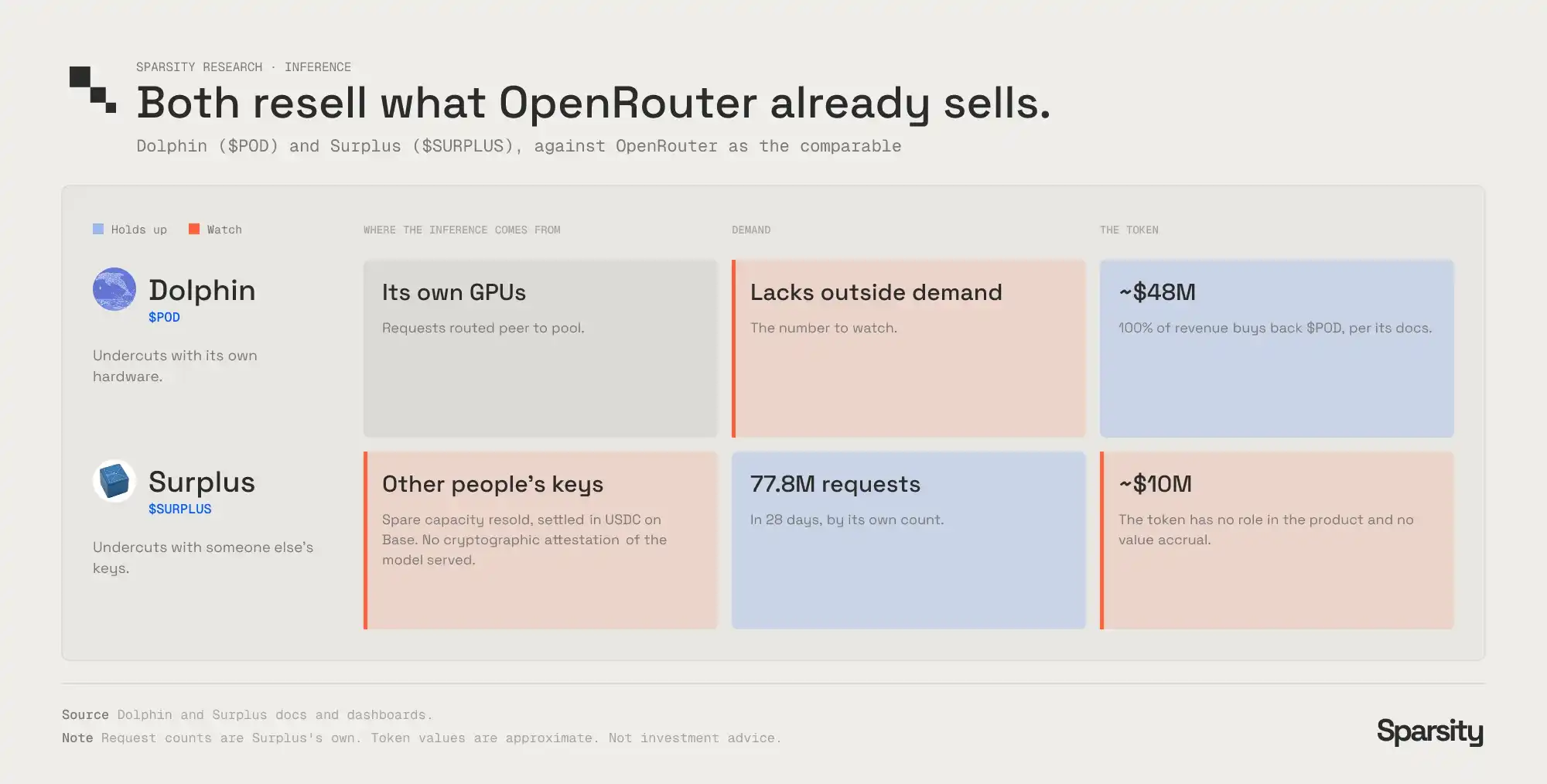
Dolphin’s decentralized network sells inference through GPUs it controls directly. User requests are routed through a Peer-to-Pool mechanism, and Dolphin’s documentation says 100% of business revenue will be used to buy back and burn $POD. The token’s market capitalization is about $48 million, according to the report.
Its edge is price. Node operators earn about $0.50 per million tokens, while the cheapest comparable rate on OpenRouter is $0.70. The report says the network works and pricing is very low. The weak point is demand from real off-chain customers, which the authors call the key metric for judging long-term value.
Surplus takes the opposite route. It owns no GPU hardware. Instead, it runs a resale marketplace for idle compute capacity. Sellers list unused API keys from providers including Bedrock, Venice, OpenRouter, Google, and OpenAI. Orders are matched off-chain, while settlement happens on Base in USDC. Based on the project’s own disclosures, the platform processed 77.8 million requests over the past 28 days, with an average seven-day discount of about 90%.
The report calls Surplus a protocol with active real users. It also points to two obvious weaknesses. First, the project’s documentation says the underlying models “lack cryptographic authenticity proofs,” so buyers must trust that sellers are actually providing the model they paid for. Second, $SURPLUS has a market capitalization of about $10 million but does not play a core functional role in the product, leaving token value capture unresolved.
OpenRouter is the common benchmark for both projects. POD undercuts it with self-operated hardware. Surplus pushes prices even lower by reselling spare API capacity from third parties.
ORBIO converts trading fees into inference credits
$ORBIO launched on the Pons platform on Aug. 31 and was paired with tokenized NVDA shares for liquidity. Users who stake 1,000 $ORBIO or more earn CREDIT, which can be redeemed at face value for AI inference balance. Trading fees generated by the token effectively pay for holders’ AI usage.
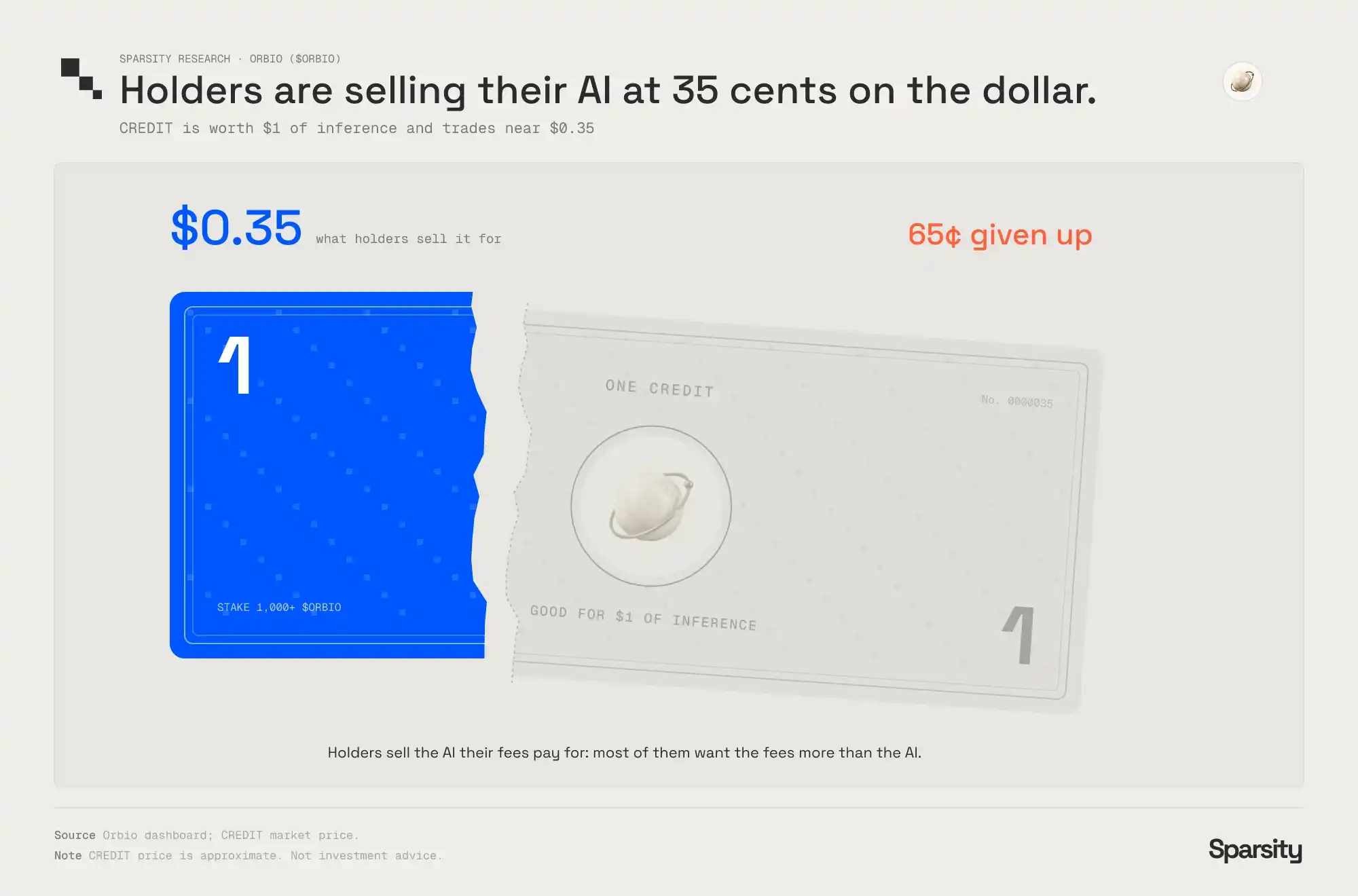
The report says the mechanism has already funded $285,180 worth of inference credits, of which about $43,500 has actually been used. In the secondary market, CREDIT with a $1 face value trades around $0.35. The authors read that discount as a sign that most holders would rather cash out fee-derived credits than spend them on AI services.
$ORBIO hit an all-time high of $0.1221 on Oct. 4, implying a circulating market capitalization of about $116 million. It is now trading around a $37 million level. On Oct. 10, the team said on social media that it had completed a $1.2 million seed round.
The report uses Venice as the scaled-up comparison. Venice disclosed 3.5 million registered users in July 2026 and monthly consumption of 1.3 trillion tokens. On Aug. 17, Erik Voorhees said annual recurring revenue had reached “$100 million.” Venice later raised a $65 million Series A led by Dragonfly at a $1 billion valuation, and its token $VVV now carries a market capitalization of about $1.06 billion. The report’s point is that a token used to buy inference can become large, but ORBIO is currently only about one-thirtieth the size of Venice, with actual usage far smaller.
IMD offers a clearer on-chain case
$IMD is the renamed and upgraded version of $FP, the token tied to the on-chain pet app Fren Pet. The report says it coordinates a large colony of paid agent workstations. All 2,000 seats have been minted, and more than 1,000 agents are active in day-to-day collaborative work.
Those agents have completed 11,014 tasks, consumed about 190 billion tokens worth of inference, and generated 320 new project launches. Since Oct. 5, 105 of those have gone live on Ethereum mainnet. Token economics are embedded in the system itself: a POOL4 Hook contract on Uniswap v4 maintains a 34.28 ETH buy wall, and the protocol has burned 33,279 $IMD. Circulating market capitalization stands at about $65.5 million.
The report says working agents pay their own inference costs, mainly through Claude Code or OpenAI Codex subscriptions. Eighteen months ago, a large agent swarm would have needed outside subsidies to keep running. Now, the compute bundled into ordinary developer subscriptions is enough to support a collaborative system.
There are still manual points of control. Payments to working agents in $IMD are still distributed manually through a multisig wallet. A single wallet also controls administrative permissions for the core Hook contract, including the closeMarket circuit-breaker function. In theory, that gives one centralized entity the power to shut the market down.
The report says the closest comparison is Virtuals, the previous cycle’s agent launch platform. At its peak, $VIRTUAL was worth about 70 times as much as today’s $IMD.
Cross-protocol composability is already appearing
The authors argue that one of the more important developments is spontaneous composability across these projects. They cite one example: Venice inference credits are already being resold at a discount on Surplus. In other words, inference funded by one tokenized system is circulating in the secondary market of another independent project. No one designed that full path from the top down, yet it is already functioning on-chain.
If that trend continues, the report says agents may eventually use tokens to buy inference from other agents on-chain, creating a closed loop with no human intervention. It adds that most autonomous on-chain agent calls could end up flowing through aggregation protocols like Surplus. If that happens, whether $SURPLUS can build a real value-capture channel will become the central question for the token.
Working products do not automatically make good tokens
The report also addresses the bearish case directly. Critics can argue, and not irrationally, that the products may be useful while the tokens still fail to capture value. The authors agree with much of that factual critique. $SURPLUS does not yet capture protocol growth in a meaningful way. CREDIT trades around $0.35 on the dollar. Product substance is not the same thing as token investability, and secondary-market investors buy tokens, not abstract utility.
That is exactly why the authors argue for project-by-project research instead of a blanket rejection of the sector. In their framework, $PRL is itself the compute product, with the token functioning as money minted from useful work. $IMD has a burn mechanism and a real buy wall inside its dedicated Hook contract. At the other end of the spectrum, $SURPLUS lacks a strong link to business growth, and ORBIO’s CREDIT trades at a steep discount.
The report’s closing point is straightforward. Last cycle, most AI tokens were little more than chatbots with tickers, and the market was rational to abandon them. In this cycle, the underlying models can actually do work, that work is happening on-chain, and the interactions are publicly visible. Yet the market is still applying the old discount. The report includes a disclaimer that it is not investment advice and says Sparsity aims only to describe observable on-chain behavior, not recommend buying or selling any asset.