
A sharp sell-off in U.S. equities on Friday laid bare a split inside the AI trade. The Nasdaq Composite fell 2.86% to 25,437, its biggest one-day decline since June 5, and stood 7.8% below its Oct. 6 record closing high. The S&P 500 dropped 1.82% to 7,580.07, while the Dow Jones Industrial Average lost 572.25 points, or 1.09%, to 51,770.31. All three major indexes finished the week lower, and the Nasdaq ended October down 5.3%, its worst monthly showing since March 2025.
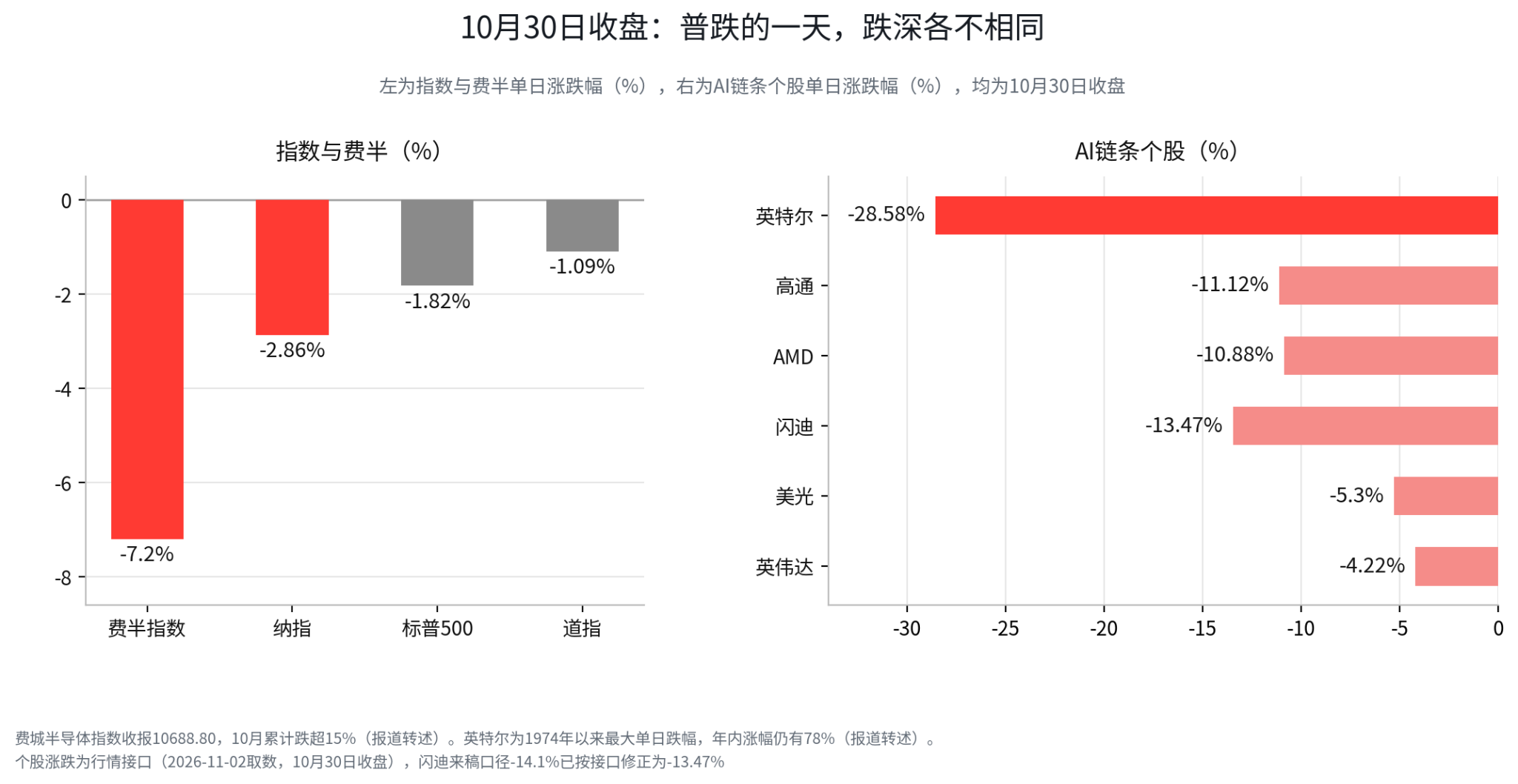
The more telling move came from the AI supply chain. The Philadelphia Semiconductor Index sank 7.2% on Friday to 10,688.80 and fell more than 15% for October. Intel tumbled 28.58% after earnings and guidance came in far below expectations, marking its biggest one-day drop since 1974, though the stock was still up 78% for the year. AMD fell 10.88%, Qualcomm lost 11.12%, Micron dropped 5.3%, Nvidia declined 4.22%, and SanDisk fell 13.47%. Nvidia’s market capitalization slipped to about $4.93 trillion.
The market is no longer pricing every AI growth story the same way
The sell-off did not amount to a sudden rejection of AI demand. What changed was the question investors were asking: can revenue growth tied to AI justify ever-larger capital spending?
Earlier in the cycle, the market was willing to pay up in advance for computing demand, order growth and long-term addressable market potential. That becomes harder when investment budgets keep rising, free cash flow comes under pressure and profit realization takes longer. Intel’s results and guidance were one direct trigger, but the broad retreat across semiconductors suggested a wider reassessment of expectations across the chain rather than a response to one company’s operating miss.
Apple moves back ahead of Nvidia as cash-flow visibility regains a premium
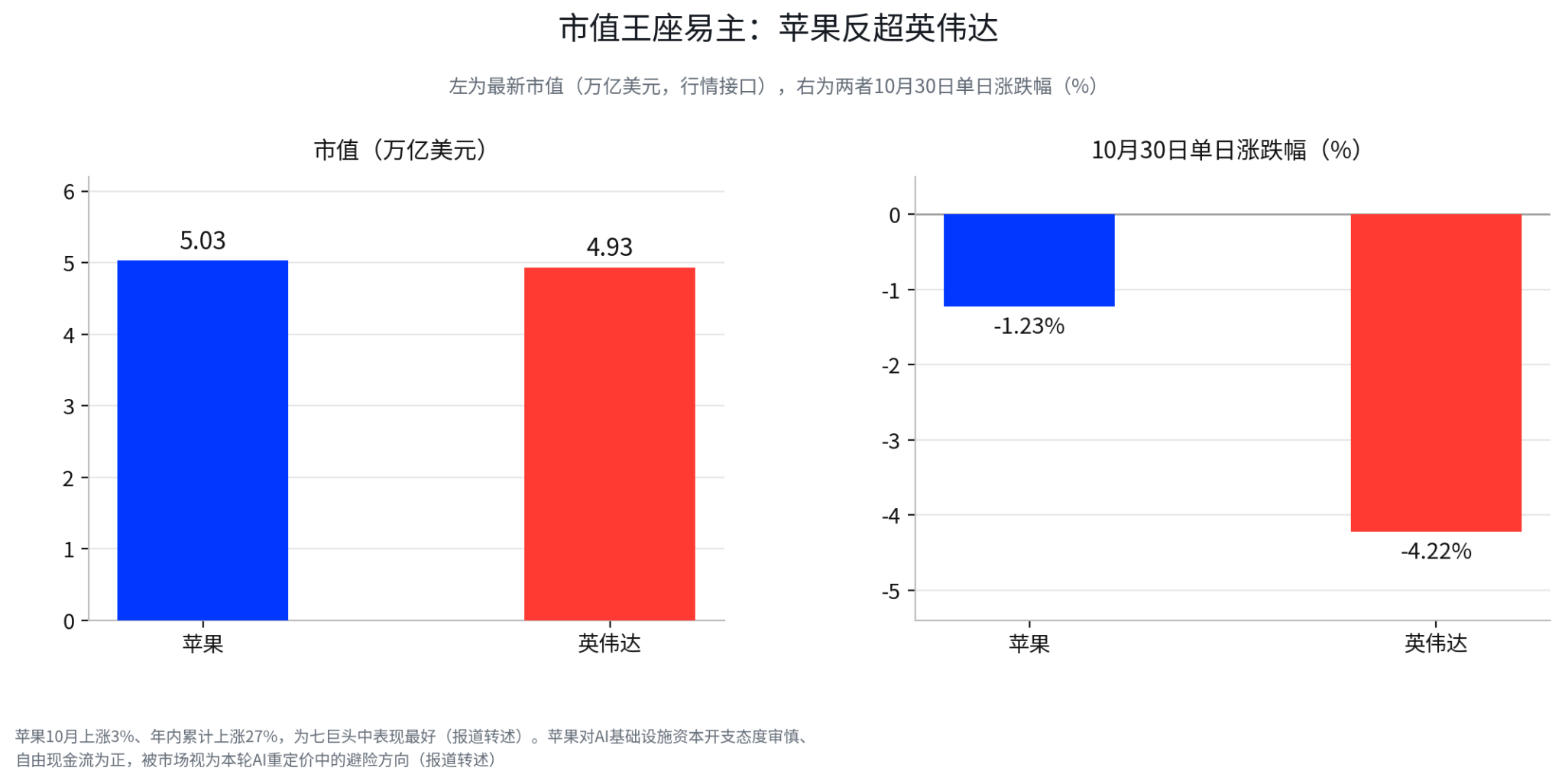
The same day semiconductors sold off, the top spot in global market capitalization changed hands. Apple fell 1.23% but still ended with a market value of about $5.03 trillion, overtaking Nvidia at roughly $4.93 trillion to become the world’s most valuable listed company again. Apple rose 3% in October and was up 27% for the year, making it one of the stronger performers among the so-called Magnificent Seven.
The shift carries symbolic weight. For the past two years, Nvidia has stood at the center of the AI infrastructure buildout, and investors were willing to assign a premium to its supply-constrained products and rapid growth. As large technology companies keep expanding spending on data centers, chips and energy, the focus is moving away from orders and revenue growth alone and toward return on investment: how much revenue and profit those outlays can generate, and how long it will take before they turn into cash flow.
Apple looks different on that score. Its capital spending profile is relatively restrained, and its cash generation still depends mainly on iPhone sales and services revenue. As AI leaders face repricing tied to infrastructure spending and longer payback periods, Apple’s appeal may rest less on a stronger AI narrative and more on a business model that does not require the same scale of AI infrastructure investment to support current earnings. A change in market-cap ranking does not prove a full style rotation, but it does show that investors are placing more value on cash-flow certainty as risk appetite cools.
Gold fell too, with Commerzbank pointing to margin calls
Gold did not act as a traditional haven during the sell-off. Spot gold dropped 3.63% on Friday to $3,875.44 an ounce, touched its lowest intraday level in more than a year, and posted its worst October performance since 2008. Silver fell below $50 for the first time since November 2025.
Commerzbank said the decline in technology shares triggered margin calls for some investors, forcing sales of liquid assets such as gold to raise cash for margin requirements or to meet redemption pressure.
That points more to a liquidity shock than to a market conclusion that gold has lost its defensive role. When high-volatility assets in a portfolio fall quickly and leveraged positions face margin pressure, investors may sell what can be converted into cash first. Treasury yields also moved lower. The 10-year U.S. Treasury yield fell 6 basis points to 4.934%, and the 2-year yield dropped 7 basis points to 4.598%. Taken together, the parallel decline in gold and technology stocks does not necessarily signal that markets are pricing stronger growth or higher inflation expectations. The move looks more consistent with investors cutting risk, rebuilding liquidity and shifting toward assets with more visible near-term returns.
Two earnings reports due tonight: Apple’s guidance and Palantir’s growth test
After Friday’s sell-off, the market needs fresh earnings data to judge whether this is a short-term position washout or a deeper change in how AI assets are valued. Apple and Palantir are both scheduled to report after the close on Nov. 2. They sit at different ends of the market’s current debate. Apple represents a mature large-cap technology company with established cash flow and relatively cautious capital spending. Palantir represents a high-growth, high-valuation AI software name. Apple needs to show its core business remains intact. Palantir needs to show growth still justifies the valuation investors have assigned to it.
Apple: the next-quarter outlook matters more than the quarter itself
This will be Apple’s first earnings report since John Ternus took over as CEO on Sept. 1. The earnings call is scheduled for 5:00 p.m. Eastern Time on Nov. 2, or 6:00 a.m. Beijing time on Nov. 3, according to the company website and cited reports. Wall Street expects fiscal fourth-quarter revenue of about $113.3 billion, with estimates ranging from $113.0 billion to $113.4 billion, and earnings per share of $1.98 to $1.99.
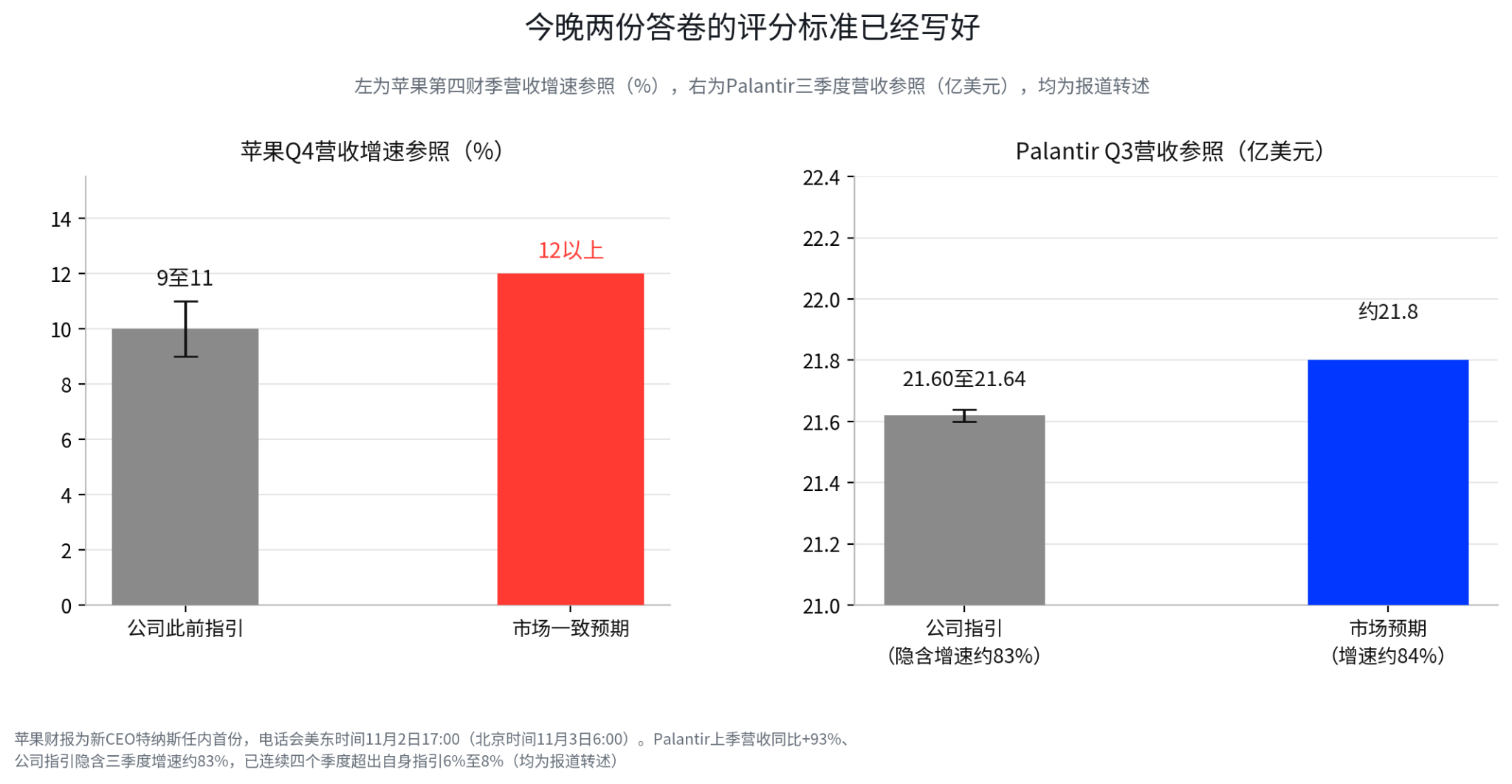
The central issue for Apple goes beyond whether it can beat consensus by a narrow margin. The market wants to know whether growth can hold up over the next several quarters. Apple had previously guided for fourth-quarter revenue growth of 9% to 11%, while the broader market expectation stood above 12%. At the same time, elevated component prices, rising memory chip costs and currency swings could weigh on margins and on forward guidance. Analysts are paying close attention to what Ternus says on the call about memory pricing, component supply and iPhone demand, not just whether quarterly revenue and EPS meet expectations.
Apple’s defensive appeal also has limits. If revenue guidance and iPhone demand remain stable, investors may continue to treat it as one of the cash-flow steadier options among mega-cap technology names. If management offers a more cautious view on costs and demand, Apple may not stay insulated from the broader valuation reset in tech. Whether Apple keeps its relative premium will still depend on fundamentals.
Palantir: strong growth is already priced in, so guidance matters even more
Palantir faces a different kind of pressure. In the previous quarter, the company posted record revenue growth of 93% year over year, U.S. commercial revenue growth of 149%, and adjusted free cash flow of $1.22 billion. For the third quarter, the market expects revenue of about $2.18 billion, up roughly 84% from a year earlier, and adjusted EPS of $0.41, nearly double the $0.21 reported in the same period last year. The company’s own guidance called for revenue of $2.160 billion to $2.164 billion and adjusted operating profit of $1.292 billion to $1.296 billion. On that basis, implied revenue growth is about 83%, below the prior quarter’s 93%.
The issue is that Palantir’s valuation already reflects very high growth expectations. Since its last earnings call, the stock had risen about 46.5%, though it fell 6.27% on Friday and 7.4% for the week to close at $184.11. The company had also warned that hiring and product investment would push third-quarter operating expenses higher, while international commercial growth was running well below the pace seen in the U.S. market.
Over the past four quarters, Palantir’s actual results beat its own guidance by about 6% to 8% each time. That has raised the bar for this report. For richly valued companies, merely meeting guidance is often the minimum. Investors want to see management lift full-year expectations again and show that incremental spending can translate into sustained revenue and profit growth. If the company only meets prior guidance, or offers a conservative fourth-quarter outlook, the stock could still come under pressure even if year-over-year growth remains strong.
Two more tests this week: AMD earnings and the October payrolls report
Apple and Palantir are only the start of this week’s event chain. Nov. 3 is U.S. midterm election voting day, and AMD is also due to report after the close that day. The election result could shape market views on fiscal policy, sector regulation and overall risk appetite. AMD’s numbers, from the supplier side, will offer another test of whether AI compute demand is holding up and whether a second tier beyond Nvidia can convert that demand into growth.
The market expects AMD to report third-quarter revenue of about $13.0 billion. Progress in ramping Helios racks and MI450 chips is expected to be a key focus, and the company’s market capitalization is about $824.0 billion. Investors will be watching not only data-center revenue growth but also delivery timing for new products, customer demand and gross margin performance. If AMD can show that its share in the AI accelerator market is expanding, that may ease some concern over compute demand. If product progress or guidance disappoints, valuation pressure across semiconductors could continue.
The U.S. October nonfarm payrolls report, due on Nov. 6, will shape the macro side of the valuation debate. A stronger-than-expected labor report could reinforce concern that interest rates will stay high. A clearly weaker report could revive concern about economic growth and corporate earnings. For AI giants dealing with pressured free cash flow and heavy capital spending, and for AI software companies whose valuations already assume rapid growth, changes in rates affect how future cash flows are discounted into present value and how much investors are willing to pay for long-duration growth.
That is why the market’s focus this week goes beyond whether a few companies can post strong quarterly numbers. The bigger question is whether three sets of signals line up: whether AI demand is real and durable, whether companies can turn growth into profit and cash flow, and whether the rate backdrop still supports paying a high premium for future growth.
Data notes
Market data cited in the source were based on the Oct. 30, 2026 close and retrieved on Nov. 2. The Nasdaq fell 2.86% to 25,437; the S&P 500 fell 1.82% to 7,580.07; the Dow fell 1.09% to 51,770.31; and the Philadelphia Semiconductor Index fell 7.2% to 10,688.80. Intel fell 28.58%, AMD 10.88%, Qualcomm 11.12%, Micron 5.3%, Nvidia 4.22%, SanDisk 13.47%, and Apple 1.23%. Nvidia’s market value was listed at $4.93 trillion and Apple’s at $5.03 trillion.
On monthly performance and drawdowns, the Nasdaq was 7.8% below its Oct. 6 record close and down 5.3% for October, its weakest month since March 2025. The Philadelphia Semiconductor Index fell more than 15% in October. Apple rose 3% in October and 27% year to date. Intel recorded its biggest one-day drop since 1974 but remained up 78% for the year.
On metals and rates, spot gold fell 3.63% to $3,875.44, touched a more than one-year low intraday, and posted its worst October since 2008. Silver fell below $50 for the first time since November 2025. Commerzbank mentioned margin calls as a factor. The 10-year Treasury yield fell 6 basis points to 4.934%, and the 2-year yield fell 7 basis points to 4.598%.
Apple is scheduled to report after the close on Nov. 2, with its earnings call at 5:00 p.m. Eastern Time, or 6:00 a.m. Beijing time on Nov. 3. New CEO John Ternus took over on Sept. 1. Consensus calls for EPS of $1.98 to $1.99 and revenue of about $113.3 billion, with estimates ranging from $113.0 billion to $113.4 billion. Apple’s prior guidance called for growth of 9% to 11%, versus consensus above 12%.
Palantir is also scheduled to report after the close on Nov. 2. Consensus calls for revenue of about $2.18 billion and adjusted EPS of $0.41. Company guidance called for revenue of $2.160 billion to $2.164 billion, implied growth of about 83%, and adjusted operating profit of $1.292 billion to $1.296 billion. In the previous quarter, revenue grew 93%, U.S. commercial revenue rose 149%, and adjusted free cash flow reached $1.22 billion. The stock had gained about 46.5% since the last earnings call, then fell 6.27% on Friday and 7.4% for the week to $184.11.
For the rest of the week, Nov. 3 is U.S. midterm election voting day, and AMD is due to report after the close, with expected revenue of about $13.0 billion and a market capitalization of about $824.0 billion. The October nonfarm payrolls report is due on Nov. 6. The source also said expectations for a December rate hike remain elevated.
The source article also stated that its content was provided for general information and market commentary, based on public materials available up to the time referenced in the text, and that market data, expectations and probabilities may change with market conditions. It added that views and strategies cited from third-party institutions, analysts or other individuals represent only those parties’ views at a specific time and do not represent BIT’s views or recommendations. The article said it does not constitute investment advice, investment research, an offer, a solicitation, or a recommendation regarding any security, investment product or trading strategy, and should not be used as the basis for any investment decision. It also noted that financial markets involve risk, security prices and market performance may fluctuate, and past performance and prior market moves do not represent or guarantee future results. Investors should assess risks independently based on their own circumstances and seek professional advice when needed. BIT’s Hong Kong stock trading service is not offered to Hong Kong residents or users in other restricted jurisdictions.




