
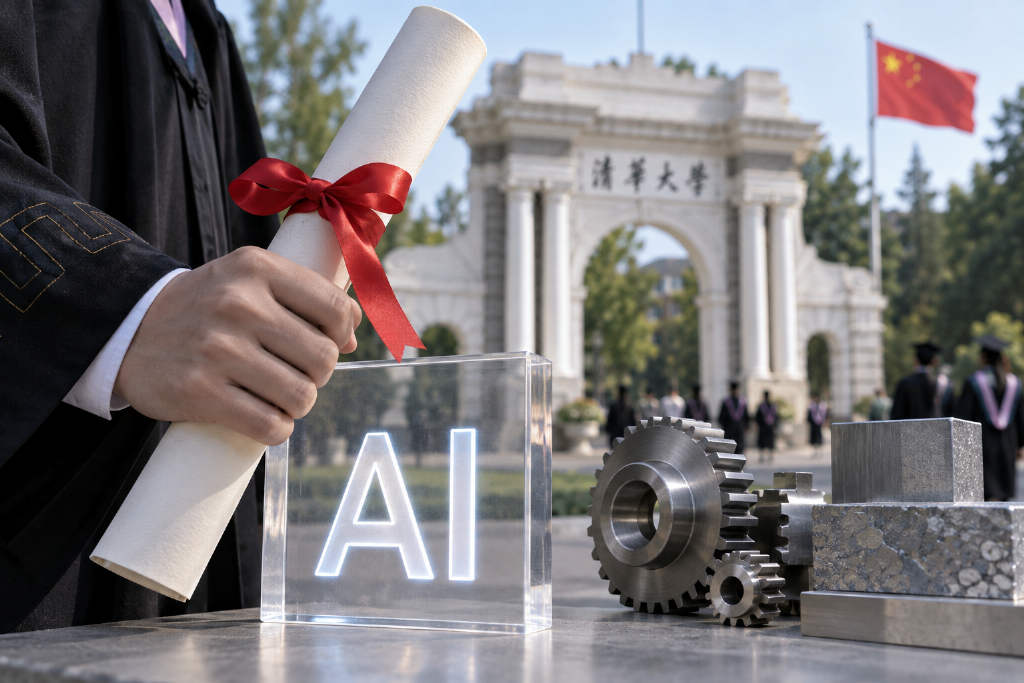
Artificial intelligence is still one of the most popular choices in China’s college admissions cycle. That popularity, though, has not translated cleanly into high starting pay for undergraduate graduates.

The report says many high-scoring students entered AI programs expecting a direct path into the best-paid jobs in the sector. Once in school, they found the link was far less direct. On Chinese social platforms, posts describing the AI major as a new academic "pitfall" have become common, reflecting frustration over a gap between entrance scores, market hype and actual pay after graduation.
Top AI pay remains concentrated in a narrow slice of candidates
Public hiring signals still point to intense competition for elite AI talent.
In March, Tencent launched its Qingyun internship program for year-round hiring and said compensation would have no upper limit. A month later, Moonshot AI rolled out Kimi’s "Voyage Program," saying it planned to grant company equity to interns who had not yet graduated. According to LatePost, ByteDance’s Top Seed campus hires were paid about 1.5 million yuan a year in 2024, rising to 3 million to 5 million yuan in 2025, with some core roles in 2026 reaching 6 million yuan or more.
Those headline figures reflect how aggressively major companies are chasing AI talent. Liepin’s 2025 talent supply-and-demand trends report said the shortfall in AI talent had reached 5 million. Recruitment pipelines have expanded in parallel: AI-related roles accounted for 80% of Alibaba’s hiring for the class of 2027, while more than 90% of Baidu’s summer internship openings for the same class were tied to AI.
But the article makes clear that these openings do not represent the average undergraduate outcome. The candidates being targeted for the highest-paid roles usually come from top research labs, have standout competition records, or hold master’s or doctoral degrees.
Liepin data shows that 46.98% of AI technical roles in 2025 explicitly required postgraduate education. Among the five AI job categories with the strongest demand, algorithm engineer and deep learning engineer roles had the highest share of postings asking for master’s or doctoral degrees, at 50.85% and 49.45%, respectively. Image algorithm and machine learning roles were around 40%, while machine vision was lower at 23.39%. In practice, that leaves nearly half of core AI technical jobs relatively unfriendly to bachelor-level applicants.

The education threshold also splits the pay curve. Data from 51job shows median monthly salaries for core positions such as large-model algorithm engineers and deep learning engineers were close to 25,000 yuan, while support roles such as AI data trainers were at about 8,500 yuan, leaving the former near three times the latter.
AI undergraduates are not seeing standout salary results
When the focus shifts from the AI industry’s highest-end jobs to AI majors themselves, the picture changes sharply.
MyCOS data cited in the article shows that 2025 undergraduate graduates majoring in artificial intelligence had a monthly income of 7,084 yuan, almost exactly around the average line for engineering disciplines. In the 2026 top 10 list of bachelor’s majors by monthly income, electronics and information-related fields accounted for nearly half the list, but artificial intelligence was absent.
Job matching was also limited. According to MyCOS, only 56% of AI graduates were working in jobs related to their major, and nearly 30% moved into unrelated work because they could not find suitable positions in the field.
The report argues that the payoff many people associate with AI has not been widely captured by undergraduate AI majors. Instead, some of the gains have gone to materials science and engineering, mechanical engineering and other fields that had at one point been treated as less attractive choices.
MyCOS data shows salary growth for undergraduate graduates in mechanical and materials-related majors exceeded 25% over the past five years, more than double the national average increase for bachelor’s graduates over the same period.

The explanation, the report says, is relatively straightforward. China only approved the undergraduate AI major in 2018, and most universities began enrolling students after 2019. The first full cohort did not graduate until 2023, leaving little time for these graduates to become the main workforce behind today’s AI industry. Materials and mechanical engineering graduates, by contrast, sit closer to industries such as semiconductors, new energy and advanced manufacturing, where demand for labor has been expanding through areas tied to wafers, batteries and robotics.
On Sept. 1, CXMT started global campus recruitment for the class of 2027 with more than 180 openings. The company said the roles targeted majors including microelectronics, integrated circuits and electronic engineering, covering circuit design, R&D technology and mass-production technology. Those jobs do not directly build large language models, but they support the hardware and industrial systems that let models run faster and at larger scale.
AI is also creating openings outside pure algorithm tracks
The article says the AI wave has not only benefited traditional engineering majors.
Liepin data shows that from March 2025 to February 2026, newly posted jobs related to prompt writing rose 486.84% year on year. Openings in AI content, narrative and creative work grew 84.21%, AI ethics, compliance and social science roles rose 78.26%, and AI training and human-machine understanding roles increased 67.70%.
Even so, the report notes that most of these positions sit lower in the AI value chain and do not offer the same compensation or status as core technical roles in model development.
Applicant interest remains high despite the gap
The labor market may be showing a layered and uneven reality, but enthusiasm at the admissions stage has not faded.

Data released June 30 by Baidu’s gaokao search platform ranked the 10 hottest majors this year as electrical engineering and automation, artificial intelligence, electronic information engineering, computer science and technology, communication engineering, law, economics, psychology, biopharmaceuticals and digital media technology. The top five were all engineering disciplines, and AI ranked second.
At leading universities, admission scores for AI-related programs continued to rise. In Zhejiang, where intake numbers stayed unchanged, Xi’an Jiaotong University gained 4 points and moved up 454 places in rank, while Beijing University of Posts and Telecommunications gained 6 points and improved by 1,114 places.
That pattern appeared across a range of top domestic institutions and was not limited to elite schools. Local universities including Wenzhou University and Zhejiang Shuren University also posted marked rank gains in AI-related admissions.
The article says families are still willing to place AI near the front of their preference lists, even as the idea of instant high pay after graduation is being corrected by real-world outcomes.
According to data from Alibaba’s Tongyi Qianwen, more than 40 million users had asked the service about gaokao applications as of July 8. The most concentrated questions included which emerging majors are rising and which jobs will be in demand over the next five years. The article frames college applications less as a pure academic choice and more as a calculation about employment prospects and return on investment.
Still, student interest inside AI is not spread evenly across subfields. iiMedia Research data shows that among AI-related majors, application development was the most favored direction, followed by data science. Only about 30% chose algorithm-related tracks, and the share for cybersecurity was lower.

That distribution closely tracks the job market. Roles in algorithms and deep learning tend to favor applicants with master’s and doctoral degrees, while application development covers a wider market and is more accessible. For most bachelor-level students, becoming a large-model scientist is not the most realistic path. Applying AI capabilities to products, business functions and industry scenarios looks more attainable.
Universities are still building the discipline
One of the central points in the report is that the undergraduate AI major is still young.
China formally approved the major in 2018. Most universities enrolled students after 2019, and the first full cohort only graduated in 2023. Compared with mature disciplines such as computer science, electronic information and automation, AI is still constructing its own curriculum, practical training model and employment pathways.
More than 600 universities across China now offer an AI major, and more than 90 have established AI schools or institutes. But expansion has not kept accelerating. After a surge in 2019, the number of newly added universities declined for four straight years before rebounding in 2024. Of the 89 universities that added the major in 2024, only six were part of the country’s Double First-Class group. Most of the new entrants were local public institutions.
The curricula at leading universities share a broad structure: students start with mathematics and computer fundamentals, move into core AI courses and then work through practice-based and interdisciplinary projects.
Tsinghua University’s Wuqiong College, for example, requires students in the AI major to take calculus, linear algebra, college physics and introductory programming, along with core courses such as machine learning, deep learning and reinforcement learning, plus required practical work including AI agent design. Nanjing University follows a similar model built around mathematics, computer science and artificial intelligence.

Some overseas universities place more weight on humanities and ethics. Carnegie Mellon University, described in the report as the earliest university in the US to offer an AI major, includes mathematics and statistics, computer science, AI and ethics, as well as general courses in science, engineering, humanities and the arts. All AI students there must complete at least 63 credits in humanities, social sciences or the arts, compared with 36 credits in science and engineering.
At the Massachusetts Institute of Technology, the Artificial Intelligence and Decision Making major set up in 2022 includes Social and Ethical Responsibilities of Computing, or SERC, in the list of required undergraduate coursework. The cited classes include Artificial Intelligence, Decision Making and Society and Ethics for Computing.
The report’s conclusion from these examples is straightforward: AI education cannot stop at technical training alone. A mature system has to teach students both how models and algorithms work and how those technologies enter industry and social settings.
AI is spreading beyond one standalone major
Universities are responding to the AI wave in ways that go beyond simply creating more AI majors.
In April, China’s Ministry of Education added 38 undergraduate majors in one batch, including embodied intelligence, brain-machine science and technology, and intelligent computing. About 30% of the new programs were directly related to AI.
Embodied intelligence has been one of the busiest tracks over the past year. According to estimates from 36Kr Research Institute cited in the report, China’s embodied intelligence market grew from 213.3 billion yuan in 2018 to 915 billion yuan in 2025. In response, the Ministry of Education used a special mechanism for strategically urgent majors to support nine top Double First-Class universities in adding embodied intelligence programs.

At the same time, another group of majors is being phased out. Statistics cited from Gaoji show that the top 10 majors canceled or suspended by Double First-Class universities from 2020 to 2024 were e-commerce, public administration, marketing, materials chemistry, international economics and trade, industrial design, tourism management, bioengineering, information management and information systems, and visual communication design.
The reasons vary. The article says they can include shifts in national strategy, regional industrial upgrading, persistently weak employment outcomes, poor alignment with a university’s strengths, and unsatisfactory student recruitment.
Policy is moving in the same direction. In 2023, the Ministry of Education and four other agencies issued a plan to optimize and adjust the setup of university disciplines and majors, targeting changes to about 20% of discipline and major placements by 2025.
The change is also crossing disciplinary boundaries. More Chinese universities are opening AI courses to students from all majors. In April 2026, the Ministry of Education and four other agencies issued the Artificial Intelligence Plus Education Action Plan, which explicitly called for broader AI literacy education across society.
Nanjing University began offering a three-layer AI general education framework for all new undergraduates in September 2024, built around one required core AI literacy course, X elective AI literacy courses and Y advanced expansion courses that integrate AI with individual disciplines. In the same academic year, Fudan University launched a large AI course program with more than 100 AI-related classes.
In that sense, the article suggests, AI may be shifting from a standalone major into a baseline capability expected across many fields.