
Artificial intelligence is being cast as a threat to jobs and, at the same time, as a source of new hiring. Research cited by ABMedia from The Economist leans toward the second view: since 2023, AI has created more than 1 million jobs in the United States, far above the roughly 200,000 positions lost in AI-related layoffs over the same stretch.

U.S. labor data remains firm
Data released by the U.S. Bureau of Labor Statistics on Sept. 4 showed the U.S. added 162,000 jobs in August, with unemployment at 4.1%. The report said that level places the jobless rate in the lowest 10% of readings seen over the past half century.
Workers aged 20 to 24, often described as an early group at risk from AI disruption, have also held up relatively well. The gap between their unemployment rate and the national rate is near one of the lowest levels seen in decades.
The article said those numbers stand in sharp contrast to the idea that the third year of large-scale AI commercialization has already triggered a broad jobs collapse. Large technology firms including Microsoft and Meta have been reshaping their workforces around AI. Mid-sized companies have made similar moves: Block, the parent of Square and Cash App, and Intuit, the maker of TurboTax, were cited as examples of firms using automation to replace some customer-service and administrative roles.
Even so, Challenger, Gray & Christmas estimates that U.S. companies have announced about 16,000 AI-related layoffs per month on average this year. That remains small next to the roughly 1.7 million separations that occur naturally each month.
Data-center spending is lifting blue-collar demand
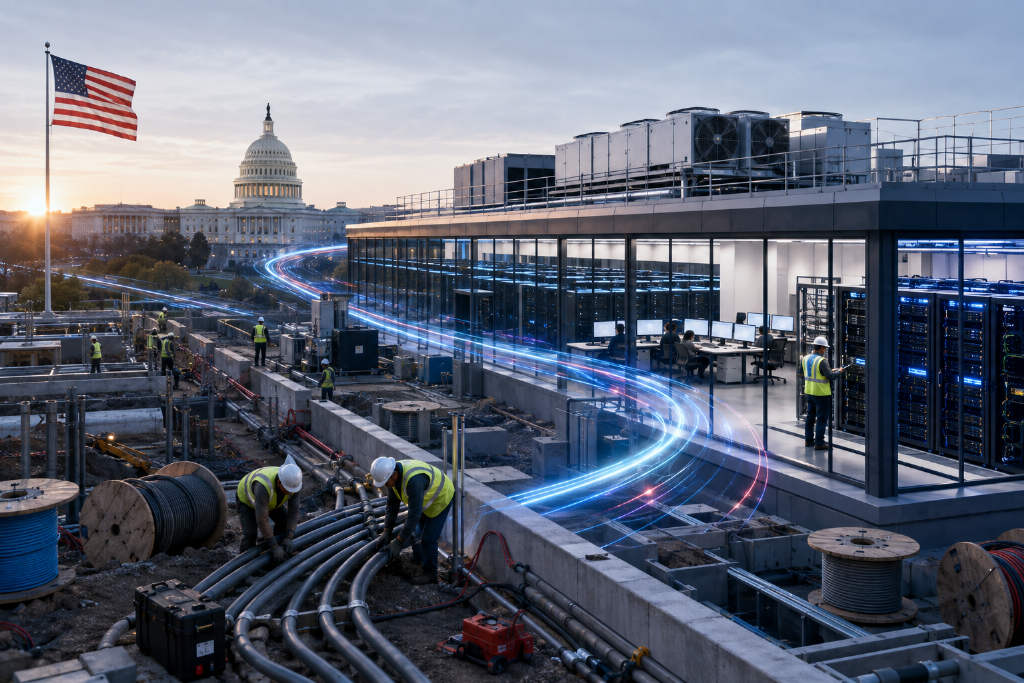
One of the clearest engines behind AI hiring is a huge wave of physical infrastructure investment. Goldman Sachs estimates that annual spending tied to AI computing needs, including chips, servers, data centers, cooling systems and electrical equipment, is about $500 billion higher than it was in 2022, the year ChatGPT was introduced.
For data-center construction alone, Census Bureau figures show spending is rising at an annual pace of more than $75 billion, nearly 60% higher than a year earlier.
That buildout is translating into strong demand for electricians handling data-center wiring, HVAC technicians keeping racks from overheating, power engineers connecting facilities to the grid, and workers who install and maintain equipment.

The Economist tracked five core sectors: electrical contracting, HVAC and plumbing, utility-system construction, commercial building, and electrical-equipment manufacturing. Since 2023, employment in those sectors has run about 320,000 above the broader trend line for construction and manufacturing, and the growth path was described as still climbing through mid-2026.
Wage data points in the same direction. According to Indeed, advertised pay for data-center installation and maintenance jobs is about 40% above comparable roles. Over the past year, average hourly pay in electrical-equipment manufacturing rose by more than 13%, while pay for electrical contractors was up close to 8%. Labor shortages remain in place despite those increases.
White-collar AI jobs have rebounded after layoffs
The picture for white-collar work has been less direct. Data tracked by The Economist showed that from early 2023 to early 2024, excess employment in roles such as engineers, software developers and data scientists fell into negative territory. That period matched the wave of layoffs at Meta, Google and Microsoft, which were presented as AI-driven reorganizations.
The downturn did not last. After 2024, software developer employment moved back up from negative levels. Data scientists, cybersecurity analysts and other emerging computer occupations also turned higher. By mid-2026, the combined excess employment across five categories had passed 700,000 and was still accelerating.
Burning Glass Institute economist Gad Levanon estimates that about 1% of U.S. professional roles are now classified as AI jobs. In computer-related and life-science fields, the share rises to 4% to 5%.
LinkedIn Americas economist Kory Kantenga said the U.S. added about 640,000 dedicated AI jobs between 2023 and 2025. Job postings for titles such as Head of AI, AI Engineer and Director of AI roughly doubled compared with 2023 to 2024. He said, 「The evidence so far suggests AI is a net creator of job opportunities.」
Winners and losers are diverging
The shift is not broad-based. It is highly uneven.

BLS occupation-level data shows that from May 2023 to May 2025, employment for data scientists rose by about 35% to 38%, the fastest growth among the occupations cited. Financial analysts, paralegals and cybersecurity analysts each posted gains of 10% to 15%. Lawyers and market research analysts also remained in positive territory.
The article argues that these jobs share a common trait: AI tools raise productivity, lower the cost of delivering services and expand overall demand. On that reading, more work is created than displaced. Employment for paralegals rose about 11% despite repeated warnings that the role would be automated away, while market research analysts grew around 6%, well above the national average of 2.5%.
Elsewhere, the picture is weaker. Graphic designers and bookkeeping clerks have seen moderate erosion. Customer-service representatives have declined by about 15% since January 2023. Data-entry keyers have fallen by more than 20%, making them one of the hardest-hit occupations in the AI wave.
BLS projects that office and administrative support occupations will lose a cumulative 752,000 jobs by 2035. The common thread is clear: these roles rely heavily on repetitive, formatted and rules-based execution, which matches the kinds of tasks AI agents currently handle best.
Historical comparisons suggest new roles can emerge
The report also looks backward. After computers became widespread, they created 6 million related occupations that did not exist before, according to The Economist. On top of that, about 8 million people now work in areas such as the gig economy, e-commerce and content creation, categories that had no real name 30 years ago.
Future labor demand may include large numbers of people supervising autonomous AI agents or arbitrating conflicts between different agents. The article said that sounds like science fiction today, but 20 years ago few people knew what an influencer was either.