
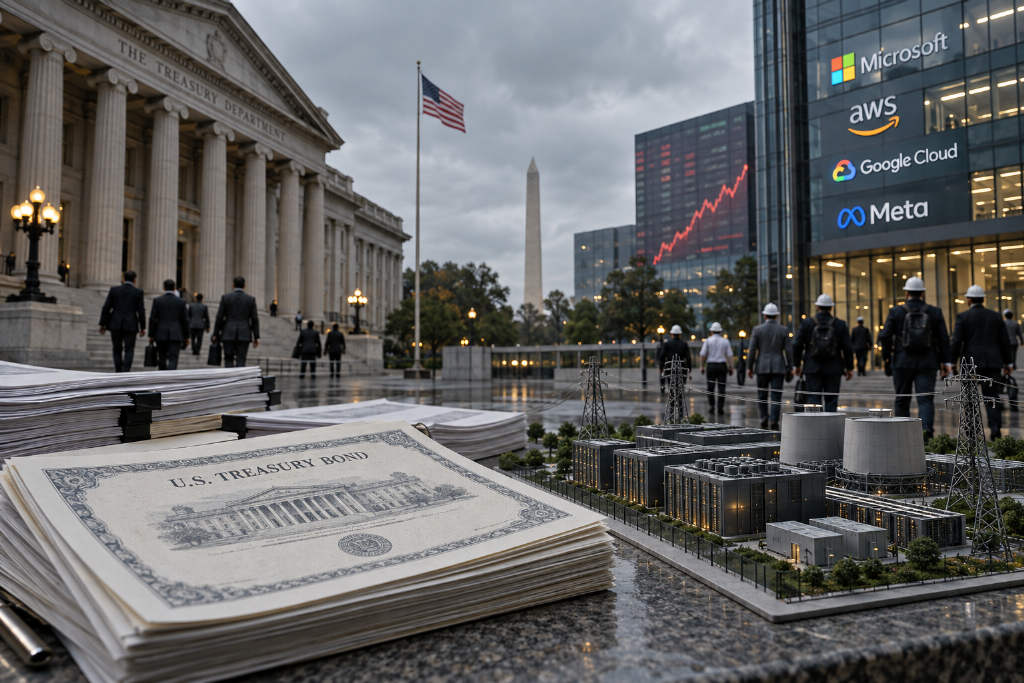
U.S. long-dated Treasuries fell across the curve on Sept. 24. The 30-year Treasury yield climbed to 5.48%, the highest in 20 years, while the 10-year moved above 5.2%, a level not seen since the financial crisis. Over the past two months, long-end yields have risen almost in a straight line. The article says Treasury Secretary Bessent stepped up buyback intervention twice, but each move bought only a single day of relief before the market reversed it.
The piece says large deficits, higher oil prices and renewed Federal Reserve rate hikes are all real forces behind the move, but not the new variable in this round. What changed, it argues, is the arrival of a borrower on the demand side that is largely indifferent to price.
AI financing demand is competing for long-term capital
To build data centers and computing capacity, major technology companies are issuing ultra-long bonds at a record pace, according to the article, and they are doing so with little regard for borrowing costs.
By August, debt issuance this year by the five largest hyperscale cloud companies had approached $230 billion, more than twice last year’s full-year total. A large share of that supply came in 20-year, 30-year and even 40-year maturities.
The article points to several standout deals. Meta, a company only 22 years old, sold a 40-year bond last October worth $30 billion, setting a record for a single corporate bond offering. In April this year, Meta added another $25 billion. Alphabet issued a sterling bond with a 100-year maturity. Amazon raised $54 billion in a single deal in March. Oracle, whose rating is only two notches above junk and whose free cash flow is negative, has continued to issue debt as well.
Why are these companies so unconcerned about rates? The article cites comments Bessent made in an August interview, saying these firms borrow without really looking at interest rates because they believe AI returns will be high enough to make current financing costs look trivial. In that reading, the normal brake that rising rates place on borrowing has stopped working for AI-related demand.
At the same time, the pool of investors willing to lock up long-term money has not expanded in step. Pension funds, insurers and long-duration bond funds remain the core buyers at the long end, and their capital is finite. Money that goes into long-dated tech bonds is money that does not go into Treasuries.
The article gives one example: with Alphabet’s 30-year corporate bond yielding 6.4%, Treasuries have to offer more to pull capital back.
It describes the shift as a form of reverse crowding out. In the usual story, government borrowing crowds out private investment. Here, the argument is that AI giants are crowding the government out of the bond market.
Nomura estimates that technology giants alone have absorbed about $200 billion in long-term capital, equal to one-quarter of the Treasury’s annual issuance of medium- and long-dated debt. Investment-grade bond funds have also been cutting Treasury holdings and adding corporate bonds this year. The article adds that foreign private capital is now buying more U.S. corporate bonds than U.S. Treasuries, something it says would once have been hard to imagine.
In the author’s view, the presence of a very large private borrower that is not sensitive to price and is permanently active at the long end has changed the rules of the market. Against that backdrop, Treasury buybacks are too small to matter. Each operation amounts to only tens of billions of dollars, the article says, a drop in a market worth more than $30 trillion. Buybacks can alter the maturity structure of Treasury debt, but they cannot control the pace of issuance by technology companies.
The article also points to a self-reinforcing loop. Heavy tech issuance pushes long-end yields higher, and higher yields then raise the financing cost of AI projects themselves. The extra spread AI giants pay on new debt has risen from a little over 2 basis points last year to 12 basis points.
AI prosperity may not expand the U.S. government’s tax base
If the problem were only a fight between AI companies and the Treasury for long-term money, the article says there would still be a way out. If AI truly drives rapid economic growth, tax revenue could eventually catch up, debt service would become easier and yields could come down.
But the author argues that an AI boom may not broaden the government’s tax base at all. Productivity and GDP could surge while the federal government’s repayment capacity still deteriorates. The article frames that deterioration in both long-term and near-term terms.
Over the long run, more than three-quarters of U.S. federal revenue comes from individual income taxes and payroll taxes combined. In other words, the fiscal system is tied to wages. The article argues that AI’s economic effect may be to compress the value of labor and labor income: companies produce more with fewer workers, profits rise, but total wages fall, leaving the government with less revenue from income and payroll taxes. It adds that if AI reduces labor income’s share of GDP by 10 percentage points, most advanced economies would face major fiscal strain.
In the near term, the article points to the “Big and Beautiful Bill” passed in 2025, which sharply reduced U.S. corporate taxes and restored full first-year expensing for capital spending. The stated purpose was to encourage investment, but the author says that for technology giants already prepared to spend heavily on data centers, the policy functions more like a windfall.
Microsoft disclosed in July that taxes payable for the period were $2.5 billion, down from $14.1 billion a year earlier, a drop of roughly 80%, even as profit surged. The article attributes that to the tax effect of depreciation. It also cites September data from the Congressional Budget Office showing that corporate income tax revenue in the first 11 months of the current fiscal year fell by one-quarter from a year earlier, down by nearly $100 billion.
Deficits, debt and interest costs keep building
In the article’s account, shrinking revenue, rising spending and a tax shortfall leave the government relying even more on debt issuance. In the first 11 months of the current fiscal year, the federal deficit had already reached $2 trillion. Total U.S. debt moved above $40 trillion in August. Annual interest costs alone are running at about $1 trillion.
The author argues that under the current system, expecting AI to rescue public finances by expanding the existing tax base is unrealistic.
The article’s conclusion: the more successful AI becomes, the harder it may be to avoid heavier taxation
The piece ends with a simple claim. The more successful AI is, the more completely it may replace labor, and the less tax revenue the U.S. government will collect from payrolls.
Government spending, meanwhile, may not fall. The article says it could rise instead, as more people need retraining and welfare support. As the fiscal gap widens, the only expanding pool left to tax may be the profits created by AI.
On that basis, the article argues that even if AI succeeds, it is unlikely to escape heavier taxation in the end.