


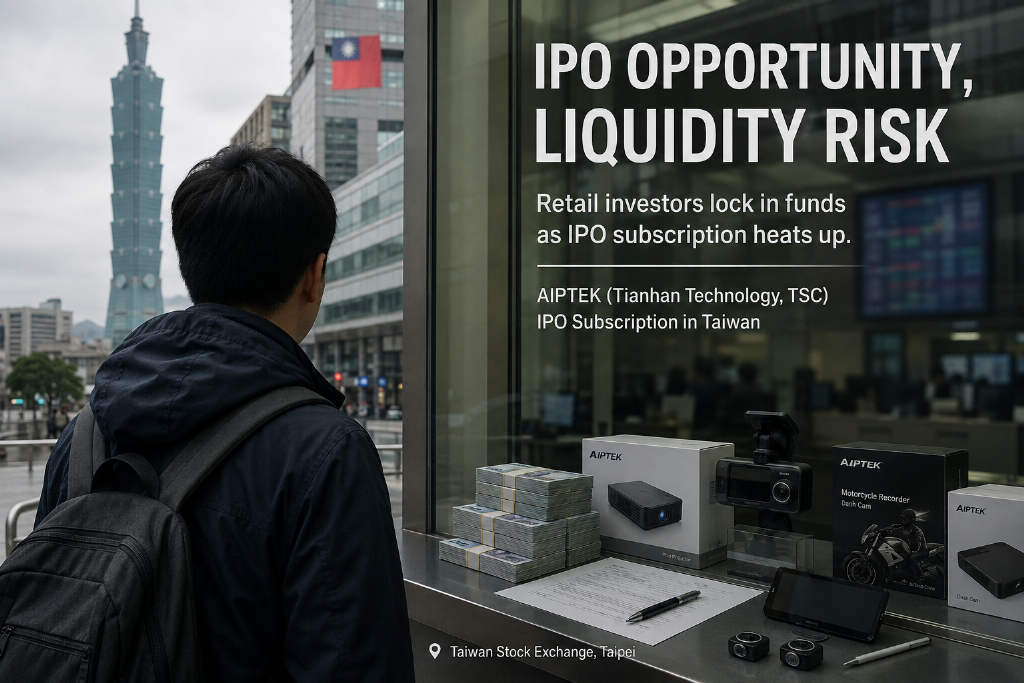
Aiptek International Inc. (6225) will open its public share subscription from Sept. 8 to Sept. 10. Based on the underwriting price of NT$17.65 and a market price of about NT$60 cited in the source article, one successful allotment could translate into a paper gain of roughly NT$42,280, or about 240%. The setup looks attractive on the surface, but the stock carries full-cash settlement status, which brings its own trading risks.

What the company does
Aiptek International was founded in 1997. It built early recognition through its AIPTEK brand and what the article describes as the world’s first pen-style digital camera, making it one of Taiwan’s long-established digital optoelectronics manufacturers.
Its main businesses cover vehicle safety imaging, including dash cams for cars and motorcycles, micro projectors, micro optoelectronic modules, and wireless pressure-sensitive electromagnetic styluses using ASIC chips, along with other digital input devices.
In recent years, the company has faced operating and transition pressure, with revenue scale shrinking. It remains in a loss-making position and under altered trading status, which in this case means full-cash settlement. The company is carrying out a cash capital increase of about NT$322 million to strengthen working capital, improve its financial structure, and try to lift net worth, with part of the offering allocated to the public subscription process.
How the public subscription works
What retail investors often call a stock lottery is formally known as a public subscription. It is a mechanism used by companies to issue new shares to the public when raising funds. When a company completes an initial public offering or a post-listing cash capital increase, part of the issuance must be made available for public subscription under the rules described in the article.

Investors submit applications through their brokerage trading platforms and must make sure the settlement account holds enough money for the subscription amount and related fees on the designated debit date. If the number of applicants is greater than the number of shares available, the Taiwan Stock Exchange conducts a computerized random draw to allocate the shares.
Risks investors need to watch
The source notes that the main reason many investors join these subscriptions is the potential spread between the underwriting price and the market price. Lead underwriters usually leave some discount in the offer to encourage participation. Even so, applying means tying up funds. After the application closes, the full subscription amount is deducted and frozen for several trading days, and the funds are only released on the refund date for unsuccessful applicants.
There are direct costs as well. Each application requires a NT$20 processing fee and a NT$50 mailing fee for the allotment notice. If an investor does not win an allocation, the subscription funds and the NT$50 mailing fee are returned, while the NT$20 processing fee is not.
The article also points out that Aiptek is currently a full-cash settlement stock. Trading volume is low, price swings can be sharp, and the stock can be more easily affected by shareholding and supply-demand conditions. There is usually a gap between the draw and the actual share delivery date. If the market price drops sharply during that period, or liquidity tightens, the apparent price spread can narrow quickly.

Subscription schedule and amount
A total of 2,737 lots will be made available to the public in this capital increase. The subscription period runs from Sept. 8 to Sept. 10.
According to the article, investors can enter the stock subscription section in their brokerage app before 2 p.m. during the Sept. 8 to Sept. 10 window and deposit NT$17,720 to participate. The draw result is scheduled to be announced on Sept. 14.
Using the underwriting price of NT$17.65 and the cited market price of about NT$60, the article estimates that one lot could carry a paper profit of about NT$42,280 if allotted.