
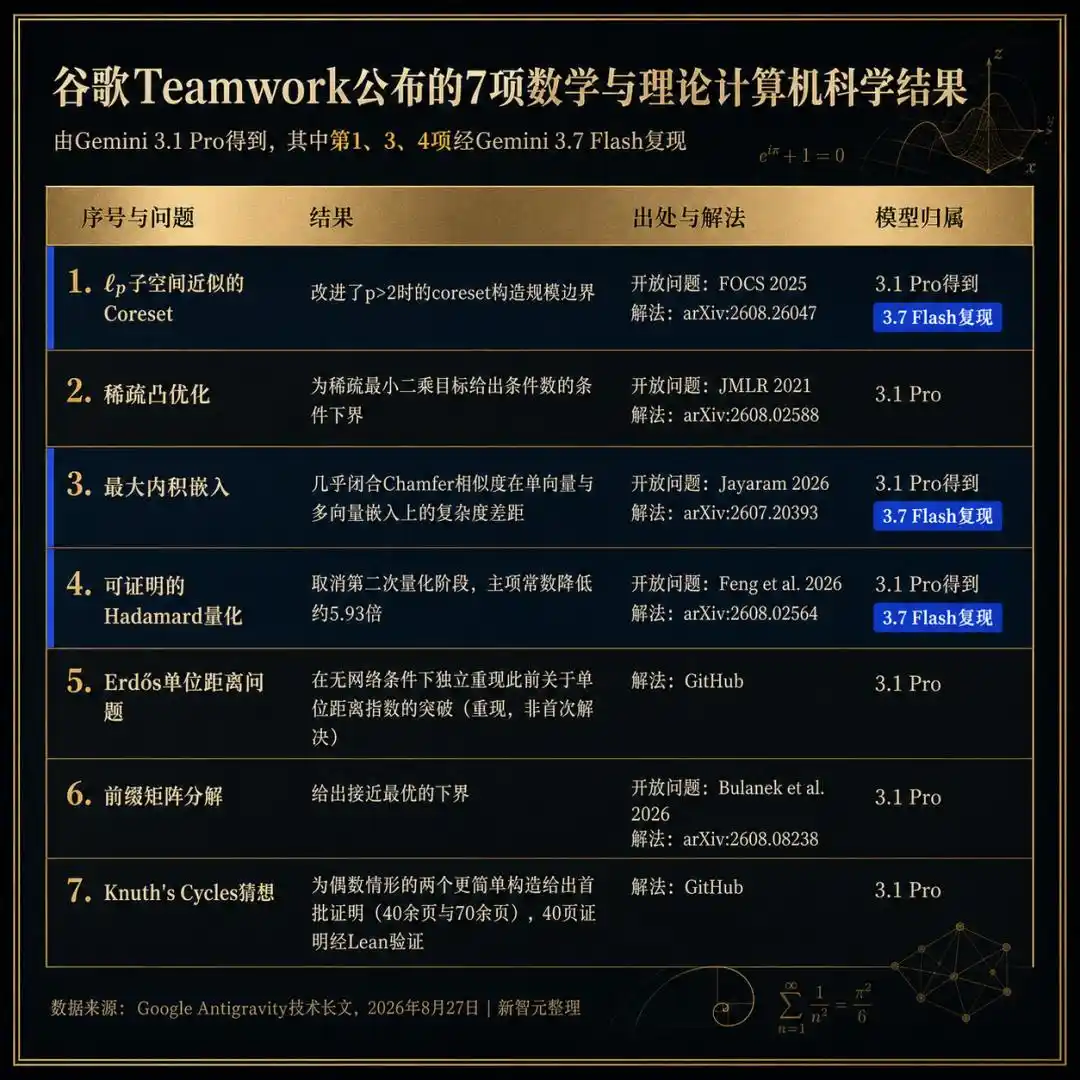
Google’s Antigravity team published a technical write-up on Aug. 27 describing Teamwork, a multi-agent orchestration framework it used across mathematics, systems engineering and open-source software. In Google’s description, seven results in mathematics and theoretical computer science were first obtained by Gemini 3.1 Pro in Teamwork’s Long Proof mode, and three of those were later fully reproduced by Gemini 3.7 Flash. Google said this marked the first time a Flash-tier model had produced PhD-level mathematical research results.
The emphasis in the post was not on a larger flagship model. It was on Gemini 3.7 Flash, a smaller model positioned around speed and lower cost. Google’s framing was that the shift came from how work was organized rather than from a sudden jump in the standalone capability of Flash itself.
Seven theory results, with three later reproduced by Flash
Google drew a strict line between the roles of different models. All seven mathematics and theoretical computer science results were first produced by Gemini 3.1 Pro under Teamwork’s Long Proof mode. Gemini 3.7 Flash then fully reproduced three of them:
- coreset construction for ℓp subspace approximation
- dimension lower bounds for maximum inner product embeddings
- Hadamard quantization with the leading constant reduced by about 5.93x
The remaining four were attributed to Gemini 3.1 Pro: a condition number lower bound for sparse convex optimization, an approximately optimal lower bound for prefix matrix factorization, Knuth’s Cycles, and an independent offline reproduction of the Erdős unit distance problem.
Google also reported a top score of 71% on TCSBench, achieved by Gemini 3.7 Flash working with Gemini 3.1 Pro. That exceeded the earlier 67.7% record produced by Gemini 3.6 Flash paired with Gemini 3.1 Pro.

The signal Google highlighted was straightforward: with the right orchestration layer, a lighter model can rerun research that had already been completed by a flagship model. The company’s point was about coordination, not raw parameter count.
Teamwork is built around structured internal criticism
Teamwork was developed by the Antigravity team. Google said a user can enter /teamwork-preview, after which Gemini reads the prompt, picks a mode and assembles a group of AI specialists that may run for hours or even days. The mathematics results discussed above came from Long Proof mode.
The design is deliberately not centered on scaling the model. Instead, it relies on multiple agents challenging one another and exposing weak points. Google broke that process into four steps.
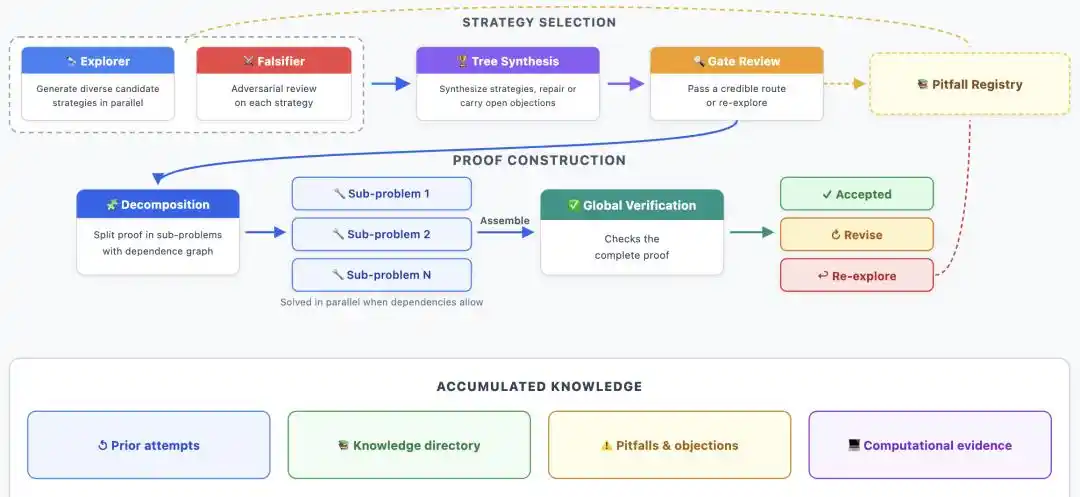
Step one: competitive strategy search
The system generates multiple candidate approaches at once and assigns each of them a dedicated falsifier whose only job is to break the proposal. Even when a path is heavily criticized, it is not discarded immediately. The rejected route and the objections stay in the process.
Step two: dependency-based decomposition
Once a promising strategy is selected, the system decomposes it into subproblems linked by dependencies and maps them as a topology graph. Independent tasks run in parallel, while dependent tasks are handled in sequence.
Step three: internal tournaments for subproblems
Each subproblem goes through an elimination-style round. Nodes review proposed solutions and their critiques, then produce an upgraded version. If that integration fails, the process restarts with the accumulated objections until the gaps are closed.
Step four: learning across rounds
Failed drafts are retained for the next round. Errors found by validators are recorded in a trap register. Dead ends and proved conclusions are synchronized into a shared knowledge base for reuse by the rest of the system.
Google’s argument was that this structure addresses a common failure mode in multi-agent systems: one mistaken line of reasoning can pull the rest of the group into agreement. Teamwork’s answer is to make mutual criticism part of the process rather than an optional behavior.
Knuth’s Cycles was not first solved here
Among the seven theory results, Knuth’s Cycles is the one most likely to be misunderstood. The article’s timeline says the problem had already been solved earlier this year by a sequence of AI models.
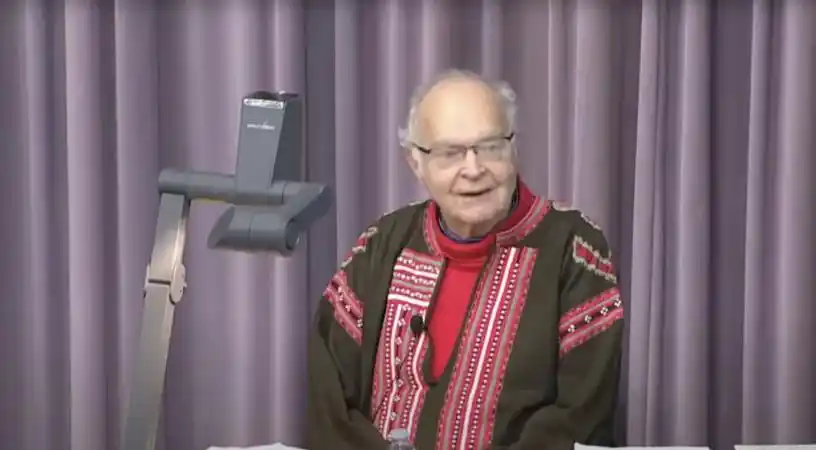
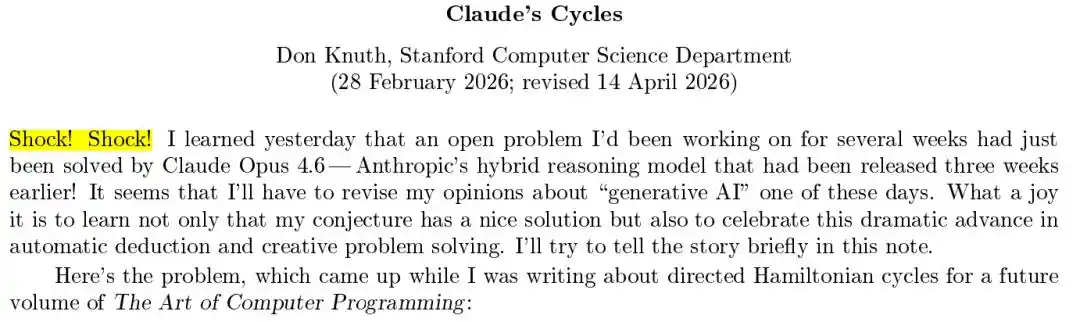
According to the piece, Claude Opus 4.6 produced a construction for the odd case in about an hour in late February, prompting Donald Knuth to open the paper with two instances of 「Shock!」. After that, gpt-5.3-codex and GPT-5.4 Pro filled in the harder even case. By mid-April, Knuth had stated in a revised version of the paper that the even case had been settled.
Google’s contribution this time was different. It said the company found two more elegant constructions for the even case and produced the first long-form proofs, one running more than 40 pages and another more than 70 pages. The 40-plus-page proof also passed Lean formal verification.
That makes the contribution substantial, but in the article’s own description it is a stronger and cleaner proof rather than the first break on the problem. The episode is used to show what Teamwork adds: not isolated brilliance from one model, but a more disciplined form of collective reasoning.
Gemini 3.7 Flash built a RISC-V simulator from scratch
The same approach was applied to a systems task. Google’s technical post explicitly said this part used Gemini 3.7 Flash. Teamwork built a cycle-level, out-of-order RISC-V CPU simulator from scratch.
Out-of-order execution is standard in high-performance CPUs and one of the easiest places for a simulator to fail. Google said Teamwork took the work in two stages. It first established microarchitectural correctness by writing an out-of-order pipeline and reorder buffer, then successfully booted the xv6 operating system into a shell. After that, it aligned the timing cycle by cycle.
The hardest problem, in Google’s telling, was the “silent execution gap.” A microarchitectural state can drift for hundreds of cycles before an architectural error appears, leaving little clue about the root cause. Teamwork’s method was to sandbox the Spike reference simulator so agents could not copy from it directly, then run lockstep co-simulation with checks at every step.
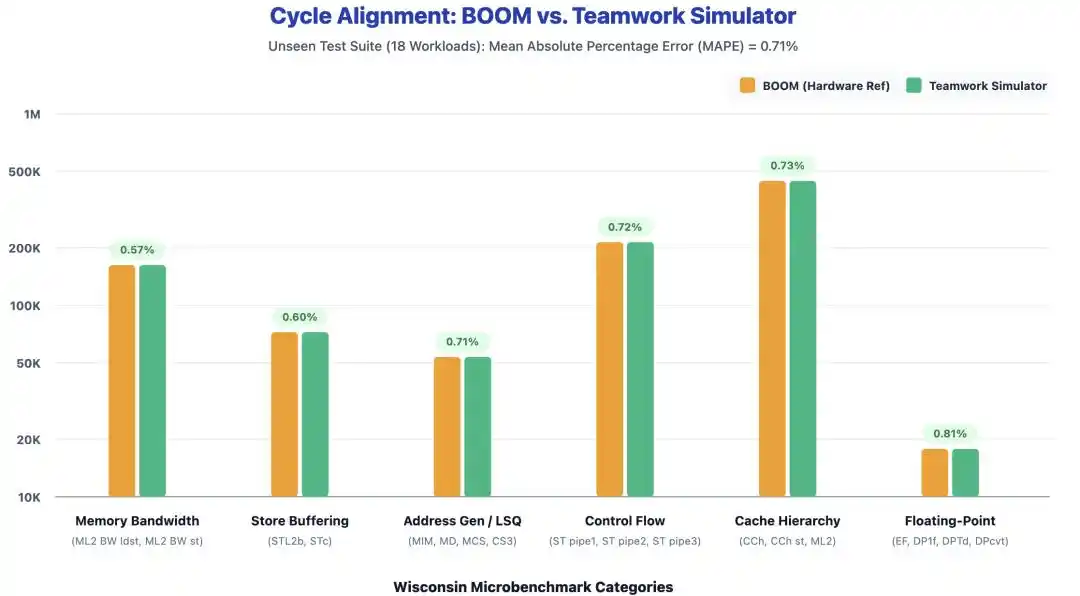
In the end, the simulator completed more than 100 standard RISC-V benchmarks. On unseen test workloads, its average cycle error versus BOOM hardware was 0.71%.
Google also made a boundary clear: this was a software simulator, not RTL chip design and not semiconductor tape-out.
Changes to Eigen and ParlayHash were merged upstream
The final set of examples came from live open-source software rather than internal benchmarks. Google highlighted work on Eigen and ParlayHash.
In Eigen, a widely used high-performance C++ linear algebra library, Teamwork found a suboptimal implementation for matrix-vector multiplication involving a single row or column and added a SIMD fast path.
In the concurrent hash table ParlayHash, Teamwork introduced optimization ideas from Swiss Table. Google said that doubled initial insertion throughput with 64 threads, lifted overall single-thread throughput by 1.5x, and reduced memory use per element by 25%.
Google stressed that these were not internal-only scores. The code went through external human review and was merged into the upstream branches.
Google’s framing: AI explores, humans verify and sign off
The article closed with a line from the author statement of a mathematics paper saying the proof was first produced by Google’s internal Gemini agent system and then checked and edited by the authors. Google used that to describe a division of labor it sees in AI-assisted research: agents explore the space of drafts at scale, while humans verify, edit and sign off.
Google’s own wording, as cited in the article, was that these problems would normally take top experts months, and Teamwork compressed the trial-and-error cycle while control over direction and final approval stayed with humans.
The piece also cited Donald Knuth, now 88, saying after learning that a construction found by Claude had been verified with Lean: 「This is a good thing」 because he had been 「making more mistakes lately」. The article’s conclusion was narrow and practical. If machines handle more of the solving work, verification becomes harder to avoid, not less.
Reference materials listed in the source included Google Antigravity’s post, “Teamwork: when AI becomes a research partner,” and a Knuth paper. The Chinese article was originally published by the WeChat public account Xinzhiyuan, written by ASI启示录 and edited by 元宇, then republished by MarsBit.