
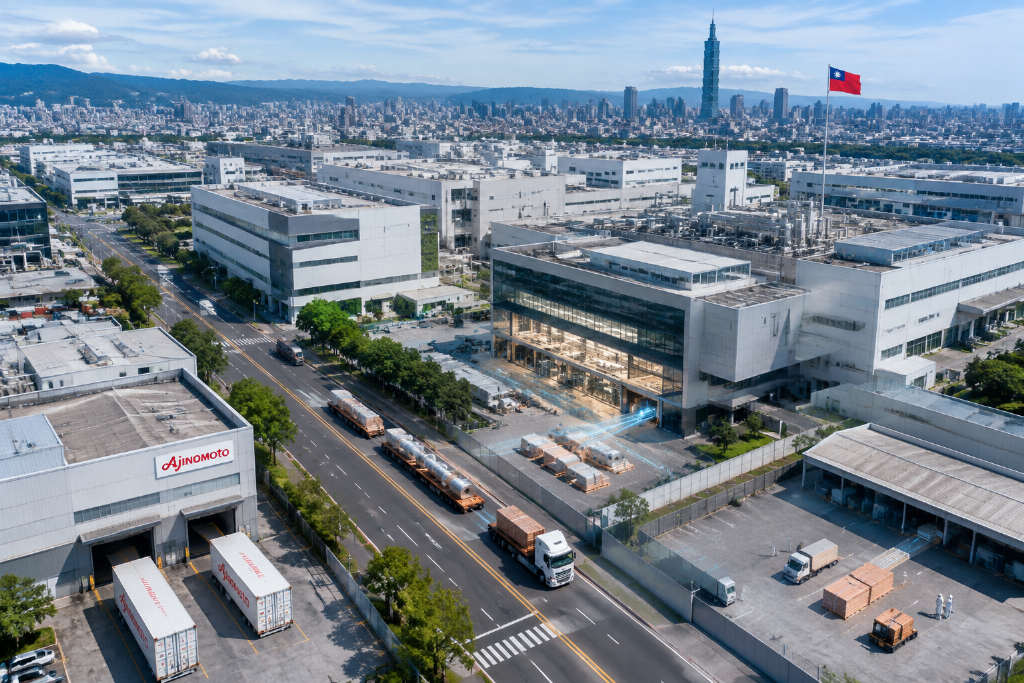
Ajinomoto has told customers it will adopt a differentiated allocation strategy for ABF film because of raw material shortages, giving priority to AI and other high-end applications. According to a channel survey cited by Meritz Securities, the Japanese supplier’s ABF film lines are expected to be fully loaded through the second quarter of 2026, while additional capacity is unlikely to ramp quickly in the near term.
The report said the spillover from tighter supply is likely to show up most clearly at leading substrate manufacturers with stable high-end production records and customer qualifications. In Taiwan, Unimicron (3037), Nan Ya PCB (8046) and Kinsus (3189) were named as companies whose pricing power and material allocation could improve.
Why ABF film matters in advanced packaging
Ajinomoto Build-up Film, or ABF, was developed by Ajinomoto in the 1990s from technology derived from byproducts of monosodium glutamate fermentation. It serves as a key insulating film between layers in IC substrates, allowing finer line widths and more stacked layers. That has made it the standard material for FC-BGA packaging used in high-end chips such as CPUs, GPUs and AI accelerators.
Compared with traditional BT resin substrates, ABF substrates offer higher circuit density and lower signal transmission loss. The main technical barriers lie in precise control of the coefficient of thermal expansion and line-width requirements approaching below 15 microns.
Although ABF film represents only a small portion of total substrate cost, a supply cut can idle an entire production line. The article said that is a major reason Ajinomoto has been able to sustain more than 95% global market share. With the new allocation policy set to take effect, the impact is expected to spread across the AI advanced-packaging supply chain.
Demand gap widens as lead times stretch
The report tied the latest demand surge to rapid jumps in AI chip specifications. It cited market data showing that substrate area required for NVIDIA’s next-generation Rubin GPU is 123% larger than that of the previous-generation Blackwell. At the same time, stacking layers for AI accelerators are rising, increasing both substrate area consumption per chip and manufacturing complexity.
Expansion in Taiwan Semiconductor Manufacturing Co.’s CoWoS advanced-packaging capacity is also lifting substrate demand. Market estimates cited in the article put the compound annual growth rate for ABF substrate demand at close to 50% from 2022 to 2026.
That imbalance is already visible in both lead times and pricing. Order lead times have moved from three to four months at the beginning of the year to more than 12 months now, and some customers have started discussing capacity for 2029. The article said several research institutions have raised their forecasts for the supply-demand gap, from 8% to 10% in the second half of 2026, to 21% to 34% in 2027, and 42% to 51% in 2028.
Taiwan’s three leading substrate makers
Ajinomoto’s allocation shift is expected to direct scarce supply toward manufacturers that already have proven high-end production scale and yield performance. The report said Unimicron, Nan Ya PCB and Kinsus are positioned to benefit first, with stronger bargaining power, larger material quotas and more room to pass through costs.
Unimicron (3037)
Unimicron is described in the report as one of the main suppliers of AI ASIC substrates for self-developed chips used by U.S. cloud service providers. The article said its earnings momentum stands out most clearly. In the first quarter of 2026, its EPS reached NT$3.28, up 446% from a year earlier. The company plans to expand total substrate capacity in 2026 by 35% to 40% from last year.
Nan Ya PCB (8046)
Nan Ya PCB is known for strong spot-pricing visibility, and the report described it as one of the more direct beneficiaries of the latest price upcycle. Full-year 2025 revenue reached NT$40.17 billion, up 24.4% year over year, while the company returned to profit with post-tax EPS of NT$3.0. Utilization across its IC substrate operations has moved above 90%, and the revenue contribution from high-end applications including AI servers and 800G switches has risen to 15% to 18.8%.
Kinsus (3189)
Kinsus currently has ABF substrate utilization at 85%, with the figure expected to approach 95% by year-end, according to the report. Market observers cited in the article estimate full-year EPS could exceed NT$10. The company is increasing its supply share of CPU substrates for U.S. AI chip customers, is pushing for more GPU substrate share, and is advancing ASIC substrate projects with multiple cloud service providers. It plans to expand high-end ABF capacity by another 25% before 2027.
The report also noted that Kinsus is dealing with shortages of T-Glass fiberglass cloth. About 10% to 15% of potential monthly revenue cannot currently be realized because of material constraints, indicating that bottlenecks in the ABF supply chain extend beyond film itself.
Pressure on non-AI customers, limited near-term replacement
The priority allocation strategy strengthens the position of leading suppliers, but it also puts non-priority customers under clearer pressure. Customers in consumer electronics, general servers and lower-end applications are expected to face reduced quotas, longer lead times and higher costs.
The article said customers in mainland China have already seen roughly 30% cuts in ABF film supply. It added that substrate manufacturers without a strong track record in high-end volume production are at a clear disadvantage when competing for material allocation, which could widen the gap with Taiwan’s three leading companies.
As for longer-term alternatives, glass substrates are seen as theoretically superior to organic ABF substrates in dimensional stability and signal transmission loss. Intel and LG Innotek have both shown samples, with mass production targets set for 2027 to 2028.
Still, the report said technical constraints remain, including through-hole process yields, cutting-related microcracks and long-term reliability. Before 2027, glass substrates are expected to reach only specific niche applications rather than large-scale volume production. For now, ABF substrates remain the most mature mainstream option for AI advanced packaging, with more stable delivery timelines.