
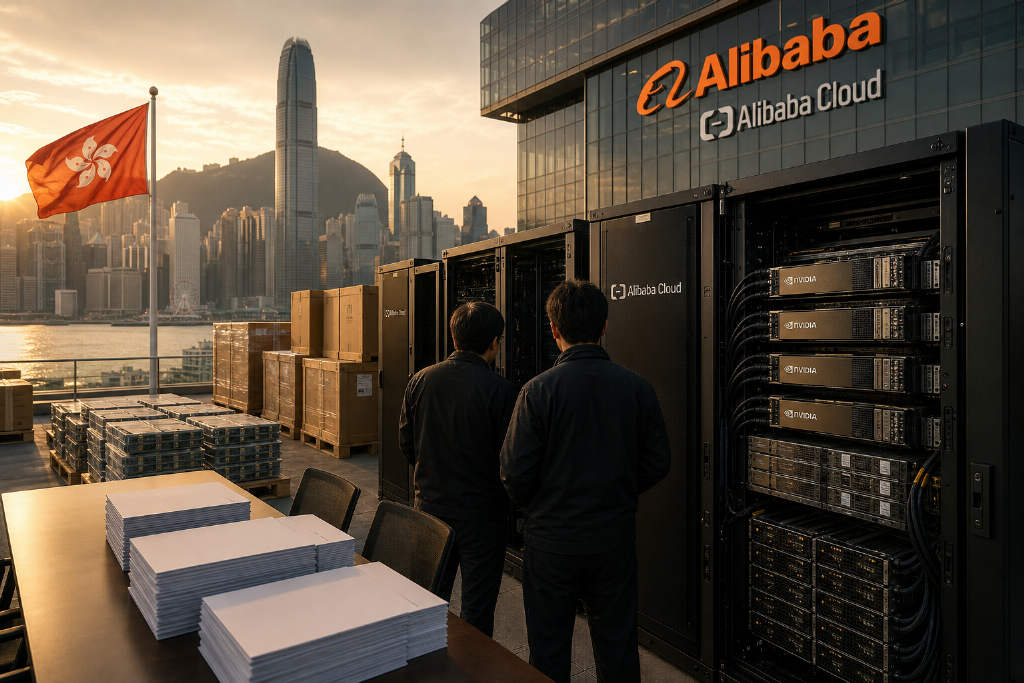
Alibaba said on Aug. 23 that it plans to place newly issued ordinary shares to investors outside the United States for total consideration of HK$80 billion, or about $10.2 billion. The company said 100% of net proceeds will be used for full-stack AI capabilities, including expanding and upgrading AI infrastructure.
The transaction remains subject to market conditions and other factors, and Alibaba said there can be no assurance that it will be completed. The company also described the planned deal as the largest primary follow-on offering ever by a Hong Kong-listed company.
WhiteLine Daily said Alibaba’s capital expenditure in the previous quarter had already approached $10 billion. With another roughly $10.2 billion now set to be raised through a new share sale, the publication said AI spending is beginning to affect equity structure directly. The next points to watch are the placement price, the number of shares issued, and investor demand.
Memory costs are pushing AI server prices higher
Bloomberg reported that some major NVIDIA customers have been told servers equipped with its AI chips will, in many cases, rise in price by more than 15% starting in early 2027. The increases involve Vera Rubin and Grace Blackwell systems, with the final change depending on chip generation and memory configuration.
According to the report, the move is being driven mainly by higher memory chip costs. Server vendors supplying data center operators including Microsoft, Google, and Oracle have already passed that message on to customers. NVIDIA has not responded.
NVIDIA is scheduled to report quarterly earnings on Aug. 26. The market is expected to focus on what the company says about costs and pricing.
WhiteLine Daily said memory price increases from MU, SK Hynix, and Samsung have started to feed into full AI server pricing. The next question is whether hyperscalers are still willing to absorb higher server prices. If orders do not cool in a visible way, that would suggest AI capex still has room to bear rising hardware costs.
Brazil commits about $444 million to AI compute expansion
The Brazilian government said it will invest about $444 million to expand the country’s AI compute capacity. Of that, about $251 million will go to a supercomputing project in Rio de Janeiro, where Huawei and iFlytek will work on general-purpose and industry large models. Another roughly $193 million will be used in a tender to procure an AI supercomputer planned for Rio Grande do Norte state.
The funding will be disbursed in stages through Brazil’s National Fund for Scientific and Technological Development. Brazilian officials expect NVIDIA could become a supplier, though the tender has not been completed. The government expects the supercomputer to enter operation before the end of 2027.
WhiteLine Daily said AI compute investment is spreading beyond the United States and the Middle East to more countries. For NVDA, sovereign AI is becoming a new source of demand. The next step is whether these state-backed projects are actually completed and converted into GPU orders.
Japanese chip equipment sales keep rising
Data from the Semiconductor Equipment Association of Japan, or SEAJ, showed that Japanese semiconductor manufacturing equipment makers recorded about $3.5 billion in sales in July, up 35.4% from a year earlier. The figure includes exports.
SEAJ had previously said capacity expansion tied to AI servers, including advanced logic chips, HBM, and DRAM, would continue to support equipment demand. It also raised its forecast for sales growth of Japanese-made semiconductor equipment in fiscal 2026 to 26%.
The latest figures suggest upstream wafer fabrication and equipment investment are still expanding at a relatively fast pace as demand for AI chips and memory remains strong. WhiteLine Daily said continued high growth in equipment sales will be a direct gauge of whether this semiconductor expansion cycle is cooling, especially for companies including Tokyo Electron, Lam Research, Applied Materials, and KLA.
What ties the day’s developments together
Across corporate fundraising, sovereign compute projects, and semiconductor capacity expansion, AI infrastructure spending is still moving higher. At the same time, higher memory costs are now reaching the server layer. The next market test is whether rising financing and hardware costs can continue to be absorbed by AI capex.