
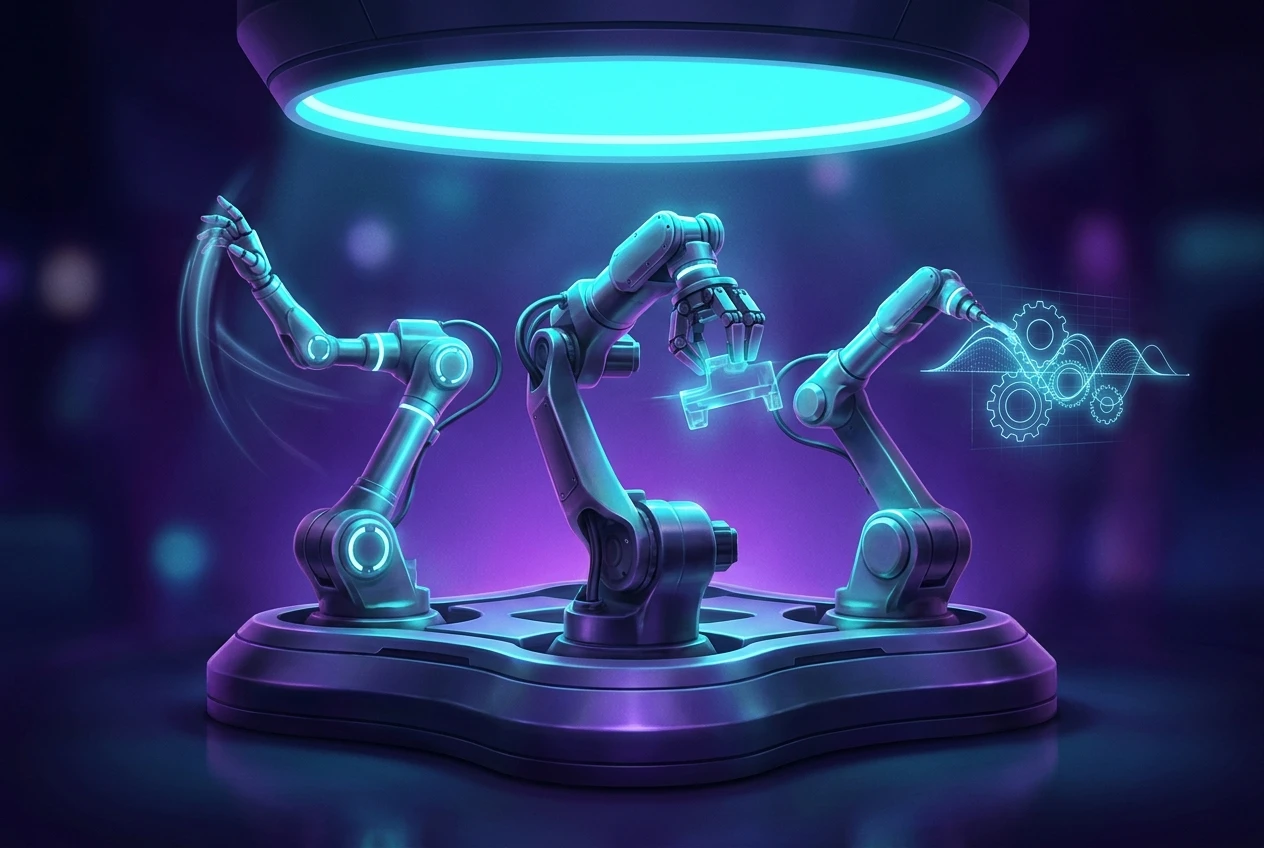
Alibaba's Qwen team released the Qwen-Robot Suite on Tuesday, a trio of foundational models forming a full-stack embodied intelligence system. Qwen-RobotNav handles mobile navigation, Qwen-RobotManip manages mechanical manipulation, and Qwen-RobotWorld simulates physical environments. Each model can work independently; together, they represent what the team calls an 'Android moment' for robotics — an operating system, not hardware.
Qwen-RobotNav: A Five-in-One Navigation Model
The navigation model integrates five tasks: instruction following, point-goal navigation, object search, target tracking, and autonomous driving. Each demands distinct visual memory strategies. Unlike most models that lock into a single strategy, Qwen-RobotNav offers a parameterizable interface — token budget, time decay, per-shot weights — allowing the planner to reconfigure during execution. Trained on 15.6 million samples, it achieves a 76.5% success rate on the VLN-CE RxR benchmark (vision-and-language navigation in real environments) and 90% on EVT-Bench (moving target tracking).
Qwen-RobotManip: Cross-Robot Manipulation
Different robots represent motion differently: Franka arms use joint angles, ALOHA dual-arm robots use gripper position and orientation, humanoids use full-body coordinates. Alibaba synthesized approximately 38,100 hours of training data from open-source robotics datasets and human videos, without relying on proprietary data collection. The model ranks first on the RoboChallenge Table30-v1 benchmark, outperforming prior methods by 20%.
Qwen-RobotWorld: Language as Universal Interface
The most ambitious model is a video world model conditioned on language, using natural language as a universal action interface. The instruction 'pick up the red cup and pour water onto the flower' applies equally to grippers, autonomous vehicles, or mobile navigation agents. The embodied world knowledge corpus contains 8.6 million video-text pairs (2 billion frames), spanning manipulation (5.9 million samples, 1,300+ skills, 20+ morphologies), autonomous driving (Waymo, NVIDIA PhysicalAI-AD), indoor navigation, and human-to-robot transfer across 14 robot arms. Qwen-RobotWorld scores first on both EWMBench and DreamGen Bench, achieving perfect scores on physics consistency tests including Newton's laws, conservation of mass, fluid dynamics, and gravity.
How It Compares to Western Labs
Western labs such as Google DeepMind, Nvidia, Figure, and Physical Intelligence pursue similar goals, but most focus on navigation or manipulation in isolation, not a modular, composable suite. Alibaba's vertical integration — from chips to applications — gives it control over the full ecosystem, and all models are open-source. Developers caution, however, that these are software models, not physical robots; deployment in household settings will still take years. Alibaba has not yet disclosed pricing, timelines, or customer names beyond pilot programs.