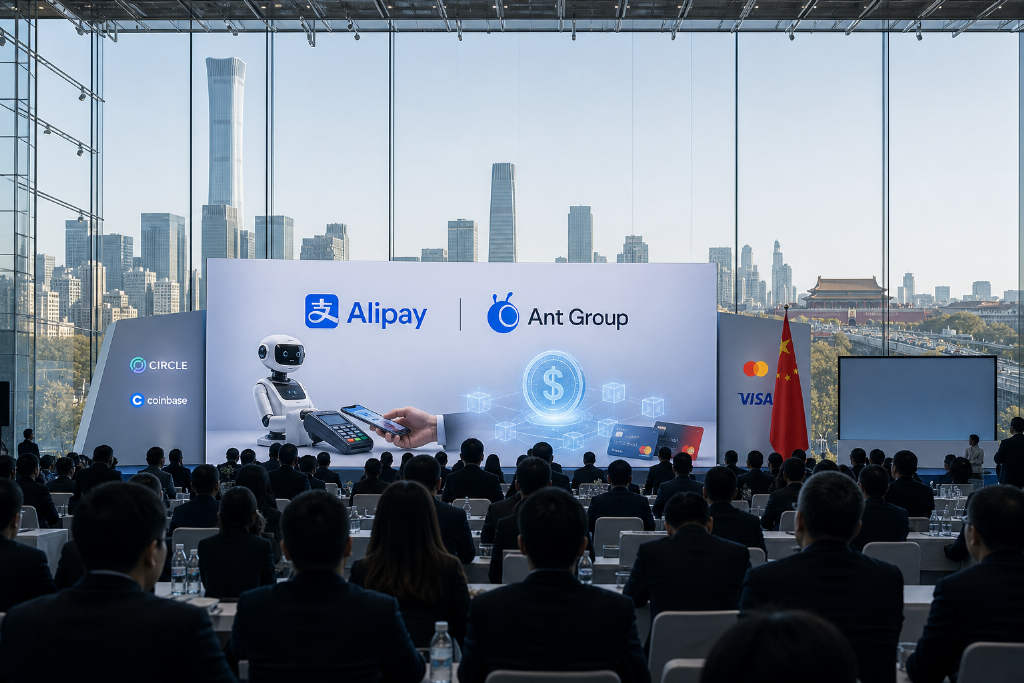
Ant Group CEO and Alipay chairman Han Xinyi recently grouped global AI payment efforts into four tracks at the China Payment and Clearing Forum: payment technology platforms represented by Stripe, crypto companies represented by Circle and Coinbase, traditional card networks represented by Visa and Mastercard, and AI platforms represented by Google and OpenAI.
That sounded at first like a neutral industry map. But the second track — using cryptocurrencies as a payment medium to directly support automated machine-to-machine payment scenarios — stood out in the context described by the article, which noted the cautious tone that has generally surrounded crypto in mainland China.
Alipay says its AI payments have passed 300 million transactions
The article argues that the weight of Han’s remarks is easier to see through Ant’s own buildout. As of the end of May 2026, Alipay’s cumulative AI payment transactions had exceeded 300 million, covering 95% of mainstream general-purpose agent frameworks. The footprint spans smart devices and platforms tied to Tongyi Qianwen and Rokid, intelligent cockpit systems from Li Auto, Chery and Geely, and AI tool platforms including Qoder and Coze.
Han summed up that system with the line: agents are the execution carrier, while tokens are the value carrier. In the article’s reading, Ant is not aiming at a single AI payment product, but at a broader set of AI-native payment infrastructure.
On-chain AI payment data points to stablecoins
Among the four routes Han listed, the report says the one that has already shown scale in machine-to-machine use is the crypto route. Citing data jointly released by Keyrock and Coinbase, it said on-chain AI agents completed about 176 million transactions between May 2025 and April 2026. Average transaction size ranged from $0.31 to $0.48, and around 76% of those payments came in below Visa’s fixed $0.3 fee threshold.
Based on those figures, the article says conventional bankcard rails struggle in high-frequency, low-value automated payment settings, while stablecoins are better positioned to handle settlement at low cost. It frames Han’s point not as an endorsement of crypto ideology, but as recognition of an infrastructure reality now taking shape: automated micropayments between AI agents are, at present, most workable on stablecoin rails.
Competition for payment entry points is moving into protocol design
The article also says the four-way framing reflects a broader reshuffle over who controls the payment gateway. Google and OpenAI, placed in the fourth category, are trying to win influence at the protocol layer.
Google’s AP2, described as an agent payment protocol, has brought in more than 60 partners, including Mastercard, PayPal and Coinbase. OpenAI and Stripe have introduced ACP, an agent commerce protocol focused on checkout. x402, launched by Coinbase and now managed by an independent foundation, revives the long-dormant HTTP 402 status code and is designed to let AI agents pay other agents, applications and services.
Visa and Mastercard are building their own offerings as well. Visa introduced its Intelligent Commerce Connection Protocol in April 2026, while Mastercard rolled out the Agent Pay framework. The article’s point is that once crypto payments are listed alongside card networks as one of several formal routes, the card networks’ old invisible default status no longer looks guaranteed.
Ant is advancing separate compliance tracks in mainland China and Hong Kong
According to the article, Ant is moving at different speeds in mainland China and Hong Kong, while staying within each market’s regulatory framework.
Within Alipay’s core business, AI payments currently follow a conversational service route built around products such as Abao. User confirmation is still required for account fund movements, and the existing product system does not include stablecoin-related functions.
In Hong Kong, Ant International was not included in the first batch of licenses issued in April 2026 under the city’s Stablecoin Ordinance. Even so, the company had previously said it wanted to put innovation in AI, blockchain and stablecoins into real, reliable, large-scale applications. The article says Ant’s historical pace in cross-border payments and blockchain suggests that effort is still moving ahead.
It also notes that Han’s public decision to classify crypto as one of the legitimate routes lines up with another business line already under development inside Ant’s broader map.
Dollar-denominated stablecoins dominate AI payment activity
The article says the data is what gives the argument its force. Coinbase recently disclosed that x402 has processed more than 205 million transactions, with $53 million in volume and coverage of 200,000 merchants. USDC now accounts for 99% of on-chain agent commerce transactions, while x402 represents 97% of usage among agent finance protocols.
Combined with the earlier Keyrock-Coinbase tally of 176 million on-chain AI agent transactions, the report says most current activity in this field is happening on dollar stablecoin rails. Out of a global stablecoin supply of $315 billion, more than 90% is denominated in dollars.
The article links that backdrop to Hong Kong’s recent push for HKD stablecoins. Its argument is that if dollar stablecoins are left unchecked, they could dominate emerging use cases including cross-border payments and tokenization of real-world assets, or RWA.
Stablecoin scale in machine payments was built over several years
The report traces the current moment back through earlier milestones. Visa began piloting USDC settlement for transactions tied to its partnership with Crypto.com as early as 2021. In 2023, PayPal launched PYUSD, its dollar stablecoin, becoming one of the first major payment companies to issue a stablecoin directly.
Then in 2025, the US Congress passed the GENIUS Act, which the article describes as the first federal regulatory framework for dollar stablecoins. Visa and Mastercard later incorporated stablecoins into their core settlement systems. By December 2025, Visa had formally launched USDC settlement in the US market, with annualized settlement volume reaching the billions of dollars, according to the article.
That same year, Google formally announced AP2 with more than 60 partners, including Mastercard, PayPal and Coinbase. Coinbase also launched x402 in 2025 with an explicit focus on automated agent-to-agent payments. By 2026, transaction count on that protocol had climbed past 200 million.
The article’s reading is that the surge in AI payments is being built on stablecoin infrastructure that had already been tested in cross-border settlement and institutional settings over the past several years, rather than on something entirely new.
What Ant is really competing for
In the article’s closing section, Ant is portrayed as working both sides of the next payment cycle: using Alipay in mainland China to expand compliant AI payment services, while having Ant International queue for a stablecoin license in Hong Kong. The two routes operate under different regulatory systems and, in the article’s view, do not conflict.
It then argues that AI payments may not end with four routes coexisting on separate tracks. One protocol or one currency could be the first to make machine-to-machine payments work at scale and then extend outward into other payment entry points. If that happens, stablecoins are among the front-running candidates today.
For now, though, most stablecoins active in agent-to-agent settings are still denominated in US dollars. Whether HKD stablecoins can secure meaningful ground in that emerging market may depend, the article says, on how quickly licenses are obtained and how widely real use cases are deployed. Han did not answer whether securing a Hong Kong license could ultimately matter more to Ant’s place in the next global payment order than the 300 million AI payment transactions Alipay has already accumulated.