U.S. Congress
Nov 8, 2026

Crypto Industry Faces a Policy Shift as Democrats Prepare to Take Congress

The crypto industry’s political advantage in Washington may be tested as Democrats prepare to take control of the U.S. Congress, according to Bloomberg in a report cited by ChainCatcher. The sector could face tighter rules and closer scrutiny of its relationship with Donald Trump. Comprehensive crypto legislation may also have less room to advance under terms previously favored by the industry. Some policy gains may prove difficult to reverse. Repealing federal stablecoin legislation would require new legislation, while rulemaking on digital assets by the Securities and Exchange Commission and the Commodity Futures Trading Commission can continue. The industry has already started seeking support across party lines as it looks for a longer-term path. Its development is no longer limited to an alliance with Trump, with digital assets increasingly connected to investment funds, stablecoin payments and financial infrastructure. Reducing partisan associations and winning support from both parties may become a priority for an industry seeking users and institutions with different political positions.


340
Crypto Industry Faces a Policy Shift as Democrats Prepare to Take Congress
Circle
Nov 5, 2026

Circle CEO says stablecoin freeze tools offer powers correspondent banks do not

Circle CEO Jeremy Allaire said on CNBC that stablecoin infrastructure has tools to freeze and seize on-chain assets, capabilities he said do not exist in the correspondent banking system. His remarks came after the roughly $6.3 billion Binance hack. Circle said it has frozen more than $1.1 billion in USDC tied to the incident, while blockchain analytics firm Elliptic said about $3.24 billion in stolen assets remains in related wallets. Allaire also said Binance has seen net deposit inflows return and rejected comparisons to FTX. He added that the incident is likely to shape future regulation and said attacks may move faster toward areas linked to AI agents. Separately, Custodia Bank CEO Caitlin Long said U.S. regulators may push for built-in freeze rules for stablecoins. The remarks were cited by BeInCrypto and summarized by Techub.

800
Circle CEO says stablecoin freeze tools offer powers correspondent banks do not
Visa
Nov 5, 2026

Visa sets up six global capability centers in Singapore, with stablecoins and digital currency in focus

Visa has announced six global capability centers at its new Solutions Centre in Paya Lebar, Singapore, according to Tech in Asia. The company said the site will bring together more than 1,500 professionals and concentrate on a broad set of areas tied to payments and financial technology. Those areas include AI and agentic commerce, digital currencies, stablecoins, programmable payments, wallets, alternative payment methods, cybersecurity, and quantum computing. Visa also said it plans to expand roles across research, engineering, and innovation. Its listed partners for the initiative include DBS Bank, Nium, and StraitsX. Singapore’s Economic Development Board said the investment will create high-value jobs for Singaporeans. The announcement also comes as Visa points to its existing work in digital assets. The company said it has already launched USDC settlement in the United States and added that stablecoins can support faster cross-border payments as well as programmable money.

630
Visa sets up six global capability centers in Singapore, with stablecoins and digital currency in focus
Aptos
Nov 5, 2026

Aptos moves to combine stablecoins, tokenized funds and payments on one stack

Aptos said it plans to bring stablecoins, tokenized funds and payment functions into a single blockchain stack as it looks to reshape digital finance, according to a Techub News brief citing Crypto Briefing. The update points to a broader product design that places multiple financial functions on one chain rather than splitting them across separate systems. At the same time, the report notes that the integrated setup faces liquidity challenges. Those constraints could weigh on the pace of growth if the model struggles to attract or retain enough capital and usage across the combined stack. No further operational details, timeline or product specifications were disclosed in the brief.

730
Aptos moves to combine stablecoins, tokenized funds and payments on one stack
Railgun
Nov 5, 2026

Railgun’s stablecoin volume hit $117 million in a record month as EIP-7702 opened private DeFi use cases

Railgun posted its busiest month on record in September, with stablecoin inflows and outflows through its privacy pool reaching $117 million, according to research from Alea Research compiled by TechFlow. Stablecoins now account for 77.2% of all assets moving through the pool, up from 33.7% a year earlier, while September privacy transactions across Ethereum, Arbitrum, BSC and Polygon climbed to 13,918. The report says Railgun’s September 30 release of Wallet Toolkit 11.2.0, built around Ethereum’s EIP-7702 upgrade, changed how private DeFi interactions are executed. Instead of routing all activity through a shared relay contract, wallets now derive one-time accounts from a user’s private key and point them to a common delegated contract. That shift allowed private interactions to extend beyond token swaps into address-bound positions such as Aave lending and Morpho vault deposits. Alea Research also examined protocol revenue and staking payouts. Railgun charges a fixed 0.25% fee on shielding and unshielding operations, with proceeds sent to the treasury. After a July 22 governance vote raised the biweekly distribution ratio from 2.0% to 4.2%, cumulative payouts to RAIL stakers reached 524.4 ETH by October 21. The report estimates the current blended annualized payout yield at about 7.6% of staked value, based on October 27 asset levels and a RAIL price of about $2.41.

1160
Railgun’s stablecoin volume hit $117 million in a record month as EIP-7702 opened private DeFi use cases
Policy Regulation
Nov 5, 2026

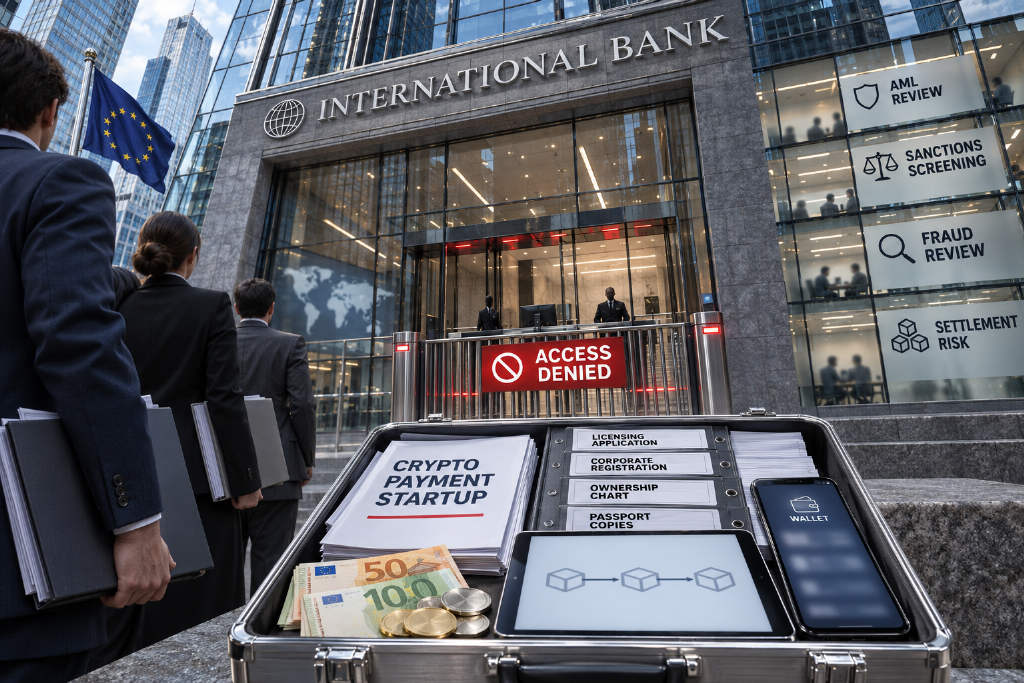
Why a Crypto Payments License Still May Not Be Enough to Get a Bank Account

A PANews article argues that licensing and banking access solve two different problems for crypto payment firms. A license determines whether a company is allowed to provide a regulated service. A bank, by contrast, must decide whether it can take on the customer and the risks tied to that customer’s transactions inside its own account and payment systems. The piece says this gap becomes sharper in business models that combine on-chain assets, cross-border flows and multiple service providers. Even after a company secures a CASP, MSB, VASP or payment-related authorization, banks still run their own due diligence on anti-money laundering exposure, sanctions, fraud, operational controls, account purpose and the transparency of customer and fund flows. The article reviews positions from FinCEN, the U.S. Federal Deposit Insurance Corporation, the European Banking Authority, the Financial Action Task Force and the Hong Kong Monetary Authority. It also outlines the structures most likely to face friction at onboarding, including platforms with weak customer look-through, projects handling complex on-chain asset sources, mismatches between licensed entities and account use, and businesses whose actual products have expanded beyond what was originally licensed or disclosed. The core point is simple: regulatory approval may let a project operate, but banking access depends on whether a bank can clearly identify, control and keep monitoring the risks attached to every flow of money.

640
Why a Crypto Payments License Still May Not Be Enough to Get a Bank Account
Total 3406 items
Go topage