
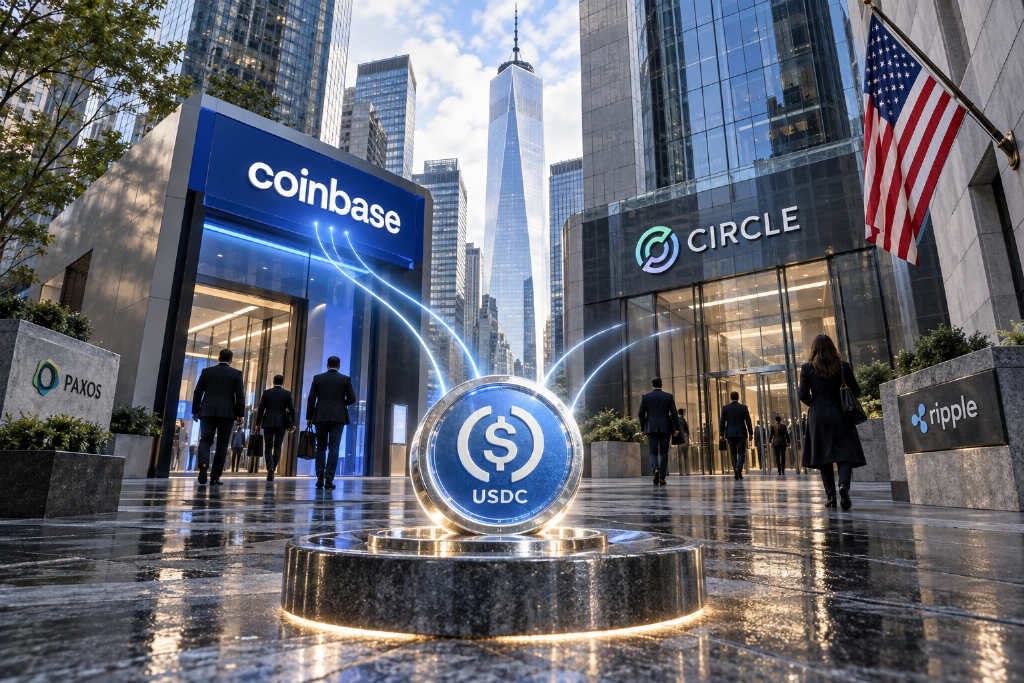
IOSG researcher Darko argues in a paper reposted by WuBlockchain that the key question in stablecoins is not simply who issues them, but who controls distribution. The piece says stablecoins have become one of the few crypto products with real use outside the industry, yet the business model points away from the issuer alone: issuance creates the profit pool, while distribution decides who keeps it.
Institutions changed their view after the regulatory picture started to form
The article says the core shift was not technological. It came from institutional acceptance. It points to the GENIUS Act, signed into effect on July 18, 2025, as the first federal regulatory framework for U.S. payment stablecoins. After that, the Office of the Comptroller of the Currency, or OCC, moved forward with or approved national trust bank charters for Circle, Ripple and Paxos.
By June 2026, Visa and Mastercard had joined Open Standard, a group with more than 140 companies, and launched Open USD. In the paper’s framing, dollar tokens had already worked since 2014. The real turning point was that banks and card networks finally understood what stablecoins could do inside payments.
Stablecoin supply is growing, but headline transfer numbers do not equal real payments
Using updated figures, the article says DefiLlama showed total stablecoin market capitalization at about $306.6B as of Sept. 28, 2026. USDT accounted for about $183.7B and USDC for about $75.4B. It also notes Citi’s base-case forecast still calls for $1.9T by 2030.
That growth story, the author writes, needs qualification. Based on estimates from Boston Consulting Group, or BCG, and Allium, total stablecoin transfer volume in 2025 was about $62T. After removing bot activity, routing and internal transfers, the number falls to $4.2T. Of that, only about $350B-$550B reflected payments for goods and services. The paper says real payment activity is one to two orders of magnitude lower than the numbers usually featured in headlines.
Supply can shrink while adjusted usage reaches a record
The article highlights June 2026 as an example. Stablecoin supply fell by $7.7B that month, the largest monthly decline since 2022, but the drop was only 2.4% and did not trigger a depeg. In the same month, adjusted transfer volume reached $1.79T, up 63% year over year. The point, the author says, is that fewer dollars in token form can still move more quickly through the system.
The paper gives three reasons. First, crypto markets were de-risking. BTC and ETH fell, and spot Bitcoin ETFs saw more than $4B in outflows. Traders redeem trading collateral during deleveraging, but corporate payroll and operating balances do not disappear at the same time. Second, the market was preparing early for restrictions on paying yield to stablecoin holders under the GENIUS Act. Those limits are set to take effect on Jan. 18, 2027, and some capital had already moved into tokenized Treasuries that can still provide direct yield. Third, money velocity increased. Standard Chartered estimated stablecoins were turning over about six times a month on average, roughly double the pace from two years earlier.
On tokenized U.S. Treasuries, the article says the market stood at about $14.9B as of Sept. 24, 2026, down from about $16B at the end of July. The direction, it says, still matters, but recent data do not show a straight one-way climb.
Issuer revenue depends on idle balances, not payment flow
The paper reduces issuer economics to a simple formula: idle balances multiplied by yield. Under that setup, wider payment adoption does not automatically help the issuer. If money turns faster, less stablecoin inventory is needed to support each dollar of payment volume.
Trading collateral that sits in place can earn for the issuer over time. Working capital that keeps moving contributes less reserve income. If the payment thesis wins, the author argues, issuers may get more usage without earning more from each unit of usage. The central question becomes which layer keeps the profit if stablecoins become the default way to move dollars on the internet.
Three business models across the stack
The article says five layers in the stablecoin ecosystem make money through three broad models. Reserve income is a rates business. Payment and money-flow fees are a volume business. Infrastructure is a software-as-a-service business. The asymmetry, in the paper’s view, is that the issuer creates the largest pool of economics, the distributor decides where balances sit, and the blockchain that actually moves the token often ends up as the cheapest layer in the stack.
Circle: more exposed to rates than to volume, with distributors taking a large share
Circle is used as the clearest public example because its disclosures are more detailed than most peers. The article says Circle’s revenue tracks balances, not payment throughput. In Q2 2026, on-chain USDC volume rose 151%, yet that did not directly lift reserve revenue. Average USDC in circulation increased 25%, while reserve income rose only 5%, because reserve yield fell by 66 basis points.
According to the paper, Circle retained 39% of economics after distribution costs in 2025, rising to 41.2% in Q2 2026. Distribution’s share did not keep climbing, but the pool being shared was already shrinking as interest rates moved lower.
Circle’s unchanged renewal with Coinbase is presented as the clearest proof point
The strongest evidence in the article centers on Circle’s relationship with Coinbase. Under a 2023 agreement, Coinbase receives most of the reserve income generated by USDC held on its platform and also gets part of the reserve income from USDC held off platform. Circle paid $324.6M in related distribution costs to Coinbase in Q2 2026, and about $1.66B to major distribution partners in full-year 2025.
That three-year agreement entered its renewal window in August 2026. Circle said on its Aug. 5 earnings call that it had been renewed on the same terms through 2029. The paper treats this as highly revealing. By then, Circle had already obtained a federal trust bank charter, its payment network was expanding, and the market had produced several distribution deals that handed 90%-100% of reserve income to channels. Two months earlier, Coinbase had also joined the rival Open USD alliance, and Circle’s stock fell about 17% that day. None of that changed the renewal terms.
The conclusion drawn in the article is blunt: customers sit with the distributor. Whether a contract renews depends largely on performance thresholds, and that is not the same as the issuer having pricing power. In Q2 2026, average USDC balances inside Coinbase products reached a record $20B, more than 30% of USDC in circulation at quarter end. The paper says nearly one-third of Circle’s revenue base depends on a single counterparty platform, and the next full renewal window does not come until 2029.
Hyperliquid, USDG and Open USD show different ways distribution captures economics
The article says Hyperliquid launched USDH in September 2025 in an attempt to keep reserve income tied to the billions of dollars in USDC sitting on its platform. USDH only reached about $21M at its peak and stopped operating on June 20, 2026.
What happened next is more important to the author. Hyperliquid still had about $6B in USDC on platform. Coinbase counted that as on-platform balance, earned the associated reserve income, and then returned about 90% to Hyperliquid. The paper says Coinbase could do that because it controlled transferable channel economics. Circle’s own economics were largely fixed in either case, and then locked in again for another three years after renewal.
Another model comes from Global Dollar, or USDG, issued by Paxos. Its partner network includes Robinhood, Kraken, Galaxy and Mastercard, according to the article. Partners can keep most of the reserve income, and if balances stay on their own platforms the share can go as high as 100%. In that structure, the issuer looks more like a service provider than the center of profit.
The piece also says Robinhood Chain launched on July 1, 2026, made USDG its only native stablecoin, issued $178M in the first week and used it to support a 7% Earn product. Once a channel can keep the economics, the article argues, it has every reason to steer its own chain, brokerage business and 27 million accounts toward the stablecoin willing to pay the most.
Open USD launched in June 2026 with more than 140 participants, including Visa, Mastercard and Coinbase. After management fees, reserve income goes to distribution channels. The article presents USDG as a contract-based version of channel economics and Open USD as the same idea built directly into product design.
It adds that USDC and Coinbase partner stablecoins together accounted for 79% of stablecoin transaction volume in the first half of 2026, up from 55% in 2025. A distributor, the author says, can remain neutral across different coins. An issuer cannot.
A 300-basis-point drop in rates can erase nearly four-fifths of issuer operating profit
The paper includes a simplified scenario. Assume an issuer has $100B in idle balances, shares 50% of yield with channels, and runs with $600M in annual operating costs. If balances stay flat and yield falls by 300 basis points, about 79% of operating profit disappears. To keep earning $1.9B annually at a 2% yield, balances would need to rise to about $250B. That means 150% growth just to get profit back to where it started.
The author says this is not purely hypothetical. Circle’s actual reserve yield in Q2 2026 was 3.48%, close to that framework. The 50% distribution-share assumption may even be conservative, given Circle posted $701M in total revenue in the quarter while distribution, transaction and other costs came to $412M.
Circle is trying to build payment and settlement positions below the issuer layer
The article also notes that Circle is not standing still. By the end of Q2 2026, Circle Payments Network had reached an annualized transaction volume of $14.7B, up 76% from the prior quarter. By July 31, that figure had climbed to $23B. Circle raised its full-year guidance for non-reserve revenue to $310M-$330M, but $242M of that came from a one-time token presale rather than recurring income. The paper says fees, not raw payment volume, are what matter if the network has not yet begun charging.
On downstream expansion, the article says Arc was still scheduled to launch on Sept. 16 when the original piece was written. As of the updated version, Arc public mainnet had launched on time, with more than 100 institutions and ecosystem builders involved on day one. BlackRock, DTCC, ICE, Mastercard, Standard Chartered and Visa were among validators or integration participants. In the author’s view, Circle is using still-strong reserve income to buy a place in the settlement layer.
Tether is not a clean comparison point
The paper says Tether may look like an exception, but a direct comparison can mislead. Tether reported about $1.5B in operating profit for Q2 2026, had USDT supply of about $184.6B, and held about $115B in U.S. Treasuries, without the same large distribution payouts seen at Circle.
But the article stresses that Tether’s stated operating profit excludes mark-to-market changes in its self-held gold and Bitcoin positions, both of which fell sharply in the quarter. Excess reserves dropped from $8.23B to $4.11B. The paper also says the often-cited $13B profit figure for 2024 included about $5B in unrealized gains. Strip out both positive and negative valuation swings, and Tether looks more like a Treasury carry business earning roughly $1B-$1.5B a quarter: very large, rate-sensitive, and exposed to balance-sheet risks that regulated issuers typically would not take.
That leads to one of the paper’s main distinctions. The real line is not regulated versus offshore, but owned distribution versus rented distribution. Circle rents channels, with terms locked through 2029. Tether built its network before the current regulatory phase arrived.
Blockchains usually capture only a small slice
The article says transfers on Solana or Base often cost less than $0.01. Compared with the interest earned by holding one dollar of reserves for a year, the transfer fee is tiny. A blockchain gets paid when money moves. The issuer earns while balances simply exist.
Tron is presented as the most instructive exception. BCG estimated that Tron handled about $235B-$375B in real-economy stablecoin payments in 2025, more than other chains. The author says this was not mainly about throughput. It reflected the fact that some cross-border corridors had formed around Tron through exchange support, wallet integration, deep USDT liquidity and long-established user habits.
Even then, the article says Tron does not own the customer. On- and off-ramp services bring users in, wallets provide the interface, and Tether provides the dollars. Tron is the settlement rail, not the distributor. Neutral blockspace, in the paper’s view, is structurally hard to price at high margins unless liquidity and habit are strong enough to make exit difficult.
Stablecoin growth is also creating demand for U.S. Treasury bills
The article says everyone in the stack is fighting over one pool of economics: interest from reserve assets. The source of that interest often gets left out of stablecoin value-chain diagrams. Under the GENIUS Act, issuers must hold cash or U.S. Treasuries with maturities of no more than 93 days. That means the law does more than regulate stablecoins. It also creates legal demand for short-dated U.S. government paper.
As of the end of Q2 2026, Tether held about $115B in U.S. Treasuries and described itself as the largest non-sovereign holder, the paper says. Circle had about $79B in reserves, most of them held in a fund managed by BlackRock. The International Monetary Fund, or IMF, noted that the two companies together held more Treasuries than Saudi Arabia.
Because about 99.8% of stablecoin supply is denominated in U.S. dollars, any growth in the sector adds to T-bill demand regardless of which layer captures the value, according to the article. Standard Chartered outlined a scenario in which stablecoins reach $2T by 2028, implying as much as $1T in additional demand for U.S. Treasuries.
The article adds two caveats. First, stablecoins are still small compared with the roughly $7T money market fund industry, so they remain a growing marginal buyer rather than a dominant one. Second, inflows and outflows do not affect yields symmetrically. Citing Bank for International Settlements research, the paper says a $3.5B inflow can push the three-month Treasury yield down by about 2-2.5 basis points, while an equal-sized outflow can lift it by 6-8 basis points. On that basis, June’s $7.7B supply contraction was not just a sentiment signal.
The steadier businesses sit in ramps, FX and compliance
In the author’s view, the fattest transaction margins across the stack often appear in on- and off-ramps and foreign exchange, not on-chain transfers themselves. BCG estimated exchange ramp fees at about 0.1%-1%, specialist providers at 1%-3%, and crypto ATMs at as much as 7%. In emerging-market cross-border corridors, those fees can be layered on top of even wider FX spreads.
The article also points to compliance, custody and payment orchestration as more stable revenue lines. Regulated institutions cannot launch a stablecoin business by plugging into a wallet alone. Screening, transaction monitoring, key management, custody, reserve services and auditable reporting are usually bought from outside vendors. Those economics may not look as flashy as reserve income, the paper says, but contract durations are longer, switching costs are higher, and the business does not depend on rates staying at 5% or on one channel renewing.
The ban on paying yield to holders may make distribution more valuable
The article says the GENIUS Act bars issuers from directly paying users simply for holding stablecoins, but does not clearly prohibit independent exchanges or wallets from using their own share of reserve income to subsidize rewards. Lawmakers intended to preserve stablecoins as payment tools rather than turn them into deposit substitutes.
The market effect may be different. If issuers cannot use yield to compete for balances directly, competition can shift toward revenue sharing with channels that own the user relationship. The distributor then decides whether to pass some of that income on to users. On that reading, the holder-yield restriction protects channel economics rather than weakening them. The paper says USDG and Open USD are built around exactly that opening.
It adds that the issue is still contested. Banking groups want the restriction expanded to third-party rewards, and some 2026 market structure proposals attempted broader limits on passive yield. The boundary is not settled. For banks, the article says, the options are to issue directly and absorb the cost, provide custody and reserve services to someone else’s coin, join a consortium, or face deposit leakage. The author’s base case is that many announced bank stablecoins will end up as consortium products or infrastructure partnerships.
Conclusion: stablecoins may commoditize, but entry points will not
The paper closes with a comparison to Visa. Visa does not issue cards, make loans or directly collect interchange. Banks do that. Visa monetizes the network. Building the payment instrument, the author argues, is not the same as controlling the profit. Value will flow to whoever controls the scarce chokepoints: acceptance networks, distribution channels, liquidity, or customer relationships.
From there, the article lays out three conclusions. Issuance is likely to become more standardized as regulated dollar stablecoins converge around similar reserve assets and disclosure rules. Falling rates are already squeezing the profit pool tied to idle balances, and any issuer model built around a 5% rate should be run again at 2%. And distribution channels hold bargaining power, with the Circle-Coinbase renewal in 2026 carrying its main signal precisely because nothing changed.
The paper also lists several filters for allocators: stress-test pure issuance models with lower yields and higher channel shares, treat renewal dates as information events rather than just risk events, separate one-off revenue from recurring revenue, study companies that control ramps and specific payment corridors, and pay attention to compliance, custody and trading infrastructure that are less sensitive to interest rates.
The final warning is that transaction volume should not be mistaken for revenue. USDC processed $14.8T in one quarter, the article says, but still made most of its money from static balances rather than movement. If this is the "Aha!" moment for money, the piece argues, the lasting pricing power will sit with scarce distribution and customer ownership, not with the token alone.
Sources and data notes cited in the article
The paper ends with a source list covering Circle’s Q2 2026 financial and operating data, the Arc mainnet launch announcement, Circle and Coinbase 10-Q filings, the Circle-Coinbase collaboration agreement, OCC charter records, the Open USD announcement, Tether’s Q2 2026 reserve attestation, DefiLlama stablecoin data, and the RWA.xyz snapshot for tokenized U.S. Treasuries.
It also notes that data vendors do not always use the same methodology for stablecoin supply, on-chain transfer volume or blockchain fees. Tether figures come from a BDO attestation rather than a U.S. GAAP audit. Forecasts from Citi and Standard Chartered should not be treated as certain outcomes.