
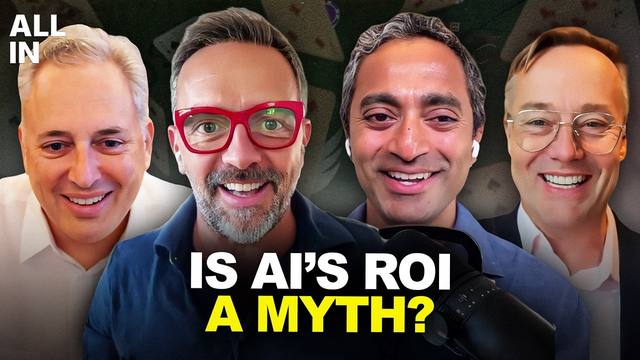
Episode 280 of the All-In Podcast opened with a question that now hangs over the AI market: who gets to the public markets first at trillion-dollar scale, and on what numbers.
Jason Calacanis said SpaceX had already set the template. In the discussion, he described SpaceX as having gone public at a $1.75 trillion valuation, raising $75 billion on roughly $35 billion of forward revenue. The stock, he said, briefly touched $200 before falling back to about $150, near the offer price, leaving the company at around a $2 trillion market value.
From there, the panel turned to Anthropic and OpenAI. Jason said Anthropic confidentially filed on June 1, and that Polymarket was pricing a 65% chance of an IPO this year. He also cited Gavin Baker’s forecast from two weeks earlier: Anthropic could generate more than $100 billion in revenue by year-end, turn profitable, and command a $3 trillion valuation if it listed now.
IPO window: Brad sees blockbuster demand, Chamath sees a race against harder questions
Chamath Palihapitiya said both OpenAI and Anthropic look like excellent businesses. His reservation was not about product quality. It was about clearing price. In his view, the key question is how much appetite the market really has for new issuance and at what level that demand holds.
He argued that OpenAI and Anthropic are at different stages. OpenAI, based on its last disclosed information, is still burning significant cash and is more exposed to consumer demand because its business is broader. Anthropic, Brad said earlier, may already have become unexpectedly profitable.
Chamath then gave the panel’s most skeptical operating datapoint. He said he asked his CTO about token spending and was told costs are doubling every 45 days. He then asked how much downstream productivity had improved and said the answer was “at most 5%.” The implication, as he framed it, is harsh: costs keep rising while benefits are roughly flat, because the next increment of performance requires much more token consumption and the gains are already showing diminishing returns.
That led to his blunt conclusion on timing: “If you can go public now, do it now, before these numbers seep into the waterline. Because I think that is the window where you can sell at a high price and raise a lot of money.”
Brad Gerstner took the opposite side. He said Altimeter would buy both deals in size if they came public. He also argued that SpaceX’s offering created a playbook for giant technology IPOs, not just in valuation but in total deal size, liquidity, lockup design and index inclusion.
His comparison was simple. If Anthropic’s annualized revenue really does move above $100 billion, while SpaceX came public on about $35 billion of forward revenue, then Anthropic could become what he called a “phenomenal” IPO. He added that OpenAI is now back to about $70 billion in revenue this year and that GPT6 could arrive within 30 days.
Brad did not see the two companies as locked in a direct sprint to list first. In his telling, both will move when the setup is right, though OpenAI may come later because its corporate restructuring is more complicated.
He also addressed the index inclusion debate around very large IPOs. The old rules existed for a reason, he said, because most newly listed companies are younger, smaller and less profitable. But SpaceX had become too large and too important to leave outside the index. Exchanges and index providers, in his account, adjusted without forcing passive investors to buy the stock at a peak and then wear the kind of 30% post-IPO drawdown often seen after major listings.
AI ROI: revenue is exploding, but Chamath says real earnings impact is still tiny
The next segment moved from market appetite to operating reality.
Jason said CTOs and CEOs had started discussing ROI openly on X. He pointed to comments from Uber CTO Pinen, who said 99% of Uber engineers are using AI tools, more than 70% of pull requests come from local or cloud agents, and engineers have built 200 agentic skills. Uber has also deployed engineers into different business units as “forward deployed” operators to map workflows with department heads.
Brad said Chamath’s critique is valid in the near term, but the time frame matters. A lot of current AI spending sits in experimental buckets and may not show immediate direct returns. Even so, he said enterprise AI adoption is still early and the addressable market is unlike anything Silicon Valley has seen. His phrasing was expansive: “We’ve never seen revenue growth like this because we’ve never seen a TAM this big. Intelligence is the largest addressable market in human history.”
He pushed that logic further with a bold forecast. If Anthropic reaches more than $100 billion in revenue by the end of this year, he said next year could bring another 3x to 5x expansion. Moving from $100 billion to $300 billion would mean $200 billion of incremental revenue, a figure he said would be without precedent in Silicon Valley history.
Chamath answered with a narrower question: where is the earnings lift, and how durable is it.
He said he asked Claude 5 how much EPS growth AI had added to the S&P 500, and the answer came back at 50%. But he then found that the number included Nvidia’s chip sales to Amazon. So he asked a second question: what is EPS growth for the S&P 493, excluding the Magnificent Seven? The answer was 9%.
He broke that 9% down this way: most of it came from pricing power above inflation, and another 3% came from buybacks. The portion that could truly be attributed to AI, he said, was only 0% to 2%.
That was the basis for one of his strongest lines in the episode: token costs are doubling every 45 days, downstream productivity gains may be capped at around 5%, and the actual return is close to flat. In his view, enterprise enthusiasm still looks strong because many buyers have not yet been forced to defend the spending with hard EPS evidence.
Once investors start asking that question more directly, he said, enterprise demand could look much weaker if companies cannot point to sustained pricing power or measurable bottom-line improvement. Consumer products may be more insulated, not because they are inherently better, but because tens of millions of users paying small amounts do not trigger the same level of ROI scrutiny.
Jason added a broader organizational angle. AI, he said, touches every employee in a way tools like Excel never did. In a 1,000-person company, if per-employee monthly AI spend rises from 200 to 400 while annual compensation is $150,000, the extra cost is only 3% to 4%. The real issue is whether that spend lifts output by 3x to 5x.
Open source vs. closed source: enterprises want cheaper routing, but spending still favors frontier labs
The discussion then shifted to model economics and architecture choices.
Jason said CTOs on X have been talking about “intelligent routing” strategies: send work to open-source models first, then fall back to Claude when the task is harder. He asked David Sacks what that means for frontier-model growth if CFOs start pressing for lower costs.
Sacks said the instinct to shift token spend to cheaper models is real. Companies can see token costs rising, and many want at least some brake on that spending. On top of that, AI sovereignty concerns have made firms uneasy about handing core alpha to frontier labs that could become competitors later.
Still, he said most enterprises lack the engineering capacity to execute the move. His summary was memorable: companies have the will, but not the strength. They want to migrate away from closed models, but usually cannot.
He cited Coinbase and DoorDash as examples of companies that have built token-routing middleware, sending frontier tasks to frontier models and routine work to cheaper alternatives. Most companies, he said, are not capable of doing that. As a result, wallet share for closed models has actually been rising.
Sacks put numbers around the point. Open-source models accounted for 19% of enterprise AI spending last year, he said. This year that share is down to 11%. He cautioned that the figure does not mean open-source usage is falling, because many open models generate hosting fees rather than direct lab revenue, which makes usage harder to capture.
He also referenced a view from the Decagon founder: if you know exactly what you are trying to do, then a small, cheap open-source model makes sense, provided you have the data and post-training stack. If you do not yet know the use case, you want the strongest general intelligence available. Mature use cases fit open source; immature use cases still favor frontier models.
Jason added another efficiency point. He cited Databricks founder Ali as saying that simply changing the harness, the orchestration layer around a model, can cut costs in half. He said GLM-5.2 performed especially well with a specific harness, reducing task count by half.
He offered his own example too. After optimizing a trend-discovery agent that runs every hour, Jason said token consumption fell 80%. Once execution got cheaper, he changed the cadence from daily to hourly and split one agent into three parallel jobs. The result, he said, was that 14 tasks were completed by the time he woke up, which felt fundamentally different.
Brad framed the whole fight around one question: does intelligence converge. He recalled that 18 months ago, during what he called the “DeepSeek moment,” markets fell 40% as many people assumed open source would quickly crush the frontier labs. Eighteen months later, he said, the opposite seems to be happening: token use is growing on both sides, but wallet share is moving toward the frontier players.
He then floated an even stronger thesis. Intelligence may not converge at all. If superintelligence becomes self-recursive, smarter models earn more money, that money buys more compute, and more compute builds better models. On that logic, the gap may widen over the next two to three years instead of shrinking.
Jason said he had recently interviewed Lovable CEO Anton, whose company, he said, went from zero to $600 million in revenue in about 30 months. He also asked 11Labs CEO Matti whether the company worried about leakage and competition given that it spends tens of millions of dollars a year with frontier labs. Both executives, he said, are building their own models. If customers spending eight or nine figures move in that direction, frontier labs will face pressure.
Chamath pushed back with a practical question. If 11Labs wants the best voice agent in the world, and the best voice capability still sits inside a frontier lab, can it really afford to compete with a weaker in-house model?
Meta’s price war and the “good enough” threshold
The fourth chapter of the conversation focused on Meta.
Jason said Meta had released Spark 1.1, describing it as a powerful agentic encoding model priced very aggressively. He also noted that Mark Zuckerberg had been unusually active on X, making a simple case to developers: same quality, one-hundredth of the cost.
Brad said Meta had made mistakes in its earlier open-source strategy, but Zuckerberg has now made a clear choice. Meta is not only building models. It is also launching a new model API and selling tokens directly. In Brad’s view, more competition is good for the United States.
He used a consulting comparison to explain why cheap models do not automatically win. If an AI agent is replacing a consultant who costs $200 an hour, then the difference between a $3 model and a $15 frontier model is not the point. What matters is whether the $15 model can complete the work reliably without breaking halfway through. If a task fails, the cost is not only tokens. It is also time.
Chamath saw a different curve. He compared AI adoption to the early iPhone years, when users kept upgrading because each new version was worth the price. Eventually, though, people decide the old phone is good enough. He said he had already seen that kind of threshold while testing Claude 5 because some research directions were restricted and the model would not answer them. Different users, he argued, will hit the “good enough” line at different times.
Chamath then widened the lens to sovereign AI. He said that during work on a United Nations AI commission alongside Benioff, Jensen and Brad Smith, under Benioff’s co-chairmanship, he came away with one broad conclusion: every country is developing its own sovereign AI strategy, and almost none want U.S. closed models to be the final answer.
Many would rather start with an open model, such as one from Nvidia, and build the rest of the stack themselves. He cited Falcon in the UAE, an Arabic LLM effort in Saudi Arabia, and Japan’s $6 billion Neoterra alliance, which he said is skipping ahead to physical AI and robotics.
His argument was that once a model gets to 95% to 99% of frontier capability, many countries will decide that is enough. He added that many companies do not have the earnings growth to support long-running AI spending, nor the willingness to make large cost cuts. In his telling, Zuckerberg only acted decisively after pressure built. Most companies let the problem accumulate.
China model export restrictions: Sacks says the pattern is familiar
The fifth segment turned from market structure to geopolitics.
Jason cited a Reuters report saying Chinese authorities are considering restrictions on overseas access to the country’s top AI models. According to his summary, two regulators have spoken with Alibaba, ByteDance and Z.AI, the company behind GLM-5.2, about limiting foreign access to leading open and closed models. The report also said Chinese authorities are treating leaks of AI research as national security crimes and looking at tighter control over who can invest in Chinese AI labs.
Sacks said the report may be overstated, but he agreed the direction is worth watching. His breakdown was that ByteDance’s top model is already closed, Alibaba’s Qwen was previously open but may be moving toward closed, and Z.AI’s GLM-5.2 was open but also appears to be shifting.
He reduced the strategy to a single line: you stay open while you are catching up, then you close once you are near the frontier. He said Sam Altman did the same thing with OpenAI three years ago, moving from nonprofit to for-profit and from open to closed.
Open source helps attract a developer ecosystem and, in AI, can create a reinforcement-learning flywheel through usage data. But once a company catches up, he said, closed models capture all of the value.
Sacks also said he had discussed the issue in Washington this week with the White House and the Treasury Department. Across the U.S. policy debate, he said, one position is nearly universal: stay ahead of China at all costs. From the president downward, the questions are how far ahead the U.S. is and what must be done to remain there. In that environment, he said, the idea of sidelining American frontier labs while allowing Chinese open models to circulate freely simply does not exist in Washington.
He made one more pointed claim: GLM-5.2 contains a distillation watermark from Mythos. On that basis, he said the U.S. government will likely move against distillation and that doing so would be justified.
Even so, Sacks argued that Chinese export restrictions may hurt China more than the United States. America can build open-source models too, he said, naming Nvidia and Reflection. He said frontier labs he has spoken with have not been eager to launch open models because demand has not been strong enough, but if demand rises, they can do it.
Chamath answered with a joke. The best thing for the United States, he said, would be for China to develop its own community of AI doomers, worried all day about job losses and existential risk. If Chinese labs become tied up by the same type of regulatory drag, that would be a major advantage for the U.S.
Trump Accounts: $1,000 at birth, 1.5 million accounts in 24 hours
The final section of the show was devoted to Trump Accounts, a program Brad described as the product of four years of work.
Jason said the app had become the most downloaded app in the world. Brad said the Invest America Act was signed into law last year as part of a broader bill and that the app officially launched on July 4 this year.
Under the program, each U.S. newborn receives $1,000 in a private investment account fully allocated to the S&P 500. The account is free for life. Within 24 hours of launch, Brad said, the platform had opened 1.5 million accounts and attracted more than $1 billion in deposits.
He added that the White House hosted what he described as the first joint bell-ringing ceremony in the history of the New York Stock Exchange and Nasdaq, with hundreds of CEOs present. President Donald Trump, he said, proposed automatically creating accounts for 50 million to 70 million Americans under the age of 18.
Sacks walked through the account design from a financial-planning perspective. Families and friends can contribute up to $5,000 a year, he said, and employers can make tax-free contributions of $2,500. The funds compound tax-free until age 18. After that, up to 25% can be withdrawn for a home purchase, starting a business or college, while the rest rolls into an IRA.
He said there is an additional tax advantage if the holder waits until they are no longer a dependent, such as just after graduation in a 0% tax bracket, and then converts from an IRA to a Roth IRA. In that case, the money can become lifetime tax-free capital at very low tax cost.
Sacks then gave the show’s headline projection. If the account is fully funded from the beginning and past 30-year market returns are used as the assumption, the child becomes a millionaire by age 28. If the balance reaches $200,000 to $300,000 by age 18, compounding can take it above $10 million by age 60.
Brad also listed several philanthropic commitments tied to the program. Michael and Susan Dell have given more than $6 billion, providing $250 each to 25 million children from low- and middle-income families. SpaceX President Gwen Shotwell donated $350 million in SpaceX stock for children in low-income communities. Micron donated $250 million, with up to $1,000 for each employee’s child. Brad said he personally pledged $100 million to cover every child in Indiana.
He told the panel they had informed the president that the platform is expected to raise $100 billion within 12 months. He described it as the largest direct philanthropy platform in U.S. history because there are no intermediaries and the money goes straight into children’s accounts, where it cannot be withdrawn before age 18.
On his projections, the program will create more than 100 million private investment accounts over the next decade, and could move $2 trillion to $4 trillion into family accounts that previously held little or no financial assets over the next 15 years.
Jason closed this part of the discussion with a broader political and social claim. He said the plan could replace Social Security and even replace the Giving Pledge as an organizing idea. Roughly 50% of Americans own stocks today, he said. If Trump Accounts scale successfully, that figure could rise to 70% or 75%.
He compared the concept with Australia’s superannuation system, which requires workers to save 12% to 14% of income into a 401(k)-like account. Trump Accounts, he said, tries to do something similar at a more basic starting point.
Jason also singled out Joe Gebbia, the Airbnb co-founder, for joining the government effort and helping design the software. He said the U.S. government had produced an unusually strong consumer-grade application. Brad added that the team includes Michael Dell, Robinhood CEO Vlad Tenev, Joe Gebbia and Treasury official Luke Pettit, with the goal of building not just the best government product, but one of the best consumer products, period.
The panel ended without resolving its core disagreements. Brad kept coming back to growth, scale and the possibility that frontier intelligence compounds its own lead. Chamath kept returning to costs, earnings impact and whether current spending survives contact with real ROI scrutiny. Sacks focused on enterprise execution, Washington’s posture and the way Chinese labs may be changing strategy as they move closer to the frontier.
Those differences, rather than any final consensus, defined the episode.